Corporate AWS Data Warehousing Training Course
Edstellar’s instructor-led AWS Data Warehousing training courses provide guidance on launching Amazon Redshift clusters, architecting data warehouses, and optimizing query performance. Upskill professionals to gain experience with AWS services such as Amazon DynamoDB, EMR, Kinesis, and S3 to contribute to robust data warehousing solutions.
(Virtual / On-site / Off-site)
Available Languages
English, Español, 普通话, Deutsch, العربية, Português, हिंदी, Français, 日本語 and Italiano
Drive Team Excellence with AWS Data Warehousing Corporate Training
AWS Data Warehousing refers to storing, managing, and analyzing large volumes of structured and unstructured data using cloud-based services provided by Amazon Web Services (AWS). It is vital for organizations as it enables the centralized storage and analysis of data from various sources and allows them to scale their data capabilities cost-effectively, gaining faster insights to drive informed decisions. The training provides professionals with essential skills to leverage AWS services effectively for designing and optimizing data warehousing solutions.
Edstellar’s AWS Data Warehousing course offers onsite/virtual training sessions to ensure a comprehensive learning experience. The course provides professionals with practical experience and real-world scenarios, ensuring they develop the skills necessary to excel. Edstellar's AWS Data Warehousing training courses empower professionals to apply their knowledge effectively within their organizations, driving innovation and success in data management and analysis.

Skills Your Employees Will Gain
These are the core, hands-on capabilities your team builds during the program.
- SQL Query OptimizationSql Query Optimization is the process of enhancing sql queries for better performance. this skill is important for database administrators and data analysts to ensure efficient data retrieval, reduce load times, and improve overall system performance.
- Database Schema DesignDatabase Schema Design is the process of defining the structure, relationships, and constraints of data in a database. This skill is important for database administrators and developers as it ensures efficient data organization, retrieval, and integrity, ultimately enhancing application performance and user experience.
- Workload ManagementWorkload Management is the ability to prioritize tasks effectively, ensuring deadlines are met without compromising quality. This skill is important for roles in project management, operations, and team leadership, as it enhances productivity and reduces stress.
- Cluster Performance MonitoringCluster Performance Monitoring involves tracking and analyzing the performance of a group of interconnected systems. this skill is important for IT professionals and data engineers to ensure optimal system efficiency, reliability, and resource allocation, ultimately enhancing overall operational performance.
- Dashboard VisualizationDashboard Visualization is the ability to create interactive visual displays of data. This skill is important for data analysts and business intelligence roles, as it enables clear insights and informed decision-making.
- ETL (Extract, Transform, Load)EtL (Extract, Transform, Load) is the process of collecting data from various sources, transforming it for analysis, and loading it into a data warehouse. This skill is important for data analysts and engineers as it ensures accurate data integration, enabling informed decision-making and insights.
What Your Team Will Achieve After This Training
- Craft complex SQL queries and analyze query execution plans for optimization
- Design efficient database schemas to enhance query performance and storage utilization
- Configuring workload management parameters and balancing query concurrency effectively
- Monitor cluster performance metrics, enabling audit logging and implementing backup strategies
- Create insightful dashboards with Amazon QuickSight to visualize key performance indicators and trends
- Extract, transform, and load data from diverse sources, such as Amazon S3, DynamoDB, and EMR, into Amazon Redshift
Topics & Program Outline
The curriculum is organized into focused modules built by industry experts and delivered virtually or on-premise. Interactive sessions reflect the evolving demands of the workplace, keeping the learning both relevant and practical.
- Relational databases
- Database model overview
- Entity-relationship model
- Data warehousing concepts
- Data aggregation
- Dimensional modeling
- Fact and dimension tables
- ETL process overview
- The intersection of data warehousing and big data
- Big data technologies overview
- Scalability challenges
- Integration with the Hadoop ecosystem
- Data lake architectures
- Overview of data management in AWS
- AWS database services overview
- AWS Glue for ETL
- Data lakes on Amazon S3
- Redshift Spectrum for data analytics
- Hands-on lab 1: Introduction to Amazon Redshift
- Setting up an AWS account
- Accessing AWS console
- Basic Redshift cluster creation
- Conceptual overview
- Architecture components
- Data distribution concepts
- Real-world use cases
- Retail analytics
- Financial reporting
- IoT data analytics
- Social media analytics
- Hands-on lab 2: Launching an Amazon Redshift cluster
- Configuring Redshift cluster
- Security group configuration
- Cluster launch process
- Basic query execution in Redshift
- Building the cluster
- Cluster configuration options
- Node types and sizes
- Multi-node vs single-node clusters
- Cluster security considerations
- Connecting to the cluster
- Connection methods
- Client tools setup
- JDBC/ODBC configuration
- Query optimization techniques
- Controlling access
- IAM roles and policies
- Database user management
- Access control lists (ACLs)
- Encryption options
- Database security
- Data encryption at rest and in transit
- Network security best practices
- Load data
- ETL processes
- Data loading strategies
- Data migration tools
- Data validation and integrity checks
- Hands-on lab 3: Optimizing database schemas
- Schema design best practices
- Table distribution methods
- Compression techniques
- Performance tuning considerations
- Schemas and data types
- Redshift data types overview
- Choosing appropriate data types
- Columnar compression
- Compression algorithms
- Storage optimization techniques
- Data distribution styles
- Key distribution styles
- Data skew and distribution considerations
- Distribution key selection best practices
- Comparison of distribution styles
- Data sorting methods
- Sort key selection strategies
- Choosing between compound and interleaved sort keys
- Data sources overview
- Overview of AWS data sources
- Data integration challenges
- Amazon S3
- Using S3 as a data lake
- Data ingestion methods into S3
- S3 security and access controls
- Amazon DynamoDB
- NoSQL data modeling concepts
- Integrating DynamoDB with Redshift
- Streaming data from DynamoDB to Redshift
- Amazon EMR
- Overview of EMR services
- Integrating EMR with Redshift
- Amazon Kinesis Data Firehose
- Real-time data streaming concepts
- Firehose integration with Redshift
- AWS Lambda Database Loader for Amazon Redshift
- Lambda function configuration
- Data loading with Lambda
- Error handling and monitoring
- Lambda security considerations
- Hands-on lab 4: Loading real-time data into an Amazon Redshift database
- Real-time data pipeline setup
- Integration with Kinesis Data Firehose
- Redshift data loading process
- Data transformation and enrichment techniques
- Preparing data
- Data cleansing techniques
- Data transformation best practices
- Loading data using COPY
- COPY command syntax overview
- Using COPY with different data formats
- Maintaining tables
- Vacuum and analyze operations
- Table reorganization strategies
- Concurrent write operations
- Managing concurrent writes efficiently
- Troubleshooting load issues
- Error handling techniques
- Log analysis
- Performance tuning
- Load monitoring and alerting
- Hands-on lab 5: Loading data with the COPY command
- COPY command execution
- Monitoring load progress
- Troubleshooting load errors
- Performance optimization techniques
- Amazon Redshift SQL
- Basic SQL queries
- Redshift-specific SQL features
- User-defined functions (UDFs)
- Creating and using UDFs in Redshift
- Performance considerations for UDFs
- Factors that affect query performance
- Data distribution impact
- Query optimization techniques
- The EXPLAIN command and query plans
- Understanding query plans
- Optimizing query performance using EXPLAIN
- Workload management (WLM)
- WLM configuration options
- Query queuing and prioritization
- WLM best practices
- Performance tuning with WLM
- Hands-on lab 6: Configuring workload management
- WLM configuration setup
- Query queuing and prioritization
- WLM performance monitoring
- WLM query execution analysis
- Amazon Redshift Spectrum
- Spectrum architecture overview
- External tables creation
- Configuring data for Amazon Redshift Spectrum
- Data partitioning best practices
- Choosing optimal file formats
- Amazon Redshift Spectrum queries
- Query optimization techniques for Spectrum
- Hands-on lab 7: Using Amazon Redshift Spectrum
- Configuring Spectrum access
- Querying external data with Spectrum
- Spectrum performance optimization
- Cost management with Spectrum
- Audit logging
- Enabling audit logging
- Analyzing audit logs
- Performance monitoring
- Monitoring cluster performance metrics
- Setting up performance alerts
- Events and notifications
- Configuring event notifications
- Handling event notifications
- Resizing clusters
- Vertical and horizontal scaling options
- Backing up and restoring clusters
- Creating and restoring cluster snapshots
- Disaster recovery strategies
- Resource tagging and limits and constraints
- Tagging resources for tracking and management
- Setting resource limits and constraints
- Hands-on lab 8: Auditing and monitoring clusters
- Setting up cluster monitoring
- Analyzing cluster performance metrics
- Configuring event notifications
- Handling critical events
- Power of visualizations
- Importance of data visualization in decision-making
- Key principles of effective data visualization
- Building dashboards
- Dashboard design best practices
- Tools for building interactive dashboards
- Amazon QuickSight editions and features
- Overview of QuickSight editions
- Key features of Amazon QuickSight
Who Should Attend?
This program suits professionals at many levels across the organization, including:
- Data Analysts
- Data Engineers
- Cloud Data Architects
- IT Managers
- Business Intelligence Analysts
- AWS Administrators
- Data Scientists
- Data Architects
- IT Consultants
- Cloud Solution Architects
- Reporting Analysts
- Database Administrators
What are the Prerequisites?
Professionals with a basic understanding of relational databases, SQL queries, data modeling, ETL processes, cloud computing concepts, and familiarity with the Amazon Web Services (AWS) platform can take up the AWS Data Warehousing training course.
Choose the Format That Fits Your Team
We design training your teams actually engage with, and deliver it the way that suits you best. Through a vetted global trainer network, Edstellar runs sessions in 10+ languages with consistent quality anywhere.


.webp)
Virtual / online: expert-led live sessions delivered anywhere, with consistency and easy scheduling.
.webp)
On-site (in-house): immersive, instructor-led learning at your office.
.webp)
Off-site: focused, instructor-led group learning away from everyday workplace distractions.
Get a Proposal Shaped to Your Needs
Need pricing for onsite, offsite, or virtual delivery? Get a proposal tailored to your team's needs.
64 hours of group training (includes VILT/In-person On-site)
Tailored for SMBs
Tailor-Made Trainee Licenses with Our Exclusive Training Packages!
160 hours of group training (includes VILT/In-person On-site)
Ideal for growing SMBs
Tailor-Made Trainee Licenses with Our Exclusive Training Packages!
400 hours of group training (includes VILT/In-person On-site)
Designed for large corporations
Tailor-Made Trainee Licenses with Our Exclusive Training Packages!
Unlimited duration
Designed for large corporations
What Sets Edstellar Apart
Experienced Trainers
Our trainers are drawn from a vetted global network and bring years of industry expertise, keeping every session practical and impactful.
Proven Quality
With a strong global track record, Edstellar is known for quality and engaging delivery.
Industry-Relevant Curriculum
Our programs are built by experts to match the demands of today's industry.
Fully Customizable
Every program can be tailored to your organization's goals.
Comprehensive Support
We provide pre- and post-session support for a complete learning experience.
Global Multi-Location & Multilingual Training Delivery
We deliver in multiple languages to support diverse global teams.
Hear from Organizations We've Trained
"The AWS Data Warehousing course revolutionized how I approach my daily responsibilities. As a Lead Data Warehouse Engineer, understanding strategic frameworks was essential, and this training delivered beyond all invaluable real-world experience. My ability to architect solutions and solve complex problems has improved substantially. The instructor's insights on expert-led workshops have proven instrumental in my professional advancement.”
Zachary Gilbert
Lead Data Warehouse Engineer,
Cloud Migration Services Company
"This AWS Data Warehousing course was precisely what I needed to design robust strategic implementation architectures. The hands-on approach to hands-on exercises and seamless integration with practical simulations projects using advanced techniques from this training. Client engagement and retention metrics have improved significantly across our practice. The comprehensive curriculum has elevated my solution delivery capabilities significantly.”
Zeng Yun
Senior Business Intelligence Developer,
Cloud Infrastructure Solutions Provider
"As a Lead MLOps Engineer leading professional expertise operations, the AWS Data Warehousing training provided our team with essential industry best practices expertise at scale. The comprehensive modules on real-world complete operational footprint. Our team has automated eighteen critical business processes, reducing manual effort by 70%. This course has proven invaluable for driving our organizational transformation and sustained excellence.”
Harish Mitra
Lead MLOps Engineer,
Amazon Web Services Consulting Partner
“Edstellar’s IT & Technical training programs have been instrumental in strengthening our engineering teams and building future-ready capabilities. The hands-on approach, practical cloud scenarios, and expert guidance helped our teams improve technical depth, problem-solving skills, and execution across multiple projects. We’re excited to extend more of these impactful programs to other business units.”
Aditi Rao
L&D Head,
A Global Technology Company
Recognition That Motivates Your Team
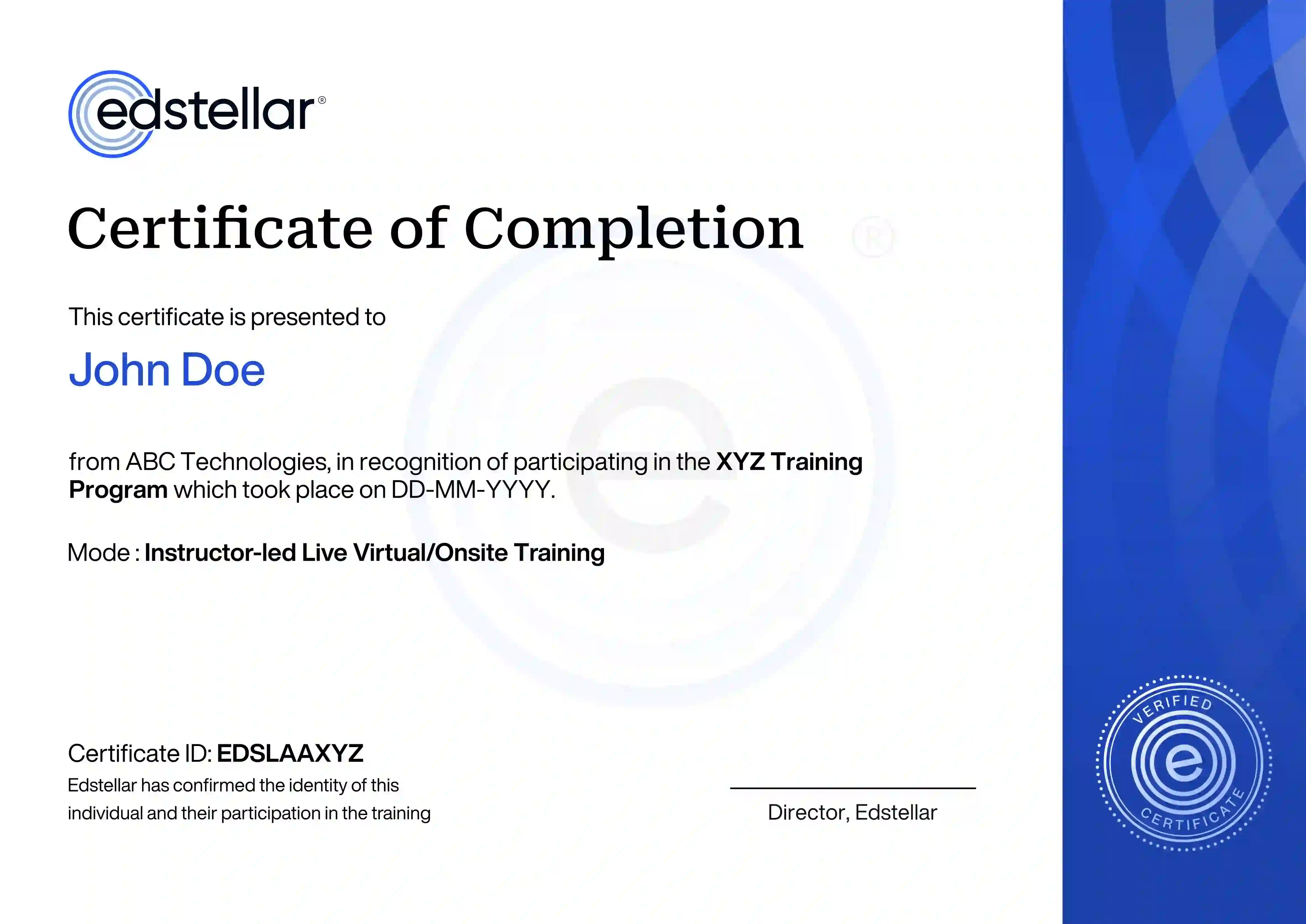
Upon successful completion of the training course offered by Edstellar, employees receive a course completion certificate, symbolizing their dedication to ongoing learning and professional development.
This certificate validates the employee's acquired skills and is a powerful motivator, inspiring them to enhance their expertise further and contribute effectively to organizational success.


Other Related Corporate Training Courses
Explore More Courses
Edstellar is a one-stop instructor-led corporate training and coaching solution that addresses organizational upskilling and talent transformation needs globally.
Marketing Excellence
Operational Excellence
Finance Excellence
HR Excellence
IT Excellence
Customer Service
Leadership Excellence
Quality Management
Software
How it WorksFAQ'sCorporate Training
CatalogStellar AI
Skill MatrixHRMS Integration
Who we ServeCEO RetreatsPricingTraining DeliveryPartner with Edstellar
CareersContact us