Corporate VMware vSphere Training Course
Edstellar's instructor-led VMware vSphere training course enables teams with virtualization skills to optimize infrastructure and applications for enhanced performance and efficiency. The course equips employees to learn how to maximize resource utilization, improve system availability, and streamline IT operations.
(Virtual / On-site / Off-site)
Available Languages
English, Español, 普通话, Deutsch, العربية, Português, हिंदी, Français, 日本語 and Italiano
Drive Team Excellence with VMware vSphere Corporate Training
Empower your teams with expert-led on-site, off-site, and virtual VMware vSphere Training through Edstellar, a premier corporate training provider for organizations globally. Designed to meet your specific training needs, this group training program ensures your team is primed to drive your business goals. Help your employees build lasting capabilities that translate into real performance gains.
VMware vSphere is a virtualization platform that enables organizations to efficiently manage their IT infrastructure by virtualizing servers, storage, and networking resources, allowing for better resource utilization, scalability, and disaster recovery capabilities. It is required for organizations to streamline their operations, reduce hardware costs, and enhance flexibility by consolidating multiple physical servers into virtual machines, optimizing resource allocation, and simplifying management tasks through features like centralized administration and automated provisioning. VMware vSphere training course provides IT professionals with the knowledge and skills to effectively deploy, manage, and troubleshoot virtualized environments, ensuring optimal performance and reliability.
Edstellar's instructor-led VMware vSphere training course provides comprehensive instruction on deploying, managing, and optimizing VMware vSphere environments. The course ensures employees gain practical insight and hands-on experience, allowing them to implement VMware vSphere effectively within their organization. Employees from around the world can customize the course curriculum and choose from virtual or onsite delivery options.

Key Skills Employees Gain from instructor-led VMware vSphere Training
VMware vSphere skills corporate training will enable teams to effectively apply their learnings at work.
- VirtualizationVirtualization is the creation of virtual versions of physical resources, like servers or storage. This skill is important for IT roles as it enhances resource efficiency, scalability, and cost-effectiveness.
- Infrastructure ManagementInfrastructure Management involves overseeing and maintaining an organization's IT infrastructure, ensuring optimal performance and reliability. This skill is important for IT managers and system administrators, as it ensures seamless operations, minimizes downtime, and supports business continuity.
- Resource AllocationResource Allocation is the strategic distribution of resources to optimize efficiency and achieve goals. This skill is important for project managers and team leaders to ensure projects are completed on time and within budget.
- Performance MonitoringPerformance Monitoring is the process of tracking and evaluating employee productivity and effectiveness. this skill is important for managers to ensure team goals are met and to identify areas for improvement.
- Network ConfigurationNetwork Configuration involves setting up and managing network devices to ensure optimal connectivity and performance. This skill is important for IT professionals, as it ensures reliable communication, security, and efficient data transfer within organizations.
- Storage ManagementStorage Management involves overseeing data storage systems to ensure efficient data retrieval, security, and capacity planning. This skill is important for IT roles, as it optimizes resources and enhances data accessibility.
Key Learning Outcomes of VMware vSphere Training Workshop for Employees
Upon completing Edstellar’s VMware vSphere workshop, employees will gain valuable, job-relevant insights and develop the confidence to apply their learning effectively in the professional environment.
- Utilize VMware vSphere features to automate routine tasks and streamline IT operations, improving overall efficiency and reducing operational costs
- Design and deploy resilient virtualized infrastructures to withstand unexpected failures and maintain system availability, ensuring uninterrupted service delivery
- Develop scalable and efficient Virtual Data Center environments using VMware vSphere technology, meeting the dynamic demands of modern business operations
- Integrate VMware vSphere with other IT technologies seamlessly, leveraging interoperability to enhance functionality and meet organizational requirements effectively
- Analyze and troubleshoot VMware vSphere deployments effectively, resolving issues promptly to ensure uninterrupted service delivery and maintain business continuity
Key Benefits of the VMware vSphere Group Training
Attending our VMware vSphere group training classes provides your team with a powerful opportunity to build skills, boost confidence, and develop a deeper understanding of the concepts that matter most. The collaborative learning environment fosters knowledge sharing and enables employees to translate insights into actionable work outcomes.
- Learn advanced virtualization techniques to optimize resource utilization and maximize infrastructure efficiency
- Develop expertise leveraging VMware vSphere features to enhance system availability and ensure uninterrupted service delivery
- Develop proficiency in troubleshooting and optimizing VMware vSphere deployments, ensuring smooth operation and minimal disruptions
- Explore strategies for enhancing security and compliance in VMware vSphere environments, safeguarding critical assets and data integrity
- Equip teams with practical skills for designing, configuring, and managing Virtual Data Center environments using VMware vSphere technology
Topics and Outline of VMware vSphere Training
Our virtual and on-premise VMware vSphere training curriculum is structured into focused modules developed by industry experts. This training for organizations provides an interactive learning experience that addresses the evolving demands of the workplace, making it both relevant and practical.
- Basic virtualization concepts
- Definition and history of virtualization
- Types of virtualization and their uses
- Benefits of virtualization in modern IT
- vSphere in the software-defined data center
- Understanding the software-defined data center (SDDC)
- The role of vSphere within the SDDC ecosystem
- Key components and functionalities of vSphere
- How vSphere interacts with CPUs
- CPU virtualization basics and technologies
- How vSphere optimizes CPU utilization
- Challenges and solutions in virtualized CPU environments
- Accessing the vCenter Server system and ESXi hosts
- Introduction to vCenter Server and its architecture
- Managing ESXi hosts using VMware Host Client™
- Create and remove a virtual machine
- Steps for creating a virtual machine in vSphere
- Removing a virtual machine and cleaning up resources
- Troubleshooting common issues during creation and removal
- Provision of a virtual machine with virtual devices
- Adding and configuring virtual hardware components
- Optimizing virtual device performance and resources
- Security considerations for virtual devices
- Identify the files that make up a virtual machine
- Core file types and their purposes
- Managing virtual machine files for backup and recovery
- Understanding the impact of file operations on VM performance
- Explain the importance of VMware Tools
- Enhancements provided by VMware Tools to guest OS
- Installation and update process for VMware Tools
- Describe the vCenter Server architecture
- Overview of vCenter Server components and design
- How vCenter Server fits into the VMware infrastructure
- Scalability and reliability features of vCenter Server
- Communicate with the vCenter Server
- Methods for secure communication with vCenter Server
- Managing vCenter Server connections and sessions
- Deploy and configure vCenter Server Appliance
- Step-by-step deployment process for vCenter Server Appliance
- Initial configuration tasks and settings
- Post-deployment best practices and maintenance
- Use the vSphere Client to manage the vCenter Server inventory
- Navigating and managing objects within the vSphere Client
- Adding and organizing inventory objects
- Access control and permissions management in the vCenter Server inventory
- Add data center, organizational objects
- Structuring your vSphere environment for efficiency and scalability
- Creating and managing data center objects
- Access objects in the vCenter Server inventory
- Techniques for efficient navigation and object management
- Custom views and filters for inventory management
- Integrating third-party tools and plugins with vCenter Server
- Backup vCenter Server Appliance
- Backup options and strategies for vCenter Server Appliance
- Scheduling and automating backup tasks
- Monitor vCenter Server tasks, events
- Utilizing vCenter Server's built-in monitoring tools
- Setting up alarms and notifications for events and tasks
- Analyzing and interpreting task and event logs for troubleshooting
- Protect a vCenter Server Appliance
- Hardening vCenter Server against common vulnerabilities
- Disaster recovery planning for vCenter Server Appliance
- VPN: Gateway-to-gateway, hub, spoke, and mesh
- Understanding different VPN topologies and their use cases
- Configuring and managing gateway-to-gateway VPNs
- Route based VPN
- Principles of route-based VPNs and how they work
- Configuration steps for route-based VPNs
- GVC with local user DB
- Setting up Global VPN Clients (GVC) with a local user database
- Managing users and authentication for GVC
- Security considerations and best practices for GVC
- SSL VPN with local user database
- Implementing SSL VPNs with a focus on local user databases
- Customizing access and policies for SSL VPN users
- Monitoring and maintaining SSL VPN performance and security
- LDAP authentication
- Integrating LDAP authentication with vSphere components
- Configuring LDAP for centralized access control
- Managing LDAP synchronization and troubleshooting issues
- Create and manage standard switches
- Basics of vSphere standard switch configuration
- Advanced management of virtual network environments
- Troubleshooting connectivity issues on standard switches
- Describe the virtual switch connection types
- Overview of virtual switch connection options
- Securing virtual network connections
- Configure virtual switch security
- Implementing security features on virtual switches
- Monitoring and auditing virtual switch security
- Addressing common security challenges in virtual networks
- Compare vSphere distributed switches and standard switches
- Key differences and use cases for distributed vs. standard switches
- Migrating from standard to distributed switches
- Managing distributed switch configurations for optimal performance
- Identify storage protocols
- Overview of storage protocols and their use in virtual environments
- Comparing iSCSI, NFS, and Fibre Channel protocols
- Selecting the appropriate storage protocol for your needs
- Discuss ESXi hosts using iSCSI, NFS
- Configuring iSCSI and NFS storage for ESXi hosts
- Troubleshooting common issues with iSCSI and NFS
- Create VMFS and NFS datastores
- Steps to create and manage VMFS and NFS datastores
- Optimizing datastore performance and capacity
- Datastore maintenance and troubleshooting tips
- Work with iSCSI, NFS, and Fibre Channel storage
- Advanced configuration options for iSCSI, NFS, and FC storage
- Integrating storage arrays with vSphere environments
- Monitoring and optimizing storage performance
- Deploy virtual machines on a VMware vSAN™ datastore
- Introduction to vSAN and its benefits for VM storage
- Configuring and managing vSAN datastores
- Use cloning to deploy new virtual machines
- Understanding VM cloning and its benefits
- Step-by-step process for cloning virtual machines
- Modify and manage virtual machines
- Techniques for modifying VM hardware and software settings
- Managing VM power states and configurations
- Automating VM management tasks
- Create a content library and deploy virtual machines
- Setting up and managing a vSphere Content Library
- Deploying VM templates from the content library
- Sharing and synchronization of content libraries across vCenters
- Dynamically increase the size of a virtual disk
- Methods for resizing virtual disks on the fly
- Considerations and impact of disk resizing on performance
- Troubleshooting disk resizing issues
- Use customization specification files
- Automating VM deployments with customization specification files
- Creating and managing customization specifications
- Perform vSphere vMotion and vSphere Storage vMotion migrations
- Understanding vMotion and Storage vMotion technologies
- Planning and executing a vMotion migration
- Create and manage virtual machine snapshots
- How to take, revert, and delete VM snapshots
- Understanding the impact of snapshots on VM performance
- Managing snapshot chains and consolidation
- Functions of VMware vSphere® Replication
- Introduction to vSphere Replication and its use cases
- Configuring and managing replication for virtual machines
- Recovery and failover processes with vSphere Replication
- Discuss CPU and memory concepts in a virtualized environment
- Virtualization overhead and resource allocation
- Techniques for optimizing CPU and memory utilization
- Managing resource contention and overcommitment
- Describe what overcommitment of a resource means
- Risks and benefits of resource overcommitment
- Identifying and mitigating overcommitment scenarios
- Tools and techniques for monitoring resource usage
- Describe methods for optimizing CPU and memory usage
- Using resource pools and limits effectively
- Advanced features for resource optimization
- Use various tools to monitor resource use
- Overview of monitoring tools available in vSphere
- Setting up and interpreting performance charts and alarms
- Explain the vSphere HA architecture
- Components and operation of vSphere High Availability (HA)
- Configuring HA settings for optimal protection
- Troubleshooting HA operation issues
- Configure and manage a vSphere HA cluster
- Managing cluster resources and host failure response
- Enhancements and updates in HA functionality
- VMware vSphere® Fault Tolerance
- Understanding Fault Tolerance (FT) and its use cases
- Setting up and managing a FT environment
- Performance impact and limitations of FT
- vSphere cluster using ESXi Cluster Quickstart
- Simplifying cluster setup with Cluster Quickstart
- Initial configuration and validation of a new cluster
- Automating cluster deployment and configuration
- Describe the functions of a vSphere DRS cluster
- How Distributed Resource Scheduler (DRS) works
- Configuring DRS for automated load balancing
- Create a vSphere DRS cluster
- Steps for setting up a DRS cluster
- Advanced DRS settings and strategies
- DRS integration with other vSphere features
- VMware vSphere® Lifecycle Manager™ works
- Introduction to Lifecycle Manager and its capabilities
- Managing ESXi software and hardware compatibility
- Automating host updates and upgrades
- Use vSphere Lifecycle Manager to update ESXi hosts in a cluster
- Planning and executing ESXi host updates
- Managing update baselines and compliance
Who Can Take the VMware vSphere Training Course
The VMware vSphere training program can also be taken by professionals at various levels in the organization.
- IT Engineers
- System Administrators
- Network Engineers
- Cloud Engineers
- Infrastructure Engineers
- Data Center Engineers
- Virtualization Engineers
- Cloud Architects
- Storage Administrators
- Security Engineers
- DevOps Engineers
- Data Center Managers
Prerequisites for VMware vSphere Training
Employees with a basic understanding of virtualization technologies can take the VMware vSphere training course.
Corporate Group Training Delivery Modes
for VMware vSphere Training
At Edstellar, we understand the importance of impactful and engaging training for employees. As a leading VMware vSphere training provider, we ensure the training is more interactive by offering Face-to-Face onsite/in-house or virtual/online sessions for companies. This approach has proven to be effective, outcome-oriented, and produces a well-rounded training experience for your teams.
.webp)
Edstellar's VMware vSphere virtual/online training sessions bring expert-led, high-quality training to your teams anywhere, ensuring consistency and seamless integration into their schedules.
.webp)
Edstellar's VMware vSphere inhouse training delivers immersive and insightful learning experiences right in the comfort of your office.
.webp)
Edstellar's VMware vSphere offsite group training offer a unique opportunity for teams to immerse themselves in focused and dynamic learning environments away from their usual workplace distractions.
Explore Our Customized Pricing Package
for
VMware vSphere Corporate Training
Looking for pricing details for onsite, offsite, or virtual instructor-led VMware vSphere training? Get a customized proposal tailored to your team’s specific needs.
64 hours of group training (includes VILT/In-person On-site)
Tailored for SMBs
Tailor-Made Trainee Licenses with Our Exclusive Training Packages!
160 hours of group training (includes VILT/In-person On-site)
Ideal for growing SMBs
Tailor-Made Trainee Licenses with Our Exclusive Training Packages!
400 hours of group training (includes VILT/In-person On-site)
Designed for large corporations
Tailor-Made Trainee Licenses with Our Exclusive Training Packages!
Unlimited duration
Designed for large corporations
Edstellar: Your Go-to VMware vSphere Training Company
Experienced Trainers
Our trainers bring years of industry expertise to ensure the training is practical and impactful.
Quality Training
With a strong track record of delivering training worldwide, Edstellar maintains its reputation for its quality and training engagement.
Industry-Relevant Curriculum
Our course is designed by experts and is tailored to meet the demands of the current industry.
Customizable Training
Our course can be customized to meet the unique needs and goals of your organization.
Comprehensive Support
We provide pre and post training support to your organization to ensure a complete learning experience.
Multilingual Training Capabilities
We offer training in multiple languages to cater to diverse and global teams.
What Our Clients Say
We pride ourselves on delivering exceptional training solutions. Here's what our clients have to say about their experiences with Edstellar.
"This VMware vSphere course was exactly what I needed to advance my career. As a Senior Software Engineer, mastering practical applications has become crucial for my success. The in-depth coverage of practical frameworks I use daily. I've confidently led multiple high-visibility initiatives leveraging this comprehensive knowledge. The real-world examples and deep dive into expert-led workshops were particularly valuable for my professional growth.”
Bryan Pierce
Senior Software Engineer,
IT Services and Solutions Provider
"This VMware vSphere course was precisely what I needed to design robust professional expertise architectures. The hands-on approach to interactive labs and seamless integration with real-world case studies was projects using advanced techniques from this training. We've successfully expanded our service portfolio based on these enhanced capabilities. The comprehensive curriculum has elevated my solution delivery capabilities significantly.”
Felix Müller
Senior Software Engineer,
Global Technology Solutions Provider
"As a Senior Software Engineer leading technical mastery operations, the VMware vSphere training provided our team with essential advanced methodologies expertise at scale. The comprehensive modules on practical our complete operational footprint. We completed our comprehensive digital transformation initiative significantly ahead of schedule. This course has proven invaluable for driving our organizational transformation and sustained excellence.”
Thyagarajan Ravi
Senior Software Engineer,
Enterprise Software Development Firm
“Edstellar’s IT & Technical training programs have been instrumental in strengthening our engineering teams and building future-ready capabilities. The hands-on approach, practical cloud scenarios, and expert guidance helped our teams improve technical depth, problem-solving skills, and execution across multiple projects. We’re excited to extend more of these impactful programs to other business units.”
Aditi Rao
L&D Head,
A Global Technology Company
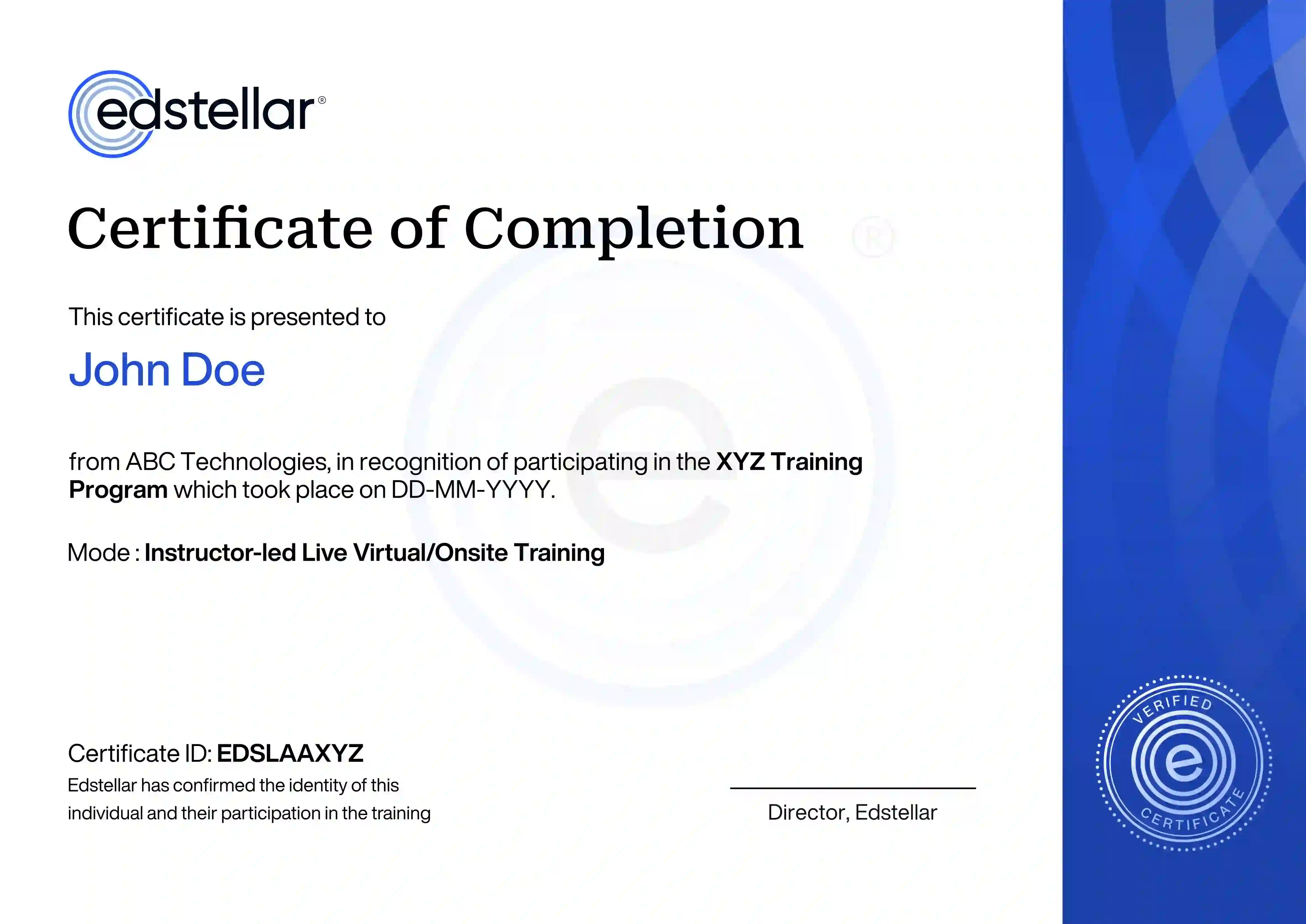
Get Your Team Members Recognized with Edstellar’s Course Certificate
Upon successful completion of the training course offered by Edstellar, employees receive a course completion certificate, symbolizing their dedication to ongoing learning and professional development.
This certificate validates the employee's acquired skills and is a powerful motivator, inspiring them to enhance their expertise further and contribute effectively to organizational success.


We have Expert Trainers to Meet Your VMware vSphere Training Needs
The instructor-led training is conducted by certified trainers with extensive expertise in the field. Participants will benefit from the instructor's vast knowledge, gaining valuable insights and practical skills essential for success in Access practices.
Other Related Corporate Training Courses
Explore More Courses
Edstellar is a one-stop instructor-led corporate training and coaching solution that addresses organizational upskilling and talent transformation needs globally. Edstellar offers 2000+ tailored programs across disciplines that include Technical, Behavioral, Management, Compliance, Leadership and Social Impact.
FAQs
BlogSitemap