Drive Team Excellence with Origin Kubernetes Distribution (OKD) Corporate Training

Kubernetes Distribution (OKD) is an open-source container management platform that allows organizations to deploy, manage, and scale containerized applications efficiently. Organizations seek to stay competitive, as it offers a robust solution for container orchestration, enabling seamless management of complex application environments. Through Kubernetes Distribution (OKD) training course, employees will gain a deep understanding of OKD architecture, networking configurations, and advanced deployment techniques, empowering them to drive innovation.

Edstellar's instructor-led Origin Kubernetes Distribution (OKD) training course is conducted by industry experts with extensive experience in product lifecycle management. The course covers key functionalities and practical applications of Origin Kubernetes Distribution (OKD) and is delivered through virtual/onsite formats. The course is tailored to meet employees' needs, offering hands-on exercises, customization options, and real-world examples to enhance learning outcomes.

Get Customized Expert-led Training for Your Teams
Customized Training Delivery
Scale Your Training: Small to Large Teams
In-person Onsite, Live Virtual or Hybrid Training Modes
Plan from 2000+ Industry-ready Training Programs
Experience Hands-On Learning from Industry Experts
Delivery Capability Across 100+ Countries & 10+ Languages
""""

Skills Your Employees Will Gain

These are the core, hands-on capabilities your team builds during the program.

  • Container Deployment and Management
    Container Deployment and Management involves packaging applications in containers for efficient deployment and scaling. This skill is important for DevOps and cloud engineers to ensure seamless application delivery and resource optimization.
  • Kubernetes Architecture
    Kubernetes Architecture is the design and structure of Kubernetes clusters for container orchestration. This skill is important for DevOps and cloud engineers to ensure efficient deployment, scaling, and management of applications.
  • Networking Configuration
    Networking Configuration involves setting up and managing network devices and protocols to ensure seamless communication. This skill is important for IT roles, as it ensures reliable connectivity and security.
  • Storage Configuration
    Storage Configuration involves setting up and managing data storage systems to optimize performance and security. This skill is important for IT roles, ensuring efficient data access and reliability.
  • Automation with Kubernetes Manifests
    Automation With Kubernetes Manifests involves using YAML files to define and manage containerized applications. This skill is important for DevOps and cloud engineering roles, as it streamlines deployment, enhances scalability, and ensures consistency across environments.
  • Troubleshooting in Kubernetes
    Troubleshooting In Kubernetes involves diagnosing and resolving issues within container orchestration. This skill is important for DevOps and cloud engineers to ensure system reliability and performance.

What Your Team Will Achieve After This Training

  • Apply Kubernetes concepts to deploy and manage containerized applications effectively in real-world scenarios
  • Analyze cluster performance and troubleshoot common issues to ensure optimal operation of Kubernetes environments
  • Develop scalable application architectures using Kubernetes best practices to meet organizational requirements
  • Implement advanced networking configurations to enable secure and reliable communication between containers in production environments
  • Automate deployment workflows using Kubernetes manifests and Helm charts to streamline application delivery pipelines

Topics & Program Outline

The curriculum is organized into focused modules built by industry experts and delivered virtually or on-premise. Interactive sessions reflect the evolving demands of the workplace, keeping the learning both relevant and practical.

  1. The role of containers & container orchestration
    • Understanding containerization
    • Importance of container orchestration
  2. Introduction to OKD
    • Overview of OKD
    • Key features of OKD
  3. Kubernetes and OKD architecture
    • Components of Kubernetes architecture
    • Differentiating Kubernetes and OKD architecture
  4. Installation of OKD
    • Environment setup for OKD installation
    • Step-by-step guide for OKD installation
  1. Installation of Docker
    • Setting up Docker on various platforms
    • Configuring Docker
  2. Docker essential commands
    • Basic Docker commands
    • Docker CLI essentials
  3. Creating containers
    • Building Docker containers
    • Customizing container configurations
  4. Managing data in Docker
    • Data persistence in Docker containers
    • Volume management in Docker
  5. Docker networking
    • Overview of Docker networking
    • Configuring network settings
  6. Docker repositories
    • Working with Docker Hub
    • Managing Docker repositories
  7. Building images
    • Creating Docker images
    • Docker image management
  8. Dockerfile
    • Understanding Dockerfile
    • Writing Dockerfile instructions
  1. Pods
    • Understanding Pods in OKD
    • Managing Pods
  2. Services
    • Overview of Services
    • Configuring Services in OKD
  3. Replication controllers
    • Role of Replication Controllers
    • Managing Replication Controllers
  4. Persistent Volume (PV)
    • Introduction to Persistent Volumes
    • Creating and managing PVs
  5. Persistent Volume Claim (PVC)
    • Understanding PVCs
    • Managing PVCs in OKD
  6. Deployment config
    • Overview of Deployment Configurations
    • Configuring Deployment in OKD
  7. Build config
    • Understanding Build Configurations
    • Building applications using Build Configurations
  1. Introduction to YAML
    • Basics of YAML syntax
    • YAML usage in OKD configurations
  2. Creating and managing pods
    • Pod creation process
    • Pod management commands
  3. Init containers
    • Understanding init containers
    • Configuring init containers in OKD
  4. Labels & selectors
    • Utilizing labels for resource identification
    • Selecting resources using labels
  5. Managing replication controllers
    • Role of replication controllers in managing pod replicas
    • Replication controller operations
  1. Managing services (ClusterIP, NodePort)
    • Configuring ClusterIP and NodePort services
    • Service management commands
  2. Working with routes
    • Route creation and management
    • Route configuration options
  3. Giving privileges to pods
    • Granting permissions to pods
    • Pod privilege management
  4. Creating NGINX and SQL application
    • Deploying NGINX and SQL applications in OKD
    • Application setup and configuration
  1. Introduction to users and groups
    • User and group concepts in OKD
    • User and group management commands
  2. Managing users & groups
    • User and group configuration
    • User and group permissions
  3. Managing user labels
    • Labeling users for resource management
    • Label management operations
  4. Limiting the number of self-provisioned projects per user
    • Project quota management
    • Limiting user project creation
  1. Introduction to deployment config and build config
    • Understanding deployment and build configurations
    • Deployment and build config concepts
  2. Source-To-Image (S2I) build
    • Overview of S2I build process
    • S2I build configuration
  3. Creating and managing builds from GitHub source code
    • Building applications from GitHub repositories
    • GitHub integration for build management
  1. Passing environment variables
    • Setting environment variables in OKD
    • Environment variable management commands
  2. Plain key-value
    • Using key-value pairs for environment variable configuration
    • Key-value management in OKD
  3. Managing config maps
    • Configuring config maps for environment variable storage
    • Config map management operations
  4. Handling secret information
    • Secure handling of sensitive data in OKD
    • Secret management commands
  1. Self-provisioning projects
    • Enabling self-provisioning projects
    • Self-provisioning project management
  2. Disabling self-provisioning
    • Disabling user project creation
    • Project provisioning restrictions
  3. Creating and managing service accounts
    • Service account creation and management
    • Service account permissions
  4. Managing Role-Based Access Control (RBAC)
    • Role-based access control concepts
    • RBAC configuration and management
  5. Managing Security Context Constraints (SCC)
    • Understanding security context constraints
    • SCC configuration and management
  1. Introduction to scheduler
    • Scheduler functionality overview
    • Scheduling principles in OKD
  2. Taints and tolerations
    • Using taints and tolerations for node selection
    • Taint and toleration management commands
  3. Node Selector
    • Selecting nodes based on node labels
    • Node selector configuration
  4. Node Affinity
    • Configuring node affinity for pod placement
    • Affinity rules and configurations
  5. Taints and tolerations vs. Node Affinity
    • Comparing different node selection methods
    • Use cases for taints, tolerations, and node affinity
  6. Daemon Set
    • Understanding Daemon Sets in OKD
    • Daemon Set deployment and management operations
  1. What Is Managed by Quotas
    • Understanding resource quotas in OKD
    • Managed resources under quotas
  2. Quotas versus Limit Ranges
    • Difference between quotas and limit ranges
    • Use cases for quotas and limit ranges
  3. Requests Versus Limits
    • Differentiating resource requests and limits
    • Setting resource requests and limits in OKD
  4. Resource Requirements
    • Determining resource requirements for applications
    • Resource requirement configuration
  5. Overriding Build Resources
    • Adjusting build resources within quotas
    • Overriding build resource limits
  1. Basic Node Commands
    • Essential node management commands
    • Node status and information retrieval
  2. Adding Nodes in Cluster
    • Adding new nodes to the cluster
    • Node addition process and configurations
  3. Deletes Nodes from Cluster
    • Removing nodes from the cluster
    • Node deletion process and considerations
  4. Marking Nodes as Unschedulable or Schedulable
    • Configuring node scheduling status
    • Node scheduling management operations
  1. Understand persistent volumes and know how to create them
    • Persistent volume concepts and creation steps
    • PV creation and configuration
  2. Understand access modes for volumes
    • Exploring different access modes for persistent volumes
    • Configuring access modes for specific use cases
  3. Understand persistent volume claims primitive
    • Overview of persistent volume claims (PVCs)
    • Managing PVCs in OKD
  4. Know how to configure applications with persistent storage
    • Integrating persistent storage with applications
    • Configuring applications to use persistent volumes for data storage

Who Should Attend?

This program suits professionals at many levels across the organization, including:

  • DevOps Engineers
  • Cloud Engineers
  • System Administrators
  • IT Engineers
  • Platform Engineers
  • Infrastructure Engineers
  • Site Reliability Engineers
  • Platform Managers
  • Network Engineers
  • Automation Engineers
  • Security Engineers
  • Release Engineers

What are the Prerequisites?

Employees with a basic understanding of basic Linux command-line operations can take the Origin Kubernetes Distribution (OKD) training course.

Request a Quote for your Corporate Training Requirements

Valid number

Delivering Training for Organizations across 100 Countries and 10+ Languages

Choose the Format That Fits Your Team

We design training your teams actually engage with, and deliver it the way that suits you best. Through a vetted global trainer network, Edstellar runs sessions in 10+ languages with consistent quality anywhere.

Virtual Origin Kubernetes Distribution (OKD) Training

Virtual / online: expert-led live sessions delivered anywhere, with consistency and easy scheduling.

We deliver anywhere worldwide
Standardized content for consistent outcomes
Join from own workspace, no travel
We scale to large groups across sites
Interactive tools keep remote learners engaged
On-site Origin Kubernetes Distribution (OKD) Training

On-site (in-house): immersive, instructor-led learning at your office.

Our trainers run face-to-face at your office
We tailor setup/content to your workplace and tools
Group exercises drive collaboration
Live demos +  hands-on practice
Direct trainer access to clarify doubts
Off-site Origin Kubernetes Distribution (OKD) Training

Off-site: focused, instructor-led group learning away from everyday workplace distractions.

We host your teams at a venue of your preferred choice
Built-in group activities for bonding
Full uninterrupted schedule for focus/retention
Boosts morale and signals commitment

Get a Proposal Shaped to Your Needs

Need pricing for onsite, offsite, or virtual delivery? Get a proposal tailored to your team's needs.

Request a Group Training Quote
""
How Many Team Members Need Training?
Please select an option or fill in the custom field.
"'

Is Your Corporate Training Requirement Only for Origin Kubernetes Distribution (OKD)?

Please select at least one course.
""
Add the List of Training Workshops
search icon

      Please select the course

      No. of Courses selected: 0

      Clear

      Upload a CSV

      Send us your Training Requirements in 3 Easy steps

      1. 1
      2. 2
        Add the required training workshops
      3. 3
        Upload to get a quick quote or email it to contact@edstellar.com

      ""

      Looking for a Complete Package?

      Looking for a one-time pricing option for all your annual training requirements?

      View Corporate Training Packages
      ""
      Select the Option that Best Describes Your Corporate Training Requirement

      Please select an option or choose from the recurring options.
      ""
      Verify and Submit Your Request

      Review Your Corporate Training Selection Summary

      Training Program: Origin Kubernetes Distribution (OKD) Training

      1. No of Team Members

      2. Selected Training Preference

      3. Selected Recurring Sessions

      1

      Review your Requirements

      Training Workshops Selected :


        Excel
        File has been
        successfully uploaded.
        Fill the form to submit
 your details
        Submit Your Professional Contact Information
        Valid number
        We've received your enquiry. Our team will be in touch soon.
        Oops! Something went wrong while submitting the form.
        Starter
        120 licences

        Tailor-Made Trainee Licenses with Our Exclusive Training Packages!

        View Package

        64 hours of group training (includes VILT/In-person On-site)

        Tailored for SMBs

        Growth
        320 licences

        Tailor-Made Trainee Licenses with Our Exclusive Training Packages!

        View Package

        160 hours of group training (includes VILT/In-person On-site)

        Ideal for growing SMBs

        Enterprise
        800 licences

        Tailor-Made Trainee Licenses with Our Exclusive Training Packages!

        View Package

        400 hours of group training (includes VILT/In-person On-site)

        Designed for large corporations

        Custom
        Unlimited licenses

        Tailor-Made Trainee Licenses with Our Exclusive Training Packages!

        View Package

        Unlimited duration

        Designed for large corporations

        What Sets Edstellar Apart

        Experienced Trainers

        Our trainers are drawn from a vetted global network and bring years of industry expertise, keeping every session practical and impactful.

        Proven Quality

        With a strong global track record, Edstellar is known for quality and engaging delivery.

        Industry-Relevant Curriculum

        Our programs are built by experts to match the demands of today's industry.

        Fully Customizable

        Every program can be tailored to your organization's goals.

        Comprehensive Support

        We provide pre- and post-session support for a complete learning experience.

        Global Multi-Location & Multilingual Training Delivery

        We deliver in multiple languages to support diverse global teams.

        Hear from Organizations We've Trained

        "The Origin Kubernetes Distribution (OKD) course revolutionized how I approach my daily responsibilities. As a Senior Cloud Migration Specialist, understanding industry best practices was essential, and this invaluable real-world experience. I've confidently led multiple high-visibility initiatives leveraging this comprehensive knowledge. The instructor's insights on interactive labs have proven instrumental in my professional advancement.”

        Sarah Williams

        Senior Cloud Migration Specialist,

        Container Orchestration Platform Provider

        "The Origin Kubernetes Distribution (OKD) training provided critical insights into advanced methodologies that enhanced my consulting capabilities. As a Lead AWS Solutions Architect, I now leverage hands-on exercises with practical simulations prepared me perfectly for real-world client scenarios. This expertise enabled us to secure a transformative contract with a Fortune 100 organization, demonstrating immediate value from this investment.”

        Adrian Popescu

        Lead AWS Solutions Architect,

        Enterprise Kubernetes Solutions Provider

        "The Origin Kubernetes Distribution (OKD) training transformed our team's entire approach to strategic implementation management and execution. As a Lead Network Architect, the extensive coverage of strategic frameworks, proven concepts to enhanced capabilities. We've successfully deployed these methodologies across all regional operations centers. Our team's productivity and solution quality have improved measurably, validating this investment.”

        Usha Jha

        Lead Network Architect,

        Cloud-Native Application Solutions Firm

        “Edstellar’s IT & Technical training programs have been instrumental in strengthening our engineering teams and building future-ready capabilities. The hands-on approach, practical cloud scenarios, and expert guidance helped our teams improve technical depth, problem-solving skills, and execution across multiple projects. We’re excited to extend more of these impactful programs to other business units.”

        Aditi Rao

        L&D Head,

        A Global Technology Company

        Recognition That Motivates Your Team

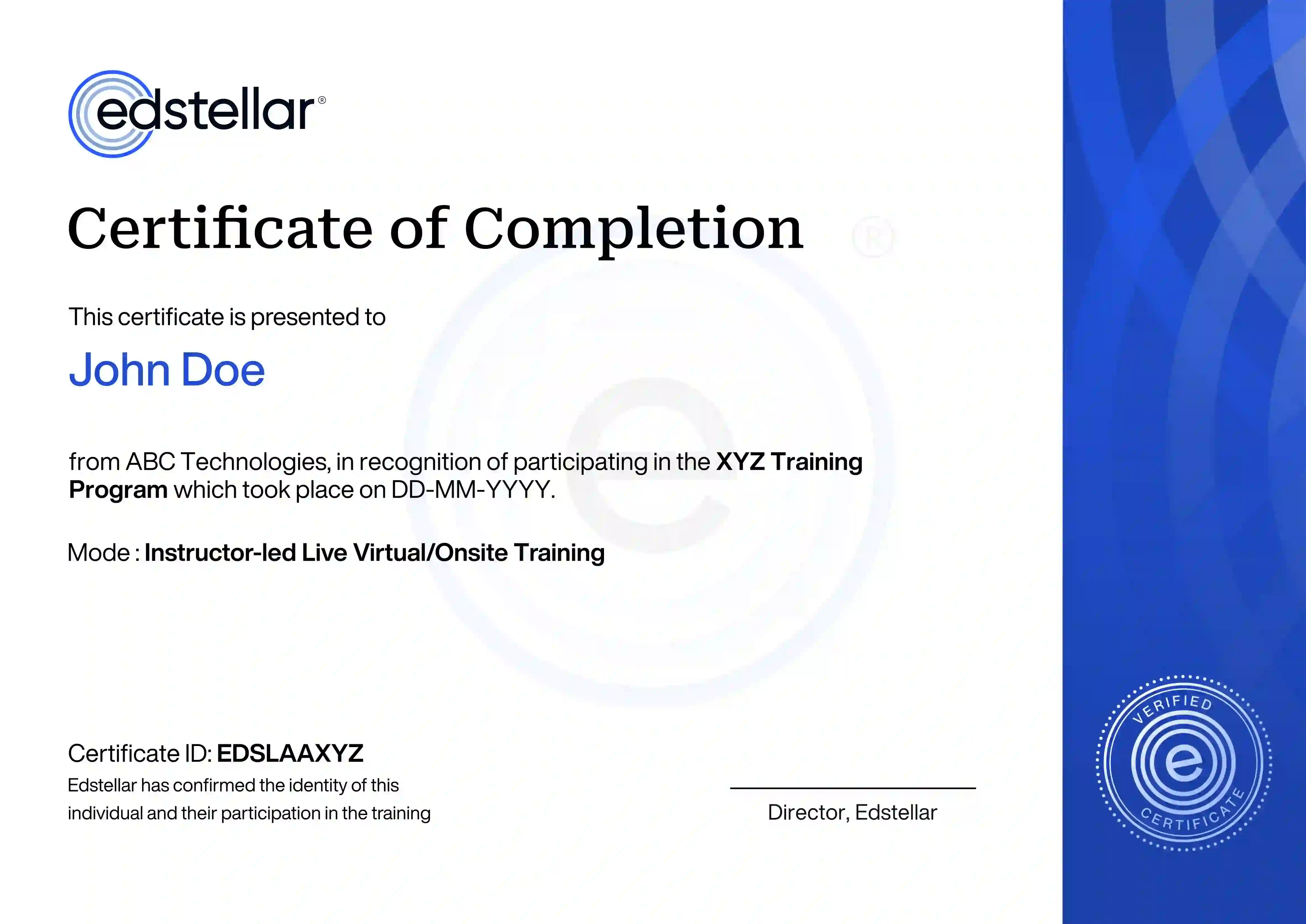
        Upon successful completion of the training course offered by Edstellar, employees receive a course completion certificate, symbolizing their dedication to ongoing learning and professional development.

        This certificate validates the employee's acquired skills and is a powerful motivator, inspiring them to enhance their expertise further and contribute effectively to organizational success.

        Recognition That Motivates Your Team
        Other Related Corporate Training Courses