

The role of Learning & Development (L&D) managers has undergone a dramatic transformation in recent years. No longer confined to organizing training sessions and tracking course completions, today’s L&D leaders are strategic partners driving organizational agility, business innovation, and workforce transformation.
As artificial intelligence reshapes how people learn and work, L&D professionals find themselves at the epicenter of organizational success, equipped with the right skills to navigate this complex landscape.
According to the LinkedIn Workplace Learning Report 2024, 58% of learning professionals now report having a seat at the executive table, up five percentage points over just two years.
This growing influence comes with heightened expectations: aligning learning programs to business goals remains the top priority for L&D for the second consecutive year, while helping employees develop their careers has surged from 9th to 4th place on the priority list.
With 4 in 5 people wanting to learn more about using AI in their profession and the U.S. Bureau of Labor Statistics projecting 6% growth for training and development managers from 2024 to 2034, faster than the average for all occupations, the demand for skilled L&D professionals has never been greater.
This article explores the essential skills that separate exceptional L&D managers from the rest, backed by the latest research and statistics from credible sources. Whether you’re an aspiring L&D professional or a seasoned leader looking to stay ahead, understanding and developing these competencies will position you for success in the evolving world of workplace learning.
Top 10 Must-Have Skills for Learning & Development (L&D) Managers
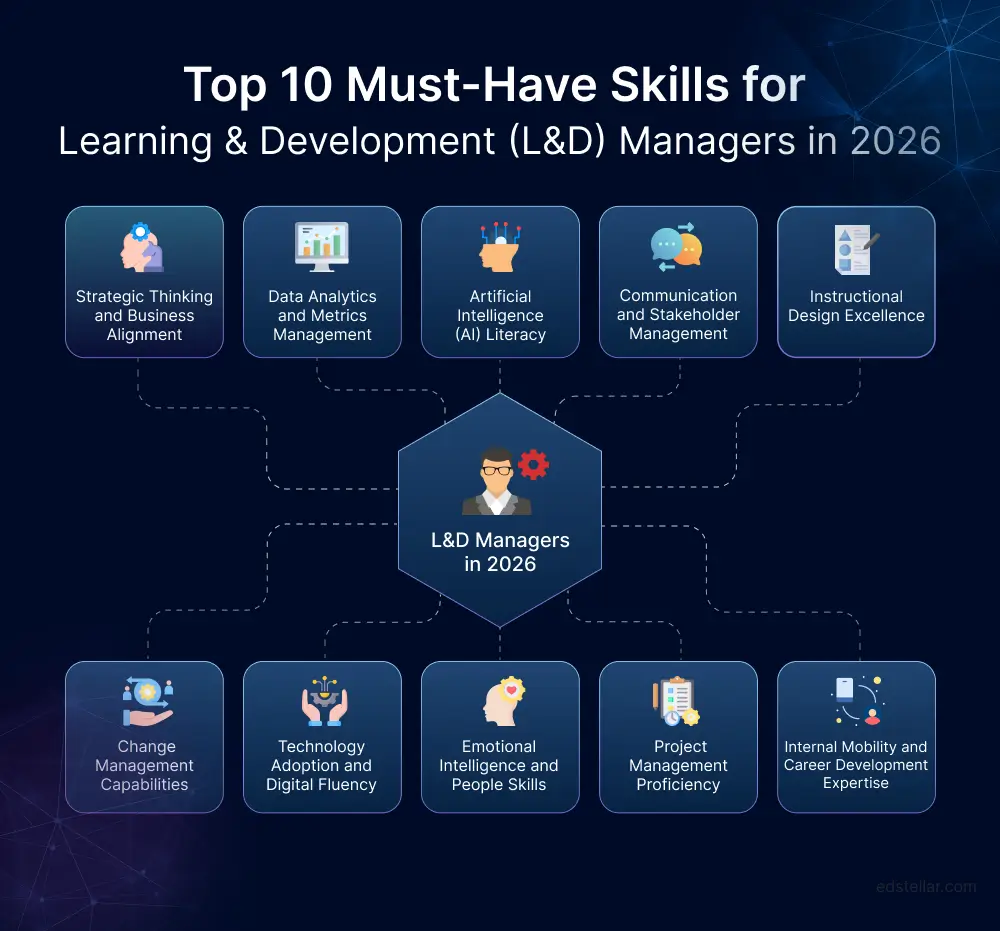
1. Strategic Thinking and Business Alignment
Strategic thinking sits at the heart of modern L&D management. The ability to connect learning initiatives directly to organizational objectives transforms L&D from a cost center into a value driver.
Why It Matters
For the second consecutive year, aligning learning programs to business goals tops the priority list for L&D professionals, as reported in the LinkedIn Workplace Learning Report 2024. This emphasis reflects a fundamental shift in how organizations view learning, not as a nice-to-have benefit, but as a strategic imperative.
“Many C-suite executives don’t understand the real value of learning they see it as just a benefit or nice-to-have. When you talk to business leaders, their questions will instead revolve around business strategy and how learning will help you get there. So even if Chief Learning Officers don’t officially change our titles, we should think of ourselves as Chief Skills Officers, or Chief Upskilling Officers, in charge of strategically building skills that will drive tangible outcomes for the business.”


Companies with strong learning cultures demonstrate remarkable business outcomes. According to LinkedIn’s 2024 research analyzing thousands of organizations, companies with strong learning cultures see:
- 57% higher retention rates compared to baseline
- 27% more internal mobility
- 23% more promotions to management
These metrics prove that when L&D managers successfully align learning strategies with business priorities, the entire organization benefits.
Key Components of Strategic Thinking
Business Acumen: L&D managers must understand their organization’s business model, competitive landscape, revenue drivers, and strategic priorities. This knowledge enables them to design learning interventions that address real business challenges.
Skills Gap Analysis: The World Economic Forum's Future of Jobs Report 2025 found that 63% of employers cite skills gaps as the primary barrier to business transformation, reinforcing why closing these gaps is the top strategic imperative for L&D.
ROI Measurement: 87% of L&D professionals say they can demonstrate business value by helping employees gain skills to move into different internal roles, showing that strategic L&D initiatives deliver measurable returns.
2. Data Analytics and Metrics Management
In an era where data drives decision-making, L&D managers must become proficient in collecting, analyzing, and interpreting learning data to demonstrate value and optimize programs.
The Rise of Data Literacy in L&D
The importance of analytical skills among L&D professionals has exploded. According to the LinkedIn Workplace Learning Report 2025, 71% of L&D professionals are already exploring and experimenting with AI in their daily tasks, with data-driven decision-making sitting at the core of this transformation. L&D professionals are moving beyond “vanity metrics” to track meaningful business outcomes:
Performance and Productivity: According to the LinkedIn report, L&D professionals measure:
- Performance reviews (36%)
- Employee productivity (34%)
- Employee retention (31%)
- Business impacts such as deals closed and customer satisfaction (30%)
- Closing workforce skill gaps (27%)
- New skills per learner (16%)
Notably, only 36% focus on traditional metrics like course completion rates, indicating a maturation of the L&D measurement approach.
Advanced Analytics Applications
- Predictive Analytics: Identifying which employees are at risk of skill obsolescence or likely to benefit most from specific training interventions.
- Learning Culture Index: LinkedIn’s research developed a learning culture scoring system based on L&D team size, employee skill development rates, and learning-related platform activity, demonstrating how multiple data points combine to assess organizational learning health.
- AI-Powered Insights: CompTIA’s Workforce and Learning Trends 2024 survey found that almost 70% of respondents indicated digital fluency continues to increase as an important capability, with data analytics at the core.
Building Data Competency
L&D managers don’t need to become data scientists, but they must develop sufficient literacy to:
- Ask the right questions of data
- Interpret statistical findings accurately
- Communicate insights to stakeholders effectively
- Use data to drive continuous improvement
3. Artificial Intelligence (AI) Literacy
Artificial intelligence has moved from buzzword to business imperative, and L&D managers must lead the charge in both understanding AI and integrating it into learning ecosystems.
The AI Imperative
The statistics are compelling: 80% people want to learn more about using AI in their profession, creating massive demand for AI-related training. Furthermore, organizations recognize AI’s importance. And 9 out of 10 global executives plan to either increase or maintain their investment in L&D, including AI upskilling and reskilling.
AI Adoption in L&D Operations
AI adoption among L&D professionals is accelerating dramatically:
AI Applications in L&D:
- Content creation and scriptwriting
- Personalized learning path recommendations
- Automated course generation
- Virtual coaching and mentorship
- Learning analytics and predictive modeling
- Translation and localization
The Human-AI Partnership
While L&D professionals agree that human skills (soft skills) are increasingly important, AI enhances rather than replaces human expertise. The most effective L&D managers understand how to leverage AI for efficiency while preserving the human elements of empathy, creativity, and strategic thinking.
“We’re transitioning from an era of one-size-fits-all learning to one where personalized learning is the norm. This transition propels the shift from traditional courses to dynamic learning resources. Human-driven professional development will focus on self-discovery and inner leadership facets, such as values and purpose, while highlighting the significance of connection. AI will provide real-time guidance, offering insights for tasks like career discussions, strategy development, or marketing campaigns."

Future-Ready AI Skills
L&D managers need to:
- Understand AI capabilities and limitations
- Identify appropriate AI applications for learning challenges
- Evaluate AI-powered learning tools
- Train employees on AI literacy and ethical AI use
- Design AI-integrated learning experiences
4. Communication and Stakeholder Management
Exceptional communication skills separate effective L&D managers from those who struggle to gain traction for their initiatives.
Multi-Level Communication
L&D managers must communicate effectively across all organizational levels:
- Executive Communication: With 60% of learning professionals now having a seat at the executive table, the ability to present learning initiatives in business language, focusing on ROI, competitive advantage, and strategic impact, is essential.
- Manager Engagement: 47% of companies invest in career mentoring and coaching to boost employee retention, requiring L&D managers to effectively train and support managers as learning facilitators.
- Learner Communication: Understanding how to motivate different generational cohorts, particularly Gen Z, who show 16 percentage points higher agreement (53% vs 37%) that learning helps them explore potential career paths.
The Growth of Interpersonal Skills
The data confirms the rising importance of communication skills. According to the LinkedIn Report 2024, among L&D professionals globally (October 2022 to October 2023):
- Interpersonal Skills showed 73% year-over-year growth
- Presentation Skills increased by 64%
- Problem Solving grew by 57%
- People Management expanded by 57%
Stakeholder Management Essentials
Effective L&D managers excel at:
- Building coalitions and securing buy-in from diverse stakeholders
- Managing expectations and negotiating priorities
- Facilitating difficult conversations about learning investments
- Creating compelling narratives around learning outcomes
- Adapting communication styles to different audiences
The SME Challenge
Subject Matter Expert (SME) collaboration presents unique communication challenges. According to Synthesia’s 2024 Survey, while 32% of instructional designers collaborate with SMEs 76-100% of the time, the median shows most designers collaborate with SMEs only 38% of the time, and 46% collaborate less than 50% of the time.
This gap in SME collaboration, often due to availability constraints, makes it critical for L&D managers to communicate efficiently and maximize the value of limited SME time.
5. Instructional Design Excellence
While some L&D managers focus primarily on strategy, understanding instructional design principles remains essential for evaluating training quality and making informed program decisions.
The Evolution of Instructional Design
The instructional design field has evolved significantly. According to Synthesia’s 2024 survey, there’s been greater role diversification:
- Full-time instructional designers: 33%
- SMEs who design courses: 26%
- Freelancers: 10%
- Directors, Founders, and Leaders: 31%
This diversification reflects the growing complexity of learning environments and the demand for specialized expertise.
Core Instructional Design Competencies
- Learning Theory Application: Understanding adult learning principles, cognitive load theory, and evidence-based instructional strategies.
- Needs Analysis: The 2024 Synthesia report highlights that poor needs analysis, often stemming from insufficient SME collaboration, can compromise the entire design phase, making this a critical competency.
- Assessment Design: Creating valid and reliable assessments that measure actual skill acquisition rather than mere knowledge retention.
Time Allocation in Instructional Design
Research reveals where instructional designers spend their time:
- Development and implementation: 37-39% (the largest portion)
- Design activities: 22-23%
- Analysis: 17-18%
- Evaluation: 10%
- Administrative tasks: 12%
This data from the Synthesia 2024 survey shows that most workload revolves around creating and delivering content, while L&D managers must ensure quality across all phases.
Modern Instructional Design Trends
- Microlearning: 47% of L&D teams plan to deploy microlearning programs, reflecting the shift toward bite-sized, just-in-time learning.
- Performance-Based Success Metrics: 165 respondents in Synthesia’s survey cited learner performance (changes in on-the-job performance) as their primary success measure, marking a shift from traditional completion rates to outcome-based metrics.
- AI-Enhanced Design: 84% of instructional designers have tried ChatGPT, with many using AI for idea generation, content drafting, and overcoming creative blocks.
6. Change Management Capabilities
In today’s rapidly evolving business environment, L&D managers must be change agents who help organizations and individuals navigate transitions effectively.
The Change Imperative
According to the World Economic Forum's Future of Jobs Report 2025, employers expect 39% of workers' core skills to change by 2030, a figure that, while down from 44% in 2023, still represents massive disruption requiring L&D managers to lead proactive change. This massive skills disruption requires L&D managers who can lead organizational change rather than simply respond to it.
Organizational Transformation: According to the LinkedIn Workplace Learning Report 2024, leadership development programs are prioritized by 70% of organizations with mature career development initiatives, confirming that building leaders who can navigate change remains a core L&D responsibility.
Technology Adoption: L&D managers must champion new learning technologies. According to Grand View Research, the global LMS market was valued at $28.58 billion in 2025 and is projected to reach $123.78 billion by 2033, growing at a CAGR of 20.2%, a scale of growth that demands skillful change management for successful platform adoption.
Cultural Transformation: Creating a learning culture requires persistent change management. Research shows that 7 in 10 people say learning improves their sense of connection to their organization, and 8 in 10 say learning adds purpose to their work, benefits that require intentional culture change efforts.
Essential Change Management Skills
- Diagnosing readiness for change
- Developing change communication strategies
- Managing resistance and overcoming barriers
- Building coalitions of change champions
- Measuring and sustaining change over time
The Manager’s Role in Change: Equipping managers with change management skills so when the unexpected becomes the “new normal,” they can keep teams engaged and effective.
7. Technology Adoption and Digital Fluency
As learning technology evolves at breakneck speed, L&D managers must stay current with emerging tools while ensuring their organizations derive maximum value from existing platforms.
The Learning Technology Landscape
The learning technology market is experiencing explosive growth:
- Market Growth: The global LMS market was valued at $28.58 billion in 2025 and is projected to grow to $123.78 billion by 2033, according to Grand View Research, underscoring the scale of technology investment L&D managers must evaluate and integrate.
- AI Integration: The WEF Future of Jobs Report 2025 revealed that AI and big data top the list of fastest-growing skills globally, with 77% of employers planning workforce upskilling, signaling that AI tool proliferation is now a primary driver of L&D technology adoption decisions.
Digital Fluency Requirements
Learning Platform Management: Understanding LMS architecture, integration capabilities, and user experience optimization.
Content Authoring Tools: According to Synthesia’s 2024 survey, the most popular content authoring tools are:
- Articulate Rise: 43% (top choice for responsive, web-based course design)
- Articulate 360: 38% (comprehensive toolkit)
- Storyline: 37% (for custom interactivity)
- AI-powered video tools like Synthesia: 5% (but growing rapidly, with many reporting 50-60% reduction in production time)
Emerging Technologies: Familiarity with virtual reality (VR), augmented reality (AR), mobile learning, social learning platforms, and AI-powered learning tools.
The Technology Adoption Challenge
While technology offers tremendous potential, adoption presents challenges:
Project Timelines: The Synthesia survey found that 29% of instructional design projects take 21-50 days to complete, and 23% extend beyond 50 days, partly due to technology complexity.
Balancing Innovation and Stability: L&D managers must evaluate new technologies while ensuring existing platforms deliver consistent value.
Strategic Technology Selection
Effective L&D managers:
- Conduct thorough needs assessments before technology purchases
- Pilot new tools with small groups before full rollout
- Ensure vendor partnerships include adequate training and support
- Monitor usage analytics to optimize technology investments
- Stay informed about emerging technologies through continuous learning
8. Emotional Intelligence and People Skills
In an age of AI and automation, human skills, particularly emotional intelligence, have become more valuable than ever for L&D managers.
The EQ Advantage
91% of L&D professionals agree that human skills (soft skills) are increasingly important, according to the LinkedIn 2024 report. This overwhelming consensus reflects recognition that as technology handles transactional tasks, human-centered leadership becomes the differentiator.
Leadership Impact: A 2024 McKinsey report underscores the importance of empathetic leadership, highlighting its role in fostering clear communication and trust in digital environments.
Core Emotional Intelligence Competencies
- Self-Awareness: Understanding your own emotions, strengths, weaknesses, and impact on others
- Self-Regulation: Managing disruptive emotions and adapting to changing circumstances
- Empathy: According to research on soft skills and EQ, empathy, communication, and adaptability are the real keys to success in an AI-driven world
- Social Skills: Building relationships, influencing others, and managing conflict effectively
The Human Skills Growth Trend
The data confirms the rising importance of people skills. The LinkedIn Workplace Learning Report 2024 shows year-over-year growth among L&D professionals (October 2022 to October 2023):
- Interpersonal Skills: +73%
- Presentation Skills: +64%
- Problem Solving: +57%
- People Management: +57%
These “fastest growing skills” indicate that L&D professionals are actively developing their emotional intelligence capabilities to meet evolving demands.
EQ in Practice
L&D managers with high emotional intelligence:
- Navigate organizational politics more effectively
- Build stronger relationships with stakeholders
- Create psychologically safe learning environments
- Respond constructively to criticism and setbacks
- Inspire and motivate learners and team members
Generational Considerations
Different generations respond to different emotional approaches. For instance, 53% of Gen Z agree that “through learning, I can explore potential career paths at my company,” compared to 37% of older generations, a 16 percentage point difference that requires emotionally intelligent communication strategies.
Edstellar’s behavioral and leadership training courses help L&D managers and their teams develop these critical emotional intelligence competencies through experiential learning, role-playing, and guided practice.
9. Project Management Proficiency
L&D managers juggle multiple initiatives simultaneously, making project management skills essential for delivering quality programs on time and within budget.
The Project Management Reality
Research reveals the demanding nature of L&D project management:
Project Loads: According to Synthesia’s 2024 survey:
- The median L&D professional manages 3 simultaneous projects
- Most handle 2-4 projects at the same time
- About 15% manage more than 6 projects concurrently
- Full-time instructional designers average 3.30 projects simultaneously
- Directors, Leaders, and Founders manage the most at 3.85 projects on average
Annual Completion: Most instructional designers complete 15-16 projects annually, though some high-volume environments see professionals completing 21-50 or even over 50 projects per year.
Project Management Skill Requirements
According to Training Industry’s research on essential L&D leader skills, L&D managers must:
- Understand the project life cycle
- Develop comprehensive action plans
- Assess and mitigate risks
- Manage timelines, costs, and quality
- Allocate and manage resources efficiently
- Facilitate clear stakeholder communication
Time and Resource Challenges
The Synthesia 2024 survey identified key barriers to speed and quality:
Barriers to Speed:
- Content creation (e.g., video production): 31%
- Delays in SME input: 30%
- Unclear stakeholder requirements: 27%
Barriers to Quality:
- Limited budgets: 18%
- Insufficient time for development: 17%
- Lack of access to SMEs: 13%
- Insufficient professional development: 10%
Project Rejection Realities
When resources are constrained, L&D professionals must make tough decisions. According to Synthesia’s research:
- 38% of instructional designers turn down 1-6 projects per year due to lack of resources
- 35% manage to take on every request
- Lack of time (33%) and unrealistic deadlines (18%) are the top reasons for rejecting projects
Effective Project Management Practices
Successful L&D managers:
- Use project management methodologies (Agile, Waterfall, hybrid approaches)
- Leverage project management software and collaboration tools
- Build realistic timelines with buffer for unexpected challenges
- Communicate proactively with stakeholders about constraints
- Prioritize projects based on business impact
- Document lessons learned for continuous improvement
10. Internal Mobility and Career Development Expertise
One of the most significant shifts in L&D priorities is the emphasis on internal mobility and career development, reflecting organizations’ recognition that employee growth drives business success.
The Internal Mobility Imperative
Priority Surge: Helping employees develop their careers climbed from #9 on L&D’s priority list to #4 in just one year.
Career Development as Retention Strategy: 47% of companies invest in career mentoring and coaching specifically to boost employee retention, and 90% of organizations are concerned about employee retention, with providing learning opportunities being the #1 retention strategy.
The Internal Mobility Gap
Despite growing interest, internal mobility programs face challenges:
Current State: Only 33% of organizations have formal internal mobility programs.
Confidence Gap: Just 1 in 5 employees has strong confidence in their ability to make an internal move, suggesting significant work remains to normalize internal career transitions.
Shared Leadership: Internal mobility responsibility often spans multiple functions. According to the 2024 LinkedIn report:
- Head of HR owns or co-owns responsibility in 48% of organizations
- Head of talent management/development: 28%
- Head of L&D: 27%
- Head of talent acquisition: 25%
- Dedicated internal mobility leader: 17%
Key Career Development Practices
According to LinkedIn’s 2024 research, organizations with mature career development initiatives prioritize:
- Leadership development programs: 70%
- Shared internal jobs: 58%
- Mentorship programs: 57%
- Individual career plans: 49%
- Internal mobility: 44%
The Career Goal Multiplier Effect
Career goals significantly amplify learning engagement. According to LinkedIn’s 2024 product research, learners who set career goals engage with learning 4x more than those who don’t set goals. This statistic underscores the importance of L&D managers helping employees connect learning to career aspirations.
L&D’s Role in Career Development
The business case is clear: 87% of L&D professionals say they can demonstrate business value by helping employees gain skills to move into different internal roles. For organizations seeking to align learning with business goals while developing employee careers, internal mobility represents the sweet spot.
Building Career Development Capabilities
Effective L&D managers:
- Map skills to career pathways within the organization
- Create transparent skill-building frameworks
- Facilitate career conversations between employees and managers
- Design learning experiences that build transferable skills
- Partner with talent management on succession planning
- Leverage technology for skills assessment and career planning
Conclusion
The role of L&D manager has evolved from training coordinator to strategic business partner, change agent, and career development catalyst. The ten skills outlined in this article represent the competencies that separate exceptional L&D leaders from those who struggle to create impact.
The research is detailed: organizations that invest in learning reap remarkable rewards. Companies with strong learning cultures see higher retention, more internal mobility, and more promotions to management. When L&D managers possess these essential skills, they unlock this potential for their organizations.
As you reflect on your own professional development, consider which of these skills represent your strengths and which require focused attention. Remember that learners who set career goals engage with learning 4x more, a principle that applies to L&D professionals as much as to the employees we serve.
The future of work is unfolding rapidly, with AI transformation, skills disruption, and evolving workplace expectations creating both challenges and opportunities. L&D managers who continuously develop these core competencies will not only navigate this complexity successfully, but they’ll shape the future of their organizations and empower their employees to thrive.
How Edstellar Supports L&D Excellence
At Edstellar, we understand the multifaceted demands facing L&D managers. Our comprehensive training solutions support your success through:
- 5,000+ Qualified Instructors: Access expert trainers across all skill domains
- 2,000+ Training Courses: AI, technical, functional, behavioral, leadership, and more
- Training Management System: Plan, schedule, and analyze training effectiveness
- Customization Capabilities: Tailor programs to your unique organizational needs
- Global Scalability: Deliver instructor-led training on demand worldwide
- End-to-End Support: From consultation through post-training evaluation
Whether you’re building your own L&D capabilities or developing training programs for your organization, Edstellar provides the expertise, technology, and support to help you succeed in this dynamic field.
Ready to elevate your L&D capabilities? Contact Edstellar today to explore how our training solutions can help you develop these essential skills and drive measurable business impact through learning.