

Malta's full-time workforce grew by 12,066 positions in the year ending October 2025, bringing registered employment to 302,927 workers, yet with unemployment at just 2.7–3.1% and over 9,000 job vacancies recorded, the island has effectively run out of available domestic workers. Malta's ICT skills gap is estimated at 1:6, meaning for every qualified tech specialist, six vacancies compete for their attention.
The iGaming sector employs 14,950 people and contributes 10.1% of national GVA when including indirect spillover, the financial services industry accounts for 8.2% of real gross value added with 14,700+ employees, and construction workforce demand continues to outpace supply across every trade. For corporate L&D leaders and HR managers operating in Europe's fastest-growing small economy, these numbers translate directly into urgent training priorities.
Several structural forces are intensifying this demand simultaneously. Foreign workers now make up over 40% of Malta's active workforce (28.7% from third countries and 11.2% from other EU states in 2023), and the Central Bank projects employment growth decelerating to 2.9% in 2026 and 2027 as the labour pool tightens further. Eight major gaming and esports firms will invest EUR 60 million by end-2026, creating 1,300 new jobs, while Evolution alone is adding 700 positions.
The EU's NIS2 directive is driving a cybersecurity hiring surge, MFSA regulatory expansion is creating compliance demand across financial services, and the MiCA framework is positioning Malta as a European crypto hub after Blockchain.com opened its Valletta office. Malta needs an estimated 7,500 additional tech professionals, and 87% of local tech companies plan to grow their teams in the next three years.
So which skills are truly driving Malta's economy, and where should organisations invest their training budgets? This guide breaks down the top 10 skills in demand in Malta, spanning iGaming technology, cybersecurity, financial services, healthcare, and construction. Drawing on Jobsplus employment data, EURES labour market analysis, MFSA sector reports, and Archer IT salary benchmarks, it provides an evidence-based picture of what jobs are in demand in Malta, whether you are planning corporate upskilling programmes, building internal talent pipelines, or advising teams on high demand skills in Malta for 2026 and beyond.
Sources Behind This Research
Every ranking in this guide is backed by data from Maltese government bodies, industry associations, and established hiring platforms.
Jobsplus (Public Employment Service)
Employment Trends & Labour Market PublicationsReported 302,927 registered workers, 4.2% employment growth, 9,000+ vacancies, and sector-level employment data. Administers skills gap surveys with NCFHE and Malta Enterprise to identify workforce shortcomings.
View source →EURES (European Employment Services)
Labour Market Information: MaltaConfirmed 2.7–3.1% unemployment, workforce composition (59.7% Maltese, 28.7% third-country nationals), and shortage occupations across tech, healthcare, construction, and hospitality sectors.
View source →Malta Financial Services Authority (MFSA)
Financial Services Sector Reports 2025Documented 8.2% of real GVA, 14,700+ employees, 21.6% workforce growth since 2020, regulatory sandbox operations, and the MiCA framework attracting crypto and blockchain companies to Malta.
View source →Malta Gaming Authority (MGA)
Gaming Industry Employment & GVA DataReported 10,685 full-time gaming jobs (9,919 online, 766 land-based), total sector employment of 14,950 including service providers, EUR 1.386 billion in GVA (6.7% of economy, 10.1% with spillover).
View source →CEDEFOP (European Centre for the Development of Vocational Training)
Malta: Mismatch Priority OccupationsIdentified priority occupations where skills mismatches are most acute in Malta, including ICT professionals, healthcare workers, construction trades, and teaching roles. Provided EU-comparative data on occupation-level shortages.
View source →Boston Link & Business of iGaming
iGaming Salary Survey 2025 & Compensation ReportsProvided comprehensive salary data across iGaming roles, documented that compliance and AML roles now rival commercial heads in compensation, and tracked the shift toward technical and product-led hiring in the gaming sector.
View source →Archer IT Recruitment
IT & Data Salary Guide Malta 2025Reported that developers and cybersecurity professionals are the highest-demand IT roles, with cloud architects earning EUR 85,000–110,000 and the 1:6 ICT skills gap ratio. Provided role-level salary benchmarks across technology and data sectors.
View source →FreeMalta & Accelerate
Malta Salary Benchmarks & Finance/Legal Salary Guides 2025–2026Provided salary benchmarks across 800+ roles in 20 sectors. Documented technology salaries of EUR 22,000–90,000, finance EUR 18,000–150,000, and iGaming EUR 18,000–130,000 with C-level roles exceeding EUR 130,000.
View source →"The most critical skills in Malta's evolving market require professionals who are confident, resilient, and strong in communication and leadership. Organizations that invest in building these well rounded capabilities across their teams create a workforce that adapts to change and drives meaningful results. "
Darine Aboulezz
10 Key Skills in Demand Across Malta's Job Market
Malta's skills landscape in 2026 reflects the paradox of Europe's lowest unemployment coexisting with severe talent shortages across every high-value sector. The 10 skills below span iGaming technology, financial services, cybersecurity, healthcare, and construction, mirroring the sectors where employer demand, salary premiums, and regulatory pressure are highest. Each ranking draws on the policy signals, job market data, and industry investments outlined in the sources above.
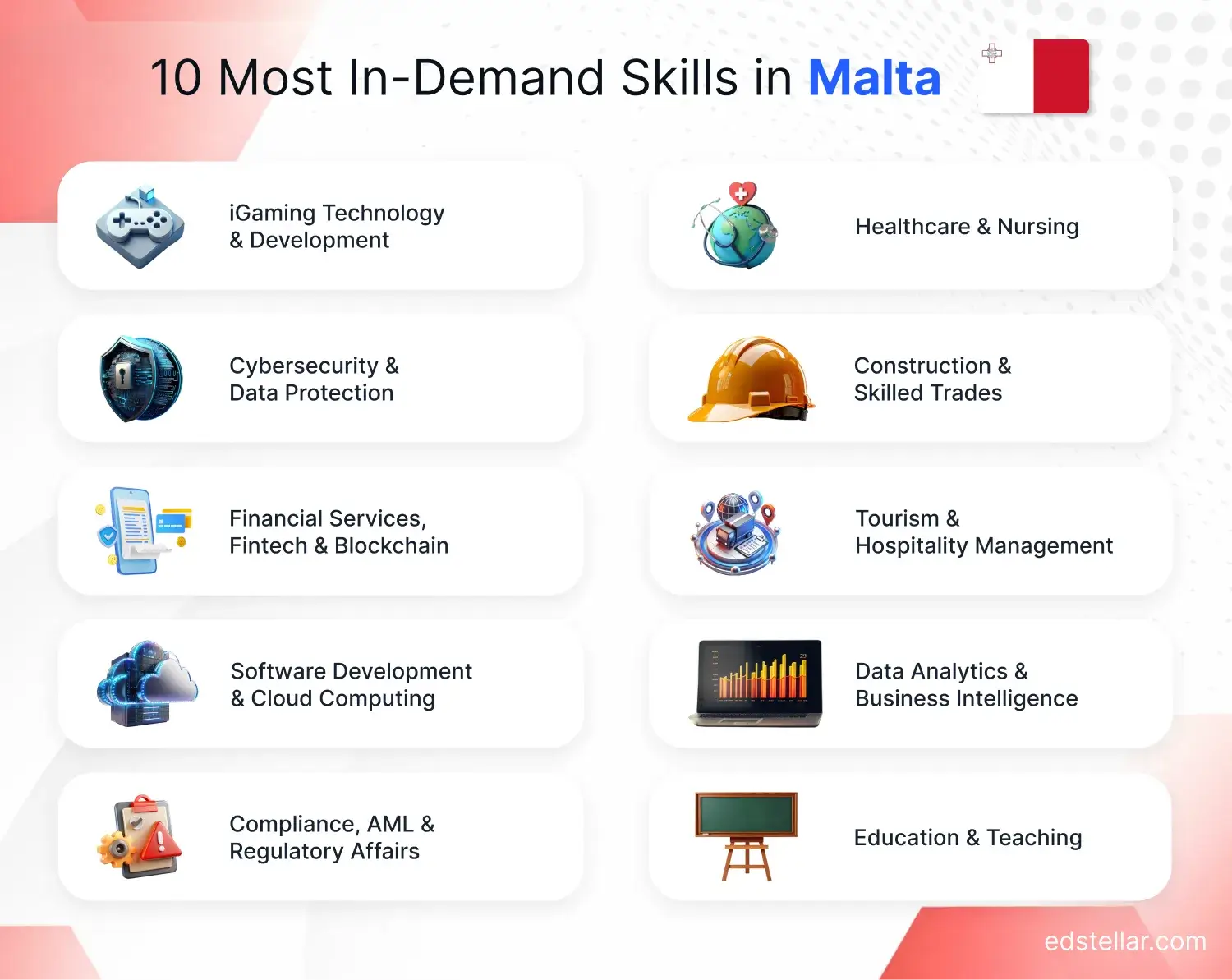
iGaming Technology & Development
Research Score: 9.30/10
Malta's iGaming sector generated EUR 1.386 billion in gross value added, representing 6.7% of the national economy, with the total contribution rising to 10.1% when accounting for indirect economic spillover. The Malta Gaming Authority reports 10,685 full-time gaming jobs, with 9,919 in online gaming, and including service providers the total reaches 14,950. Eight major firms across gaming, esports, and iGaming will invest EUR 60 million by end-2026, creating around 1,300 new high-paying jobs, while Evolution alone is adding 700 positions.
Technical and product-led roles dominate the upper salary tiers, with experienced developers, data specialists, and product leaders capable of driving platform scalability, automation, and game performance in highest demand. iGaming C-level roles exceed EUR 130,000 annually, and the sector competes with fintech and traditional technology companies for the same pool of software engineers, DevOps specialists, and data engineers. The shift toward AI-driven personalisation, real-time analytics, and responsible gaming technology is creating new skill requirements beyond traditional gaming platform development.
Major employers include Betsson, Kindred Group, LeoVegas (MGM), Evolution, Tipico, and hundreds of smaller operators licensed by the MGA. Malta's position as Europe's iGaming capital, with more licences issued than any other EU jurisdiction, creates a self-reinforcing talent ecosystem where expertise in gaming regulations, player analytics, and platform engineering is concentrated. For developers and data professionals, Malta's iGaming sector offers compensation that significantly exceeds the national average alongside career pathways in one of the world's most dynamic digital entertainment industries.
Key Sub-skills
Top Industries
Online Gaming Operators (MGA-Licensed), Game Studios & Content Providers, Platform & Payment Technology, Esports & Live Casino
Cybersecurity & Data Protection
Research Score: 9.05/10
Malta's cybersecurity market is projected to grow at 9.21% through 2029, with roles offering EUR 40,000–144,000 and the EU's NIS2 directive driving a hiring surge across critical infrastructure, financial services, and iGaming. The ICT skills gap ratio of 1:6 is felt most acutely in cybersecurity, where Enemalta recruits for critical infrastructure protection, Bank of Valletta and HSBC Malta hire for financial security, and Betsson Group and other MGA-licensed operators need professionals to meet evolving responsible gaming and data protection requirements.
The concentration of iGaming operators handling millions of player accounts, financial services firms processing cross-border transactions, and government digital services on a small island creates a uniquely dense attack surface. GDPR enforcement, MGA compliance requirements, and the incoming NIS2 obligations mean that cybersecurity engineers with both technical defence skills and regulatory compliance expertise are in acute demand across virtually every sector of Malta's economy.
Cybersecurity Managers earn up to EUR 120,000 annually, and the compliance-security intersection is one of the fastest-growing compensation categories. CISSP, CISM, CEH, and CompTIA Security+ certifications carry significant premiums in a market where qualified professionals can choose among multiple competing offers. For IT professionals in Malta, transitioning into cybersecurity represents one of the highest-return career investments, with structured pathways available through MCAST and international certification programmes.
Key Sub-skills
Top Industries
iGaming & Online Entertainment, Financial Services & Banking, Government & Critical Infrastructure, Telecommunications
Financial Services, Fintech & Blockchain
Research Score: 8.80/10
Malta's financial services industry accounted for 8.2% of real GVA in 2025 and employed more than 14,700 individuals, with the sector's workforce growing 21.6% since 2020 according to MFSA data. The MiCA regulatory framework is positioning Malta as a European crypto and blockchain hub, with Blockchain.com opening its Valletta office and OKX designating Malta as its regional hub. The MFSA's regulatory sandbox allows startups to test products under real-world conditions, and in 2024 the authority collaborated with the University of Malta to launch a Postgraduate Diploma in Financial Regulation and Compliance.
One of the clearest upward salary trends is in compliance, AML, responsible gaming, and legal functions, with compliance leaders now rivalling commercial and product heads in total compensation, a direct reflection of regulatory pressure across Europe. Finance roles range from EUR 18,000 to EUR 150,000, and demand remains high for professionals in fintech, risk management, and compliance as stricter EU regulations and digitalisation drive structural change. The convergence of traditional financial services with blockchain, DeFi, and tokenisation is creating hybrid roles that require both financial regulation expertise and technology architecture knowledge.
Major employers include HSBC Malta, Bank of Valletta, APS Bank, and dozens of international fund administrators and insurance companies, alongside the growing crypto and fintech ecosystem clustered around the Malta Tech Hub and FinanceMalta. For finance professionals, Malta offers a unique career environment where EU-standard regulatory complexity meets a compact market that provides unusually broad exposure across multiple financial disciplines.
Key Sub-skills
Top Industries
Banking & Insurance, Fund Administration, Crypto & Blockchain (MiCA-Licensed), Fintech & Payments
Explore Related Training:
Financial Risk Management Financial Crime Prevention All Finance & Accounting Programs"As Malta's gaming industry evolves, it is essential to adapt and strengthen the foundations that support its success. The Skills Gap Report reveals important insights into the challenges and opportunities ahead, particularly the need for targeted skills development and stronger partnerships between educational institutions and industry."

Software Development & Cloud Computing
Research Score: 8.55/10
Malta needs an estimated 7,500 additional tech professionals, and 87% of local tech companies plan to grow their teams in the next three years. The tech industry is growing at 6.14% annually, supported by government initiatives emphasising AI, blockchain, and cybersecurity. Developers and cybersecurity professionals are the highest-demand IT roles, and the demand for DevOps, software development, and data analytics professionals remains high as businesses focus on automation, efficiency, and scalability across iGaming, financial services, and digital government.
Cloud architects earn EUR 85,000–110,000 annually, and AI Architects command up to EUR 130,000, making Malta's senior tech salaries competitive with larger European markets when adjusted for the island's favourable tax environment. The iGaming sector's voracious appetite for platform engineers, the financial services industry's cloud migration requirements, and the government's digitalisation agenda are all competing for the same limited pool of developers and infrastructure specialists.
Major tech employers include the iGaming operators, financial services firms, and dedicated technology companies including KPMG Digital, Deloitte Digital, and local firms such as RS2 Software, ICON, and Alert Communications. For international developers, Malta offers EU residency, English as an official language, a Mediterranean lifestyle, and tax incentives that make effective compensation higher than headline salaries suggest. Python, Java, JavaScript, Go, and cloud-native frameworks are the most requested technologies.
Key Sub-skills
Top Industries
iGaming Technology, Financial Services, Government Digital, Technology Consultancies
Compliance, AML & Regulatory Affairs
Research Score: 8.30/10
Malta's dual identity as Europe's iGaming capital and a growing financial services centre creates extraordinary demand for compliance professionals. The MGA enforces responsible gaming regulations, the MFSA oversees financial services and MiCA crypto compliance, and GDPR applies across all sectors. Compliance leaders now rival commercial and product heads in total compensation according to Boston Link's salary survey, with the upward pressure on compliance salaries being a direct reflection of the regulatory intensity unique to Malta's economy.
The iGaming sector alone requires AML officers, responsible gaming specialists, and regulatory affairs managers for each of its hundreds of licensed operators. Financial services firms need compliance officers versed in EU directives including MiFID II, AMLD, and the incoming MiCA framework. The MFSA's collaboration with the University of Malta on a Postgraduate Diploma in Financial Regulation and Compliance signals the formal recognition that Malta needs a structured compliance talent pipeline, not just individual hires.
For professionals with legal, accounting, or risk management backgrounds, specialising in iGaming or crypto compliance represents one of Malta's most lucrative career pathways. The intersection of EU regulatory frameworks with Malta's specific licensing regimes creates niche expertise that is both highly compensated and difficult to replicate, making experienced Maltese compliance professionals attractive to international firms establishing European operations.
Key Sub-skills
Top Industries
iGaming (MGA-Licensed Operators), Financial Services (MFSA-Regulated), Crypto & Blockchain, Insurance & Fund Administration
Explore Related Training:
Financial Crime Prevention Financial Risk Management All Risk Management ProgramsNeed a Training Plan for Your Malta Team?
Edstellar's Training Needs Analysis consultants identify your priority skill gaps and build a customised training roadmap. Get matched with the right programmes in 48 hours.
Request a Free Consultation →Healthcare & Nursing
Research Score: 8.05/10
Malta faces a shortage of over 500 nursing positions, with the Malta Chamber describing the situation as a "crisis in waiting." The increasing proportion of Malta's population aged 65 and over is driving demand for specialised elderly care, geriatric nursing, and chronic disease management services. Nursing wages in Malta increased 15% in the past year due to the growing competition for healthcare professionals, and the dependency on foreign nurses has created challenges around cultural diversity, language barriers, and communication with patients.
Malta's National Health Workforce Strategy (2022–2030) addresses shortages through improved training, retention, and professional development. Collaborations with UK universities aim to improve the quality of nursing education and better prepare graduates for clinical practice. Mater Dei Hospital, the island's main acute care facility, and the government's network of health centres and long-term care facilities are the largest public employers, while private clinics and residential care homes are expanding to serve both the aging local population and the growing expatriate community.
For international healthcare professionals, Malta offers EU residency, English-speaking clinical environments, and competitive compensation packages that have improved significantly with the recent 15% wage increase. The compact healthcare system means that clinical professionals gain unusually broad experience across specialities, making Maltese-trained nurses attractive to larger European health systems. The island's growing medical tourism sector adds further demand for specialist nursing and allied health professionals.
Key Sub-skills
Top Industries
Mater Dei Hospital, Government Health Centres, Private Clinics & Care Homes, Medical Tourism
Construction & Skilled Trades
Research Score: 7.80/10
Malta employed 20,420 construction workers in September 2025, and the sector faces persistent shortages of electricians, plumbers, plasterers, stonemasons, carpenters, and site supervisors. Ongoing construction, renovation, and infrastructure projects across the island's 316 square kilometres create concentrated demand that the domestic workforce, even supplemented by significant foreign labour, cannot fully meet. The housing crisis, with property development accelerating alongside tourism infrastructure, is intensifying the competition for skilled tradespeople.
Malta's construction sector has distinctive characteristics: the small island geography means that projects are concentrated and logistics are compressed, limestone construction requires traditional masonry skills alongside modern techniques, and EU building standards and environmental regulations add compliance requirements. The renovation and restoration of historic properties in Valletta, Mdina, and the Three Cities requires specialist skills in heritage conservation that combine traditional craftsmanship with modern engineering.
For international tradespeople, Malta offers English-speaking work environments, EU residency, and year-round construction activity without the seasonal shutdowns common in northern European markets. The shortage of qualified trades workers boosts job security and bargaining power, particularly for those with certifications recognised under EU mutual recognition frameworks. MCAST (Malta College of Arts, Science and Technology) provides vocational training pathways, but graduate output remains well below market demand.
Key Sub-skills
Top Industries
Residential & Commercial Development, Heritage Restoration, Infrastructure & Utilities, Hotel & Tourism Construction
"Automation is shifting jobs from low-skilled and low paid to high-skilled and high paid. This is why I describe this as a transitional phase during which we need to really plan for the upskilling and reskilling of workers."

Tourism & Hospitality Management
Research Score: 7.55/10
Malta welcomes over 2.5 million visitors annually, and the tourism workforce is undergoing professionalisation through the Skills Pass initiative, which since May 2024 requires third-country nationals to demonstrate competency standards for hospitality employment. From January 2026, all workers in hospitality and tourism, including EU nationals, must obtain a Skills Pass, raising the bar for service quality across the sector. As of 2025, 98% of third-country nationals in tourism have already acquired the skills pass.
The Institute of Tourism Studies (ITS) provides structured training for hospitality careers, and the expanding hotel industry offers year-round employment rather than the purely seasonal patterns of other Mediterranean destinations. Hotel managers, chefs, guest experience specialists, event coordinators, and food and beverage professionals are consistently in demand. The growing MICE (Meetings, Incentives, Conferences, Exhibitions) segment and luxury boutique hotel development add higher-value hospitality roles to the traditional tourism employment base.
Major hotel groups including Corinthia Hotels (headquartered in Malta), Hilton, Marriott, and local operators compete for trained hospitality staff alongside restaurants, tour operators, and the entertainment sector. For young Maltese and international workers, the hospitality sector offers accessible entry points with structured progression pathways, and the English-speaking environment removes language barriers common in other Mediterranean destinations.
Key Sub-skills
Top Industries
Hotels & Resorts (Corinthia, Hilton), Restaurants & Catering, Tour Operators & Heritage Tourism, MICE & Events
Data Analytics & Business Intelligence
Research Score: 7.30/10
The iGaming sector's reliance on player analytics, real-time reporting, and regulatory compliance data creates one of Europe's most concentrated markets for data analysts and BI specialists. Every MGA-licensed operator requires teams that can monitor player behaviour, generate compliance reports, optimise marketing spend, and feed product decisions with data-driven insights. The financial services sector adds demand for risk analytics, transaction monitoring, and regulatory reporting professionals.
Python, SQL, R, Tableau, Power BI, and cloud-based analytics platforms are the core technical requirements. The convergence of traditional analytics with AI and machine learning is creating hybrid roles where statistical foundations and ML capabilities are equally valued. Malta's compact economy means that data professionals often work across multiple domains, gaining breadth of experience that specialists in larger markets rarely achieve within a single role.
For mid-career professionals transitioning from business roles, data analytics represents one of the strongest reskilling pathways in Malta's job market. The University of Malta and MCAST offer data science programmes, and the iGaming industry's own training initiatives provide industry-specific pathways into analytics careers. The combination of EU data governance standards (GDPR) with sector-specific requirements (MGA, MFSA) creates a regulatory analytics niche that is particularly well-compensated.
Key Sub-skills
Top Industries
iGaming & Online Entertainment, Financial Services, Government & Public Sector, Technology Consultancies
Education & Teaching
Research Score: 7.05/10
CEDEFOP identifies teaching as a mismatch priority occupation in Malta, with shortages across primary, secondary, and vocational education. The challenge is circular: without enough qualified teachers in STEM, ICT, and technical subjects, Malta cannot produce the graduates needed to fill its technology, healthcare, and trades shortages. The English-language education system, while an advantage for attracting international workers, requires teachers who can deliver curriculum in English at EU-equivalent standards.
MCAST, the University of Malta, and private education providers all face recruitment challenges for academic staff in high-demand disciplines, particularly where industry salaries significantly exceed academic compensation. The growing number of international schools serving the expatriate community (which now comprises over 40% of the workforce) creates additional demand for qualified teachers, particularly in English, STEM subjects, and international curricula.
Corporate training is a growing segment as organisations invest in workforce development to bridge the skills gap across iGaming, financial services, and technology. The compact market means that trainers often deliver across multiple sectors, requiring versatility and broad industry knowledge. For education professionals, Malta offers EU working conditions, English as the medium of instruction, and a market where qualified teachers have genuine bargaining power due to structural shortages.
Key Sub-skills
Top Industries
State Schools & University of Malta, MCAST & Vocational Education, International & Private Schools, Corporate Training
Explore Related Training:
Advanced Leadership Communication Strategies All Leadership Communication Programs"We need a well-structured economic transformation strategy that ensures that present and future generations are equipped with the skills needed to support this strategy, meaning our education system must be aligned and adequately resourced to meet these demands."


Top 6 Sectors to Work in Malta in 2025, covering career opportunities across iGaming, tech, renewable energy, healthcare, tourism, and fintech.
Skills Demand Across Malta's Key Economic Sectors
Malta's compact geography means skills demand is best understood by sector rather than region, with the island's 316 square kilometres hosting a concentration of economic activity that larger countries distribute across multiple cities. The iGaming cluster, financial services hub, and construction sector operate in close proximity, creating talent competition across overlapping skill sets.
| Sector | Key Employers | Top Shortage Skills |
|---|---|---|
| iGaming & Digital Entertainment | Betsson, Evolution, Kindred, Tipico, LeoVegas | Software Development, Data Analytics, DevOps, Cybersecurity, Compliance |
| Financial Services & Blockchain | HSBC Malta, Bank of Valletta, Blockchain.com, OKX | Compliance & AML, Risk Management, Blockchain, Fintech, Data Analytics |
| Technology & IT | RS2 Software, KPMG Digital, Deloitte, ICON | Cloud Architecture, AI/ML, Cybersecurity, Full-Stack Development |
| Healthcare | Mater Dei Hospital, government health centres | Nursing (Geriatric, ICU, Psychiatric), Allied Health, Healthcare Management |
| Construction & Property | Developers, contractors, heritage firms | Electricians, Plumbers, Stone Masons, Civil Engineers, Site Managers |
| Tourism & Hospitality | Corinthia Hotels, Hilton, Marriott, ITS graduates | Hotel Management, Culinary, Guest Experience, Revenue Management |
The iGaming sector dominates technology and data hiring, while financial services and blockchain lead compliance and regulatory demand. These two sectors compete for the same cybersecurity, software development, and compliance professionals, creating salary pressure that benefits skilled workers but challenges employers. Healthcare and construction face structural shortages rooted in training pipeline limitations rather than salary competition. For organisations planning workforce strategies in Malta, the key insight is that talent competition is compressed: every sector draws from the same small island talent pool, making retention strategies as important as recruitment.
How to Develop These Skills in Demand in Malta
Malta's skills challenge is defined by the paradox of near-full employment alongside severe shortages: 2.7% unemployment, 9,000+ vacancies, a 1:6 ICT skills gap, and over 40% of the workforce comprising foreign nationals. With iGaming, financial services, and technology all competing for the same limited pool of developers, data analysts, and compliance professionals, organisations need a systematic approach to build capability rather than simply competing on salary. Here is how to approach it.
- Start with a skills audit. Use a structured training needs analysis to map your current team capabilities against the skills your business needs over the next 12 to 24 months. Focus on the gaps that directly affect regulatory compliance, service delivery, and platform stability. With a 1:6 ICT skills gap and over 9,000 vacancies across the island, identifying your organisation's specific mismatches is essential before committing training budgets.
- Build individual development plans. Generic training programmes produce generic results. Use individual development plan templates to tailor learning pathways to each employee's current skills and career trajectory. An iGaming platform engineer at an MGA-licensed operator has different development needs than a compliance officer at an MFSA-regulated financial services firm, even though both operate within Malta's intersecting regulatory environment.
- Combine certifications with applied learning. International certifications such as AWS, CISSP, ACAMS, and CFA carry significant weight in Malta's iGaming and financial services market and command clear salary premiums. However, applied projects and instructor-led workshops build the practical capability that certifications alone cannot provide. The most effective programmes pair certification preparation with hands-on exercises drawn from Malta-specific scenarios, particularly in MGA audit processes, MFSA supervisory interactions, and NIS2 compliance under the Maltese transposition framework, where local context matters considerably.
- Address performance gaps systematically. A guide to understanding performance gaps can help managers distinguish between skill deficits, onboarding inconsistencies, and structural barriers before investing in training. In Malta's workforce, where over 40% of employees come from outside the island, a data analytics team missing reporting targets may need SQL or BI training, while a compliance team falling short on AML filings may need clearer escalation procedures rather than additional certification.
- Leverage Malta Enterprise incentives and local institutional partnerships. Malta Enterprise offers training grants and co-funding for qualifying businesses, reducing the net cost of instructor-led development programmes. The University of Malta, MCAST, and the Institute of Tourism Studies each provide structured vocational and professional pathways across ICT, healthcare, construction, and hospitality. The MFSA's Postgraduate Diploma in Financial Regulation and Compliance, delivered in collaboration with the University of Malta, offers a formal pipeline for compliance talent that organisations can feed into their internal development tracks.
Malta's economic trajectory, driven by iGaming's continued expansion, the MiCA-enabled blockchain ecosystem, cybersecurity demand from NIS2 compliance, and healthcare infrastructure growth, signals that demand for skilled professionals will only intensify on an island that has already exhausted its domestic labour reserve. Organisations that build their training strategies around these national priorities, supported by a catalogue of over 2,000 instructor-led courses, will be better positioned to attract and retain talent in Europe's most competitive small-economy labour market.
Frequently Asked Questions
What skills are in high demand in Malta?
The most in-demand skills in Malta for 2026 include iGaming technology and development, cybersecurity and data protection, financial services and blockchain, software development and cloud computing, compliance and regulatory affairs, healthcare and nursing, construction and skilled trades, tourism and hospitality management, data analytics and business intelligence, and education and teaching. iGaming technology leads the list, driven by Malta's position as Europe's iGaming capital with EUR 1.386 billion in GVA and 14,950 sector employees.
What jobs are in demand in Malta in 2026?
The highest-demand jobs in Malta for 2026 include iGaming platform developers, cybersecurity analysts, compliance and AML officers, cloud architects, data scientists, registered nurses, electricians, plumbers, hotel managers, and STEM teachers. Malta recorded over 9,000 job vacancies with a 1:6 ICT skills gap, and 87% of tech companies plan to grow their teams. Evolution is creating 700 new jobs, and eight gaming firms will invest EUR 60 million creating 1,300 positions by end-2026.
What are the highest paying jobs in Malta?
iGaming C-level roles exceed EUR 130,000 annually, AI Architects earn up to EUR 130,000, cloud architects command EUR 85,000 to EUR 110,000, cybersecurity managers earn up to EUR 120,000, and compliance leaders in iGaming and financial services rival commercial heads in compensation. Finance roles range from EUR 18,000 to EUR 150,000 depending on specialisation. Malta's favourable tax regime means effective take-home pay can exceed larger European markets for equivalent roles, particularly for expatriates qualifying for tax incentive programmes.
How do I get a job in Malta as a foreigner?
EU/EEA citizens can work in Malta without a permit. Non-EU professionals access the job market through employer-sponsored single permits, which require a valid employment contract. Malta actively recruits foreign workers to bridge labour shortages across iGaming, technology, financial services, healthcare, construction, and hospitality. English is an official language, removing communication barriers. The Skills Pass is required for hospitality roles. iGaming and technology companies are the most active international recruiters, with many roles not requiring Maltese language skills. Malta's compact size means most jobs are within a 30-minute commute.
Why is Malta's iGaming sector so important for jobs?
Malta's iGaming sector generates EUR 1.386 billion in GVA (10.1% of the economy with spillover), employs 14,950 people directly and in service roles, and has more licensed operators than any other EU jurisdiction. The Malta Gaming Authority was the first EU regulator to license online gaming, giving the island a two-decade head start in building its iGaming ecosystem. The sector drives demand across technology (platform development, data analytics), compliance (AML, responsible gaming), finance (payment processing), and legal services, making it Malta's most significant source of high-value employment.
What is the average salary in Malta?
The overall Malta average salary is approximately EUR 33,499 per year, but this varies significantly by sector: technology EUR 22,000 to EUR 90,000, finance EUR 18,000 to EUR 150,000, and iGaming EUR 18,000 to EUR 130,000. Senior roles in cloud architecture (EUR 85,000 to EUR 110,000), cybersecurity management (up to EUR 120,000), and AI architecture (up to EUR 130,000) significantly exceed the national average. Malta's tax incentive programmes for qualifying expatriates can make effective compensation substantially higher than headline figures suggest.
Is Malta a good place to work in technology?
Malta is an excellent technology career destination, particularly for professionals interested in iGaming, blockchain, and fintech. The tech industry grows at 6.14% annually, 87% of local tech companies plan to hire, and the island needs 7,500 more tech professionals. English is an official language, EU residency is granted to workers, and the Mediterranean lifestyle combined with tax incentives makes Malta attractive. The compact market means developers and engineers gain unusually broad experience across multiple sectors (iGaming, finance, government) within a single career. The main limitations are smaller scale compared to major European tech hubs and housing cost pressures.
What kind of jobs are available in Malta for foreigners?
Foreign workers make up over 40% of Malta's active workforce and are employed across virtually every sector. The most common roles include iGaming technology and operations (at Betsson, Evolution, Kindred), financial services and compliance (at HSBC Malta, Bank of Valletta, and crypto firms), software development and IT (at technology consultancies and operators), healthcare (international nurses at Mater Dei and care homes), construction trades (electricians, plumbers, and engineers), hospitality (hotels, restaurants, and catering with Skills Pass requirement from January 2026), and education (at international schools and language centres). English-speaking ability is the primary requirement for most professional roles.
Conclusion
Malta's skills landscape in 2026 is defined by the paradox of Europe's lowest unemployment coexisting with over 9,000 unfilled vacancies, a 1:6 ICT skills gap, and a workforce where more than four in ten workers are foreign nationals. The iGaming sector generates 10.1% of national economic value, financial services grew its workforce 21.6% in five years, cybersecurity demand is surging under NIS2, and every construction trade faces persistent shortages. The gap between what this small island's economy demands and what any labour pool can deliver is fundamentally a skills development challenge, not a recruitment one.
The ten skills in demand in Malta covered in this guide represent the intersection of regulatory complexity, digital innovation, and structural workforce shortage. From iGaming technology and cybersecurity driving the digital economy, through financial services and blockchain navigating EU regulatory expansion, to healthcare serving an aging population and construction building on limestone foundations, each skill area offers clear returns on training investment. The organisations that close their skills gaps fastest will be the ones that attract talent, meet compliance obligations, and lead their industries in Europe's most competitive micro-economy.
Ready to Upskill Your Malta Team?
Join 500+ organizations that trust Edstellar for corporate training. Get matched with expert trainers in 48 hours.
Schedule a Free Training Consultation →