.svg "edstellar")

Apache Kafka Corporate Training Program for Employees
Give your data engineering teams the skills to build, scale, and operate real-time Apache Kafka streaming pipelines, through instructor-led corporate training customized to your data architecture and workloads.

(Virtual / On-site / Off-site)
.svg)
What is Apache Kafka? Apache Kafka is an open-source, distributed event streaming platform that lets organizations publish, store, and process high-volume streams of records in real time, with fault tolerance and horizontal scalability across a cluster of brokers. For data and engineering teams, it means moving data between systems reliably and at scale, powering real-time analytics, event-driven applications, and modern data pipelines.
As organizations move to real-time, event-driven architectures, this program helps your teams design, build, and operate Kafka pipelines confidently. Empower your people with expert-led on-site, off-site, and virtual sessions delivered by Edstellar, a premier corporate training provider serving organizations worldwide. Built around your goals, the program turns Apache Kafka skills into lasting capabilities that lift performance across data engineering, platform, and application teams.
Delivered instructor-led and fully customized to your data architecture, the training is available worldwide in person and virtually across popular languages, and covers Kafka end to end, including brokers, topics, partitions, replication, producers and consumers, Kafka Streams, Kafka Connect, and cluster operations. Your organization gains reliable real-time data flow, lower integration cost, and engineers who can scale streaming workloads as data grows. Request a tailored proposal to align the curriculum with your stack and use cases.
.svg)

- Explain Kafka's architecture, including brokers, topics, partitions, offsets, and replication.
- Build producers and consumers with the right partitioning, delivery guarantees, and offset management.
- Design topics and partitioning strategies that balance throughput, ordering, and durability.
- Develop real-time stream processing with Kafka Streams and ksqlDB.
- Integrate databases and external systems into pipelines using Kafka Connect.
- Operate, secure, and tune Kafka clusters in production, including monitoring and disaster recovery.
- Apache Kafka Foundations and Architecture
- Event streaming concepts and common enterprise use cases
- Kafka architecture: brokers, topics, partitions, and offsets
- Producers, consumers, and consumer groups
- Metadata management with ZooKeeper and KRaft (Kafka Raft)
- Producers, Consumers, and the Client APIs
- Producing messages: keys, partitioning, and acknowledgments
- Consuming messages: consumer groups, offsets, and rebalancing
- Delivery guarantees: at-most-once, at-least-once, and exactly-once
- Serialization, schemas, and the Schema Registry
- Topics, Partitions, and Data Replication
- Topic design, partitioning strategy, and retention policies
- Replication, leaders, followers, and in-sync replicas (ISR)
- Log compaction and cleanup policies
- Durability, ordering, and throughput trade-offs
- Kafka Streams and Stream Processing
- Stream processing fundamentals with the Kafka Streams API
- Stateless and stateful transformations
- Windowing, joins, and aggregations
- ksqlDB for stream processing with SQL
- Kafka Connect and Data Integration
- Kafka Connect architecture: source and sink connectors
- Integrating databases, object stores, and external systems
- Single Message Transforms and connector configuration
- Building real-time pipelines and change data capture (CDC)
- Operations, Security, and Production Best Practices
- Cluster sizing, monitoring, and performance tuning
- Security: authentication, authorization (ACLs), and TLS/SASL encryption
- Multi-data-center replication and disaster recovery (MirrorMaker)
- Capacity planning, upgrades, and production deployment
- Data Engineers
- Software Developers
- System Architects
- IT Managers
- DevOps Engineers
- Cloud Architects
- Data Scientists
- Application Developers
- Software Engineers
- Solution Architects
- Backend Developers
- System Administrators
Participants should be comfortable with general programming concepts and the basics of distributed systems, and ideally have some familiarity with the Linux command line and a JVM language such as Java or Scala. Prior messaging or streaming experience is helpful but not required, as the program includes guided setup and fundamentals. Edstellar tailors the starting point to your team's experience, so both engineers new to Kafka and those running existing clusters can take part productively.


.webp "Virtual Apache Kafka Training")
.webp "On-site Apache Kafka Training")
.webp "Off-site Apache Kafka Training")
64 hours of group training (includes VILT/In-person On-site)
Tailored for SMBs
160 hours of group training (includes VILT/In-person On-site)
Ideal for growing SMBs
Tailor-Made Trainee Licenses with Our Exclusive Training Packages!
400 hours of group training (includes VILT/In-person On-site)
Designed for large corporations
Tailor-Made Trainee Licenses with Our Exclusive Training Packages!
Unlimited duration
Designed for large corporations
Experienced Trainers
Our trainers are drawn from a vetted global network and bring years of industry expertise, keeping every session practical and impactful.
Proven Quality
With a strong global track record, Edstellar is known for quality and engaging delivery.
Industry-Relevant Curriculum
Our programs are built by experts to match the demands of today's industry.
Fully Customizable
Every program can be tailored to your organization's goals.
Comprehensive Support
We provide pre- and post-session support for a complete learning experience.
Global Multi-Location & Multilingual Training Delivery
We deliver in multiple languages to support diverse global teams.
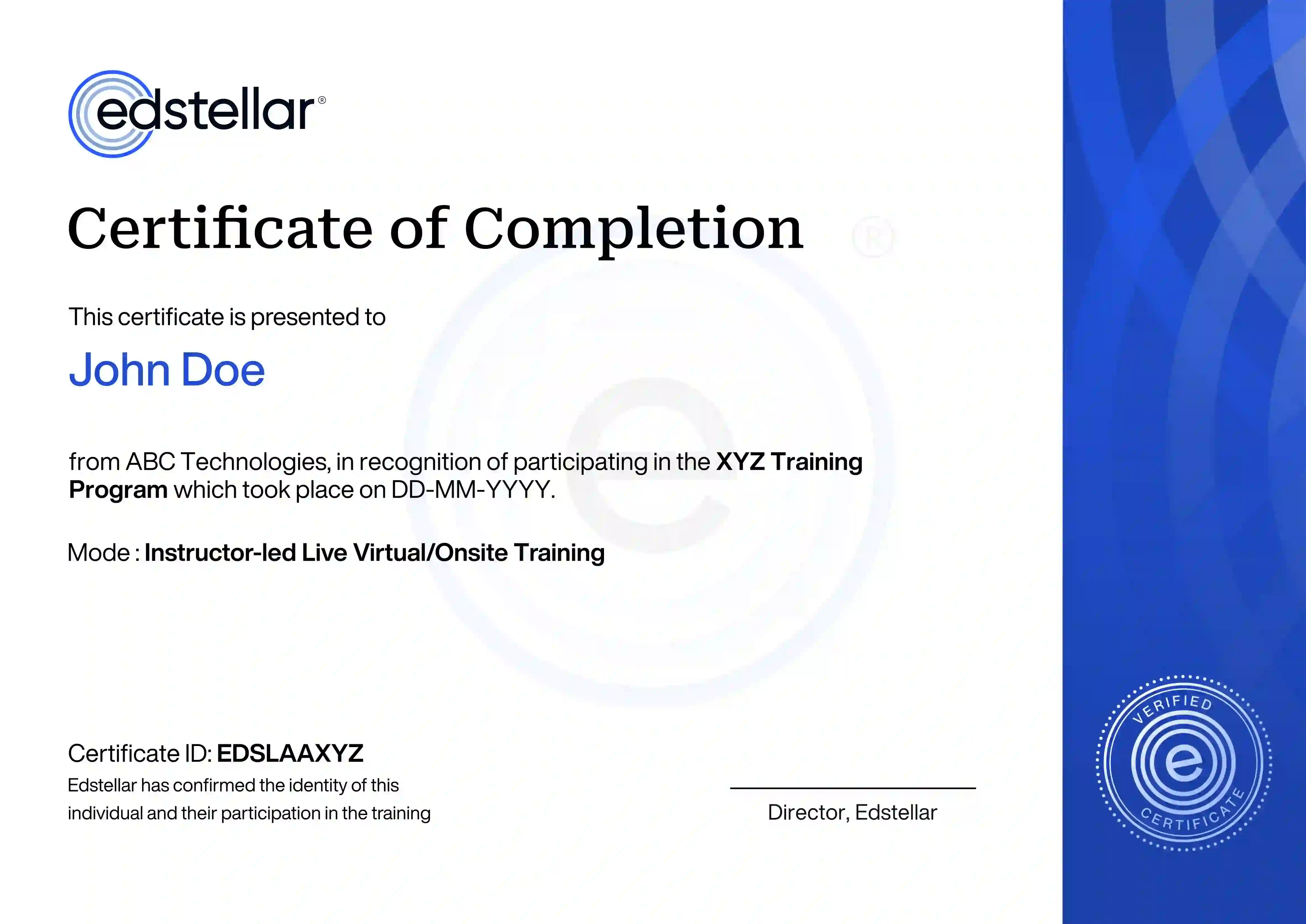
Recognition That Motivates Your Team


Frequently Asked Questions
Explore More Courses


.svg)
.svg)
.svg)

.svg)