.svg "edstellar")

Appium Corporate Training Program for Employees
Give your QA teams the skills to automate mobile app testing on Android and iOS with Appium, through instructor-led corporate training customized to your apps, devices, and release pipeline.

(Virtual / On-site / Off-site)
.svg)
What is Appium? Appium is an open-source, cross-platform test automation framework that lets teams write and run automated functional tests for native, hybrid, and mobile web applications on Android and iOS using a single codebase and the standard W3C WebDriver protocol. For QA and engineering teams, it means automating repetitive mobile testing, catching regressions earlier, and shipping reliable apps faster across devices and operating systems.
As organizations ship mobile apps faster across Android and iOS, this program helps your teams build reliable, maintainable Appium automation suites that cut manual testing effort. Empower your people with expert-led on-site, off-site, and virtual sessions delivered by Edstellar, a premier corporate training provider serving organizations worldwide. Built around your goals, the program turns Appium skills into lasting capabilities that lift performance across QA, mobile development, and DevOps teams.
Delivered instructor-led and fully customized to your mobile stack, the training is available worldwide in person and virtually across popular languages, and covers Appium end to end, including environment setup, the WebDriver protocol, locator strategies, touch actions and gestures, the Page Object Model, and CI/CD integration. Your organization gains faster release cycles, broader device coverage, and engineers who can scale mobile test automation as your app portfolio grows. Request a tailored proposal to align the curriculum with your apps and devices.
.svg)

- Set up and configure the Appium environment, drivers, and real-device, emulator, and simulator test setups.
- Locate mobile elements reliably using accessibility IDs, resource IDs, UISelector, and XPath strategies.
- Automate gestures, touch actions, scrolling, and complex user interactions across Android and iOS.
- Build maintainable test frameworks using the Page Object Model, TestNG or JUnit, and data-driven design.
- Add logging with Log4j, manage dependencies with Maven, and integrate suites into CI/CD pipelines.
- Run cross-platform tests in parallel and on cloud device farms to widen coverage and speed feedback.
- Mobile Test Automation and Appium Foundations
- Mobile testing challenges and the business case for automation
- Appium architecture, the client-server model, and the WebDriver protocol
- Native, hybrid, and mobile web applications explained
- The Appium ecosystem: drivers, Appium Inspector, and supported platforms
- Environment Setup and Configuration
- Installing Appium, the Android SDK, and Xcode/iOS tooling
- Configuring emulators, simulators, and real devices
- Desired capabilities and starting Appium sessions
- Your first automated test and inspecting apps with Appium Inspector
- Locators and Element Interactions
- Locator strategies: accessibility ID, resource ID, XPath, and UISelector
- Finding and inspecting elements with Appium Inspector
- Interacting with text fields, buttons, lists, and menus
- Handling waits, synchronization, and dynamic elements
- Touch Actions, Gestures, and Advanced Interactions
- TouchActions and the W3C Actions API
- Tap, swipe, scroll, drag-and-drop, and multi-touch gestures
- Handling alerts, notifications, and device events
- Hybrid apps and context switching between native and webview
- Test Frameworks, Logging, and Data-Driven Design
- Page Object Model for maintainable mobile tests
- Structuring suites with TestNG or JUnit
- Logging with Log4j and managing dependencies with Maven
- Data-driven and parameterized testing
- Cross-Platform, Parallel, and Cloud Execution
- Sharing code across Android and iOS test suites
- Parallel execution and the Appium and Selenium Grid
- Running tests on cloud device farms such as BrowserStack and Sauce Labs
- Reporting, screenshots, and failure diagnostics
- CI/CD Integration and Framework Building
- Designing a scalable, reusable Appium automation framework
- Integrating tests into CI/CD pipelines with Jenkins and Git
- Managing test data, configuration, and environment profiles
- Best practices for stable, fast, and maintainable mobile suites
- Mobile Testers
- Quality Assurance Analysts
- Test Automation Engineers
- Software Developers
- IT Managers
- DevOps Engineers
- Mobile Application Developers
- System Administrators
- Technical Support Teams
- Product Managers
- Software Engineers
- Test Leads
Participants should be comfortable with basic programming in a language such as Java, JavaScript, or Python, and understand core software testing concepts. Familiarity with mobile apps and the command line is helpful, and prior Selenium or automation experience is a plus but not required, as the program includes guided setup and fundamentals. Edstellar tailors the starting point to your team's experience, so manual testers moving into automation and engineers extending existing suites can both take part productively.


.webp "Virtual Appium Training")
.webp "On-site Appium Training")
.webp "Off-site Appium Training")
64 hours of group training (includes VILT/In-person On-site)
Tailored for SMBs
160 hours of group training (includes VILT/In-person On-site)
Ideal for growing SMBs
Tailor-Made Trainee Licenses with Our Exclusive Training Packages!
400 hours of group training (includes VILT/In-person On-site)
Designed for large corporations
Tailor-Made Trainee Licenses with Our Exclusive Training Packages!
Unlimited duration
Designed for large corporations
Experienced Trainers
Our trainers are drawn from a vetted global network and bring years of industry expertise, keeping every session practical and impactful.
Proven Quality
With a strong global track record, Edstellar is known for quality and engaging delivery.
Industry-Relevant Curriculum
Our programs are built by experts to match the demands of today's industry.
Fully Customizable
Every program can be tailored to your organization's goals.
Comprehensive Support
We provide pre- and post-session support for a complete learning experience.
Global Multi-Location & Multilingual Training Delivery
We deliver in multiple languages to support diverse global teams.
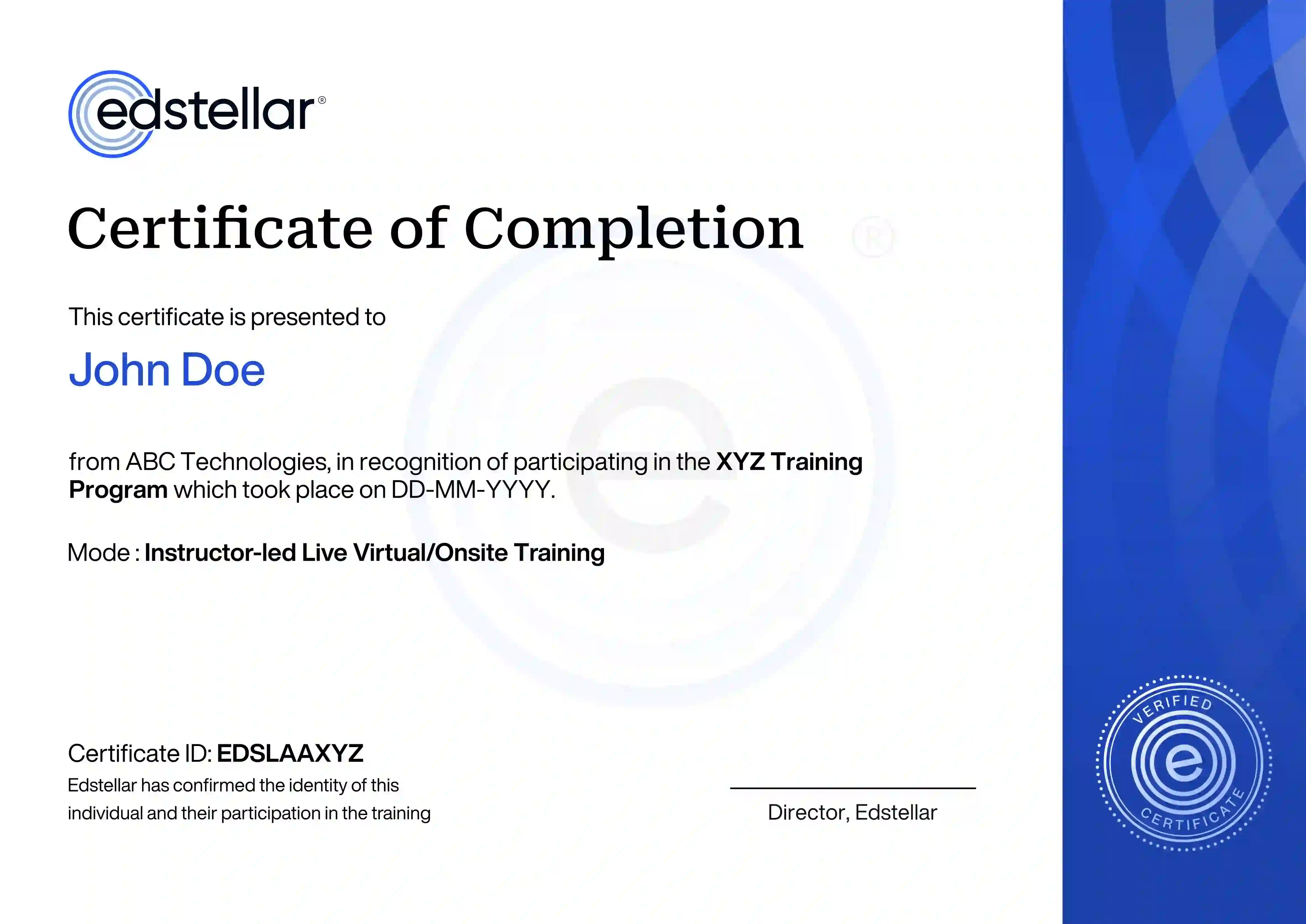
Recognition That Motivates Your Team



Frequently Asked Questions
Other Related Corporate Training Courses


Explore More Courses


.svg)
.svg)
.svg)

.svg)