.svg "edstellar")

Assembly Language Corporate Training Program for Employees
Give your engineering teams the low-level skills to read, write, and optimize Assembly code, unlocking direct control over processors, memory, and performance that high-level languages cannot reach.
(Virtual / On-site / Off-site)
.svg)
Equip Your Engineering Teams to Master System-Level Programming with Assembly
Assembly language is a low-level programming language that maps almost directly to a processor's machine instructions, giving developers precise control over registers, memory, and hardware behavior. Each instruction corresponds closely to a single CPU operation, so engineers can read, write, and optimize code at the exact level the processor executes it. As performance, security, and embedded systems demand finer control than high-level languages provide, teams that understand Assembly language can debug, reverse-engineer, and optimize software where every cycle and byte matters.
As organizations build performance-critical, embedded, and security-sensitive systems, this program helps your teams read, write, and optimize Assembly confidently inside real system-level workflows. Empower your people with expert-led on-site, off-site, and virtual sessions delivered by Edstellar, a premier corporate training provider serving organizations worldwide in-person and virtually across popular languages. Fully customized to your goals, the program turns Assembly language skills into lasting capabilities that lift performance across your systems, embedded, and security engineering teams.
By the end of the program, your team can work confidently with CPU architecture and registers, write and debug Assembly routines, interface Assembly with C, and apply optimization and basic reverse-engineering techniques. The result is faster, leaner software, sharper debugging, and engineers who understand exactly what their code does at the hardware level.
.svg)

- Understand CPU architecture, registers, memory addressing, and the instruction execution cycle that Assembly directly controls.
- Read and write core Assembly instructions, including data movement, arithmetic, logic, control flow, and stack operations.
- Translate between high-level constructs and Assembly, and interface Assembly routines with C and other languages.
- Debug and trace programs at the instruction level using disassemblers, debuggers, and register and memory inspection.
- Apply low-level optimization techniques to improve performance, reduce code size, and use hardware resources efficiently.
- Apply Assembly skills to real tasks such as embedded programming, system calls, and introductory reverse engineering.
- Architecture and Toolchain
- How CPUs execute instructions: fetch, decode, and execute
- Registers, memory, and the role of the instruction set architecture
- Binary and hexadecimal number systems for low-level work
- Assembly syntax, assemblers, and the build, link, and run toolchain
- Instructions and the Stack
- Data movement, addressing modes, and working with registers and memory
- Arithmetic and logical instructions
- Flags, comparisons, and conditional logic
- Working with the stack: push, pop, and stack frames
- Branching and Subroutines
- Jumps, branches, and loops in Assembly
- Defining and calling procedures and subroutines
- Calling conventions and passing parameters
- Recursion and managing the call stack
- Working with Data
- Arrays, indexing, and memory layout
- String operations and efficient string processing techniques
- Advanced string processing and buffer handling
- Structures and working with structured data at the byte level
- Talking to C and the OS
- Calling Assembly from C and C from Assembly
- System calls and interacting with the operating system
- Interrupts, basic I/O, and hardware interaction
- Inline assembly and mixed-language programming
- Analyze and Optimize
- Using debuggers and disassemblers to trace execution
- Reading and understanding compiler-generated Assembly
- Low-level performance optimization and code-size reduction
- Introduction to reverse engineering and analyzing binaries
- Embedded Systems Engineers
- Software Developers
- Computer Science Students
- Firmware Engineers
- System Programmers
- IT Managers
- Hardware Engineers
- Robotics Engineers
- Electronics Engineers
- Performance Engineers
- Technical Support Teams
- System Administrators
Participants should have working programming experience in a high-level language such as C, along with basic familiarity with how computers represent data in binary and hexadecimal. No prior Assembly experience is required; comfort with general programming logic and the command line is sufficient to get the most from the Assembly Language training.


.webp "Virtual Assembly Language Training")
.webp "On-site Assembly Language Training")
.webp "Off-site Assembly Language Training")
64 hours of group training (includes VILT/In-person On-site)
Tailored for SMBs
160 hours of group training (includes VILT/In-person On-site)
Ideal for growing SMBs
Tailor-Made Trainee Licenses with Our Exclusive Training Packages!
400 hours of group training (includes VILT/In-person On-site)
Designed for large corporations
Tailor-Made Trainee Licenses with Our Exclusive Training Packages!
Unlimited duration
Designed for large corporations
Experienced Trainers
Our trainers are drawn from a vetted global network and bring years of industry expertise, keeping every session practical and impactful.
Proven Quality
With a strong global track record, Edstellar is known for quality and engaging delivery.
Industry-Relevant Curriculum
Our programs are built by experts to match the demands of today's industry.
Fully Customizable
Every program can be tailored to your organization's goals.
Comprehensive Support
We provide pre- and post-session support for a complete learning experience.
Global Multi-Location & Multilingual Training Delivery
We deliver in multiple languages to support diverse global teams.
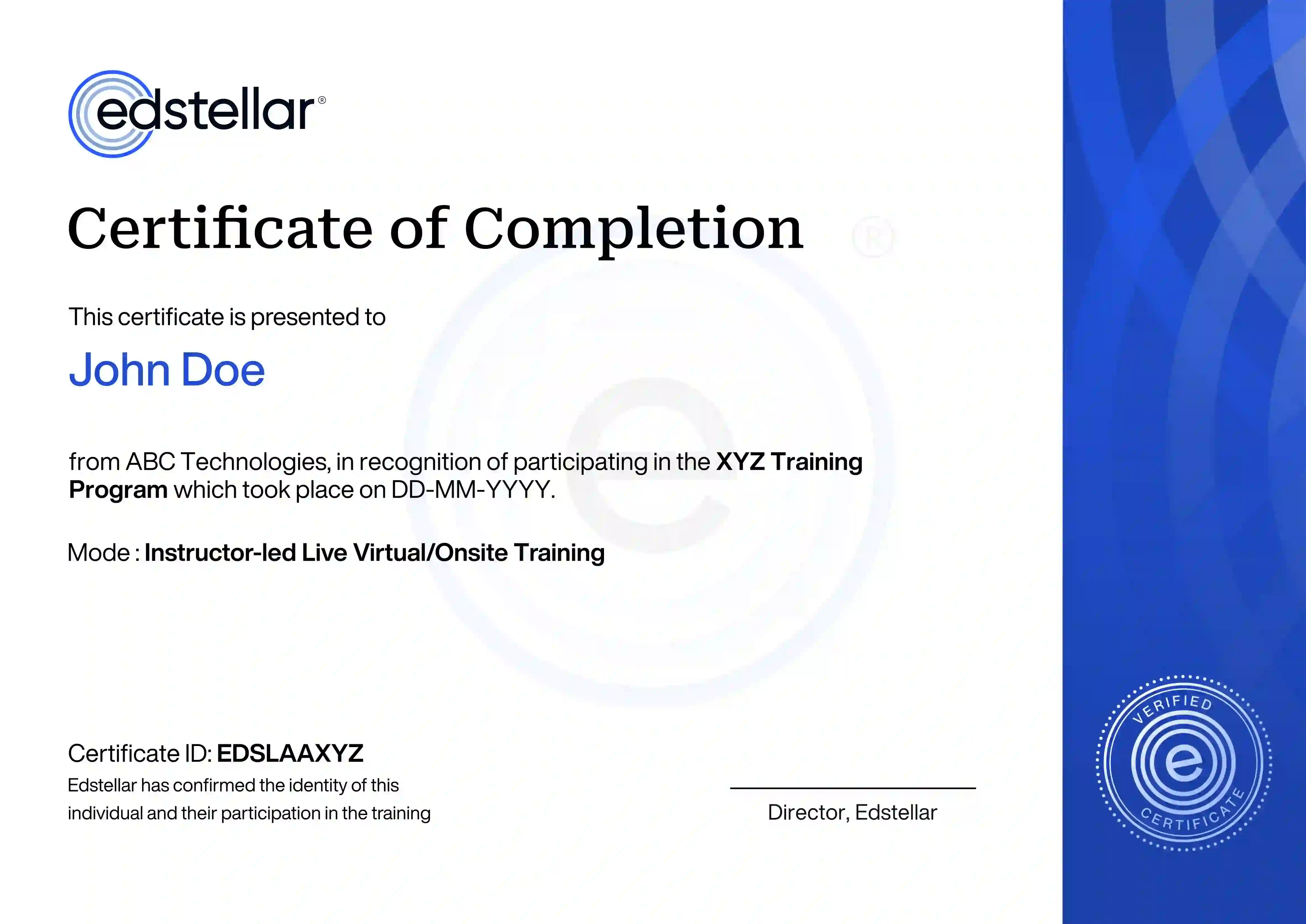
Recognition That Motivates Your Team

Frequently Asked Questions
Other Related Corporate Training Courses


Explore More Courses


.svg)
.svg)
.svg)

.svg)