10 Essential KPIs and Metrics Every CEO Should Track
Content
Table of Content
Most CEOs are not short of numbers; they’re drowning in them. Every board cycle brings thick packs on revenue, EBITDA, profit, and pipeline. Those are essential, but they mostly answer “What happened?” and “Did we hit the plan?” They’re much weaker at answering the questions that actually keep a CEO up at night:
How fragile is this performance?
Where is execution quietly slipping?
What risks are building up that the P&L won’t show for another 3–6 quarters?
McKinsey’s report has repeatedly shown that around 70% of them fail to achieve their stated goals. And the pattern is familiar: it’s rarely because senior teams had the wrong slide deck strategy; it’s because they never built the conditions for execution, ownership, behaviours, cross-functional collaboration, and capabilities to make that strategy real.
Jeff Bezos captured the CEO’s real job in his shareholder letter:
“We will continue to measure our programs and the effectiveness of our investments analytically, to jettison those that do not provide acceptable returns, and to step up our investment in those that work best."
Jeff Bezos
Chairman and Founder, Amazon
That is the point of CEO-level KPIs: not to decorate a dashboard, but to decide what to stop, what to double down on, and where execution risk is compounding out of sight.
This article introduces ten CEO-level KPIs that are deliberately different from the usual finance and sales metrics. They focus on questions like:
Is our EBITDA actually high-quality and repeatable?
How reliable is our free cash flow, quarter after quarter?
Are our strategic bets, talent, and customer base concentrated in ways that quietly increase risk?
Taken together, these KPIs are designed to give CEOs earlier, sharper signals about execution, resilience, and the durability of enterprise value so they can reallocate attention, capital, and leadership before the headline numbers start to crack.
The 10 CEO KPIs That Matter Most
Traditional CEO dashboards focus on lagging metrics that surface problems only after performance is already damaged. The CEO KPIs below act as leading indicators, highlighting execution bottlenecks, capability gaps, customer behaviour shifts, and risk concentration before they show up in the P&L. Together, they give CEOs the visibility needed to steer strategy, allocate capital, and intervene early with confidence.
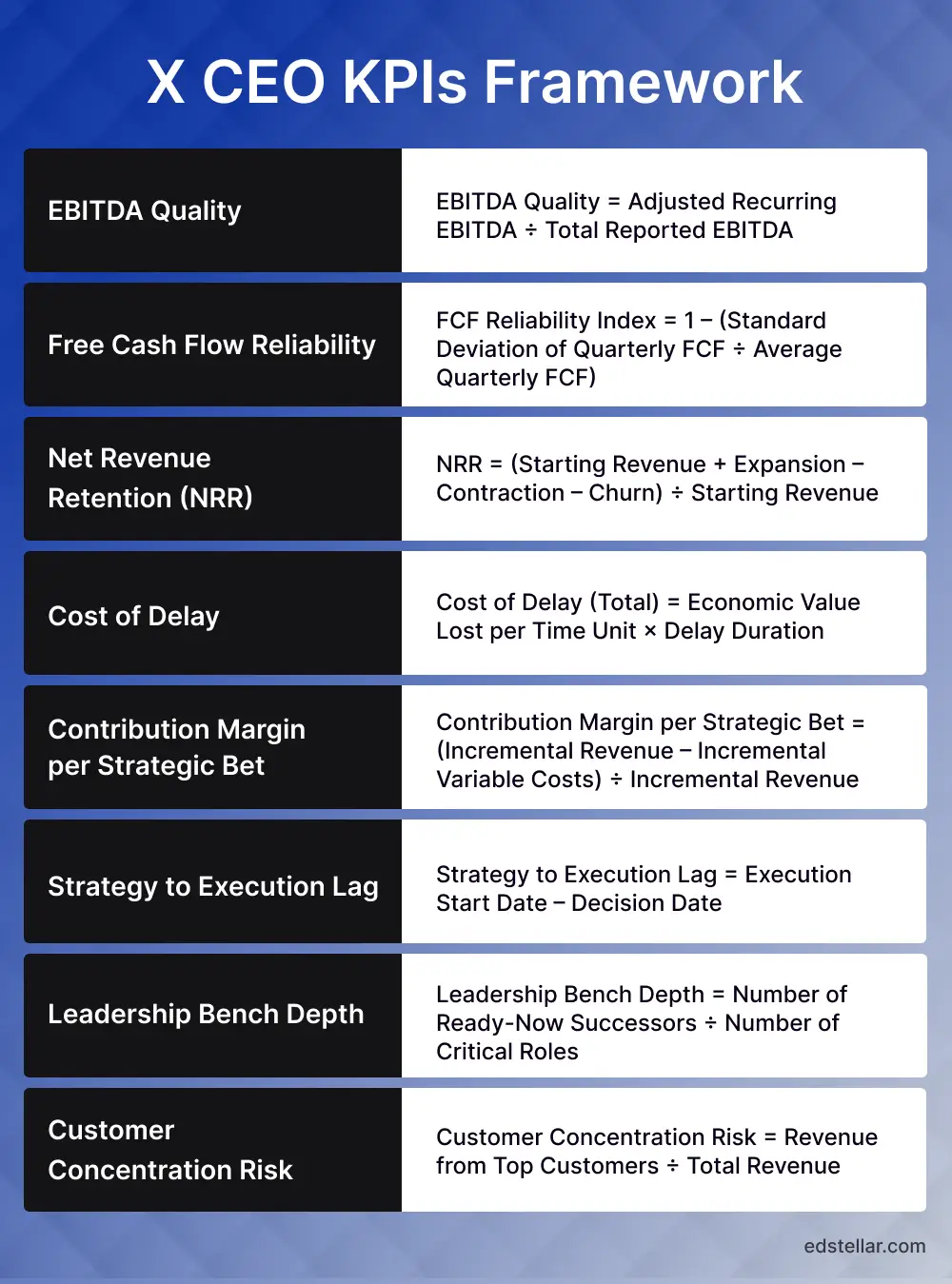
1. EBITDA Quality
EBITDA Quality measures how much of reported EBITDA is recurring, cash-backed, and derived from core operations. It strips out one-time gains, accounting reclassifications, and extraordinary items to show the true strength of the earnings engine.
Formula:
EBITDA Quality = Adjusted Recurring EBITDA ÷ Total Reported EBITDA
Where:
Total Reported EBITDA = EBITDA as reported in financial statements.
Adjusted Recurring EBITDA = EBITDA minus one-offs (e.g., settlements, asset sales, unusual FX gains) and non-operational items, plus any necessary normalizations.
A higher ratio (closer to 1.0) means most EBITDA is recurring and operational.
A lower ratio signals that earnings rely heavily on one-offs or accounting choices.
Headline EBITDA can look strong while the underlying engine is weak. Item-level adjustments reveal how dependable performance really is.
High EBITDA Quality → strong, repeatable earnings and more predictable cash generation.
Implement a quarterly earnings-quality review that:
Separates recurring vs non-recurring EBITDA line by line.
Flags any KPI improvements that are driven mainly by one-off items or accounting changes.
Tracks EBITDA Quality over time as a board-level risk indicator, not just a finance footnote.
2. Free Cash Flow Reliability
Free Cash Flow Reliability measures how stable and predictable free cash flow is over time. It shows whether cash generation comes from steady operations or is overly influenced by timing differences, working capital swings, and one-off items.
Formula:
FCF Reliability Index = 1 – (Standard Deviation of Quarterly FCF ÷ Average Quarterly FCF)
Higher index (closer to 1) = more reliable cash flow.
Lower index = unstable, harder-to-plan cash flow.
High Free Cash Flow Reliability
Cash flows are consistent with plan and less volatile quarter to quarter.
Easier to make long-term commitments and allocate capital with confidence.
Low Free Cash Flow Reliability
Cash flows swing heavily despite similar levels of activity or EBITDA.
Indicates issues in working capital discipline, timing management, or reliance on one-offs rather than a robust cash engine.
CEO-Level Use and Actions:
Review FCF Reliability alongside EBITDA and revenue to avoid being misled by purely P&L-driven KPIs.
Make cash flow predictability, not just total cash, a KPI for business unit and operational leaders.
Tie leadership incentives partly to working capital performance and FCF stability, not only growth metrics.
3. Net Revenue Retention (NRR)
Net Revenue Retention (NRR) measures how much recurring revenue you retain and expand from existing customers only over a period, after accounting for churn and downgrades. It shows whether the current customer base is growing or shrinking in value without counting new logo wins.
Where (for the chosen period, e.g., month or year):
Starting Revenue = Recurring revenue from existing customers at the beginning of the period.
Expansion = Additional revenue from those same customers (upsells, cross-sells, seat increases, price uplift).
Contraction = Revenue reductions from those customers (seat reductions, downgrades, discounts).
Churn = Revenue lost from customers who fully cancel.
NRR > 100% → Existing customers, on average, are expanding. The customer base is a self-reinforcing growth engine
NRR ≈ 100% → Existing customer revenue is broadly flat; growth depends heavily on new sales
NRR 100% → You are losing more revenue from churn/downsells than you gain from expansion; this is an early warning signal, even if topline revenue is still growing
CEO-Level Use and Actions
Track NRR by segment (customer size, industry, product line) to spot where value erosion or saturation is happening.
Use NRR as a board-level indicator of product-market fit durability, customer success effectiveness, and competitive pressure.
Align incentives across sales, CS, and product so they own NRR together, not just new bookings.
4. Cost of Delay
Cost of Delay (CoD) quantifies the economic value you forfeit by delaying a strategic decision, product release, or operational improvement. It makes the trade-off between speed and value explicit, so slow execution carries a visible price tag.
Formula:
Cost of Delay (Total) = Economic Value Lost per Time Unit × Delay Duration
To make that calculable, define: Economic Value Lost per Time Unit (per week or per month, pick one and standardize):
Typically estimated as:
Forecasted incremental profit/cash flow per period
Or risk-adjusted NPV per period for the initiative
Delay Duration = Number of periods (weeks/months) the initiative is postponed beyond the originally required / value-optimal date.
You can then track either or both:
Total Cost of Delay per Initiative (absolute currency)
Portfolio Cost of Delay (sum across top initiatives in a quarter)
High Cost of Delay → A strategic initiative loses significant future value with every week or month of delay. Waiting for perfect clarity costs more than moving forward with a well-reasoned decision.
Low Cost of Delay → The initiative has low time sensitivity, and delaying or resequencing it creates minimal financial impact. Helpful for prioritizing when resources are limited.
CEO-Level Use and Actions
Require major initiatives to quantify the Cost of Delay alongside expected ROI and payback
Use CoD as an input to prioritization: high-CoD items should move earlier in the roadmap and get faster paths through governance
Hold teams accountable not only for delivering scope and ROI, but also for managing delay-driven value erosion
5. Contribution Margin per Strategic Bet
This KPI measures the economic value created by each strategic initiative (“bet”) by looking at how much contribution it generates after variable costs. It lets CEOs see which bets are genuinely accretive and which are just burning capacity.
Formula:
Contribution Margin per Strategic Bet = (Incremental Revenue – Incremental Variable Costs) ÷ Incremental Revenue
Where:
Incremental Revenue = Additional revenue directly attributable to the initiative in the period
Incremental Variable Costs = Variable costs that scale with that revenue (e.g., COGS, delivery costs, success-based commissions)
Use Contribution Margin per Bet to understand the unit economics of each strategic initiative.
Use Contribution per Investment Dollar (if you adopt it) to rank bets by economic output per $ invested.
Low contribution margin or poor contribution per invested dollar signals: Mispriced offerings, bloated delivery models, or misaligned initiatives that are not pulling their economic weight.
CEO-Level Use and Actions:
Review the contribution margin per strategic bet quarterly for all major initiatives
Explicitly compare bets on the same basis (same cost definitions, same time windows)
Redirect budget, capacity, and leadership attention away from chronically low-contribution initiatives into ones with stronger economics
6. Strategy to Execution Lag
Strategy to Execution Lag measures the time gap between when a strategic decision is formally approved and when execution actually starts. It exposes how quickly the organization can translate intent into action.
Formula:
Strategy to Execution Lag = Execution Start Date – Decision Date
Where:
Decision Date = Date on which the strategic decision/initiative is formally approved (e.g., board / ExCom sign-off)
Execution Start Date = Date on which meaningful execution begins (e.g., project kickoff, first deployment, first customer-facing change).
Measure in days or weeks, and track:
Per the major initiative, and
As a median/average lag across all strategic initiatives.
Long Lag → Indicates structural bottlenecks, slow alignment, bureaucracy, or unclear ownership between “decide” and “do”.
Short Lag → Reflects stronger organizational agility and faster conversion of strategic intent into real-world results.
CEO-Level Use and Actions:
Set maximum acceptable lag thresholds for different initiative types (e.g., pricing, product, org changes).
Require reporting of Strategy to Execution Lag on major initiatives and escalate when thresholds are breached.
Use patterns in lag data to pinpoint and fix specific bottlenecks (governance, approvals, handoffs).
7. Leadership Bench Depth
Leadership Bench Depth measures how well critical roles are covered by ready-now successors, indicating how resilient the organization is to leadership transitions.
Formula:
Leadership Bench Depth = Number of Ready-Now Successors ÷ Number of Critical Roles
Where:
Critical Roles = Roles that have disproportionate impact on strategy, revenue, risk, or culture
Ready-Now Successors = Internal candidates assessed as able to step into the role within 0–6 months with minimal disruption
You can also track this by:
Function (e.g., Sales, Operations, Tech)
Level (e.g., C-suite, business unit heads)
Higher Bench Depth → Indicates a strong internal talent pipeline, reduced risk from sudden exits, and smoother transitions for critical roles.
Lower Bench Depth → Signals heavy reliance on a few individuals, higher disruption risk, and longer time-to-fill for key positions.
CEO-Level Use and Actions:
Review bench depth for all critical roles at least annually, ideally quarterly
Tie leadership development, succession planning, and high-potential programs explicitly to improving Leadership Bench Depth
Set minimum coverage thresholds (e.g., at least one ready-now successor per critical role) and flag any gaps for targeted action
8. Customer Concentration Risk
Customer Concentration Risk measures how much of your total revenue is exposed to a small set of top customers (e.g., top 1–5). It shows how vulnerable the company is to a single client’s decisions.
Formula:
Customer Concentration Risk = Revenue from Top Customers ÷ Total Revenue
Where:
Revenue from Top Customers = Combined annual revenue from the top N customers (commonly top 1, top 3, or top 5 by revenue)
Total Revenue = Total annual revenue from all customers
Express this as a percentage (e.g., “Top 5 customers = 42% of total revenue”).
High Concentration → Increases exposure to renewal risk, pricing pressure, and demand shocks. Issues with a single customer can materially affect overall performance.
Lower Concentration → Creates a more diversified and resilient revenue base, offering greater negotiation power and reduced dependency on any single account.
CEO-Level Use and Actions:
Set concentration ceilings (e.g., no single customer >X% of revenue; top 5 <Y%)
Track concentration quarterly by segment and geography
Use this KPI to guide account diversification, pricing strategy, and risk management decisions
9. Talent Flight Risk
Talent Flight Risk estimates the likelihood that high-value employees (e.g., critical roles, top performers, successors) will leave within the next 12 months, based on performance criticality, engagement, tenure patterns, and external demand for their skills.
Reflects where the employee is in typical “move/leave” patterns for the role/market (e.g., just past usual promotion window, long without progression, or at a known churn point)
Market Demand (0–25)
Higher score = stronger external demand and ease of switching (role scarcity, salary gap, active hiring in market)
You can then interpret:
0–30 = Low flight risk
31–60 = Moderate risk
61–100 = High risk
(Adjust thresholds if needed, but keep them explicit.)
Rising Average Talent Flight Risk Score → Signals increasing vulnerability to losing key talent and critical institutional knowledge across pivotal roles.
High Scores in Specific Functions or Locations → Indicate targeted issues related to leadership, culture, workload, or rewards that require focused intervention.
CEO-Level Use and Actions
Track Talent Flight Risk monthly or quarterly for critical roles and top performers
Tie leadership expectations and HR priorities to reducing high-risk scores through development, progression, manager quality, and rewards
Use this KPI alongside Leadership Bench Depth to understand both succession coverage and retention risk in one view
10. Cross-Functional Flow Efficiency
Cross-Functional Flow Efficiency measures the share of total lead time during which work is actively progressing, versus sitting in queues, handoffs, or waiting for approvals, inputs, or resources. It reveals how much of the timeline is true value-creating work vs organizational friction.
Formula:
Flow Efficiency = Active Work Time ÷ Total Lead Time
Where:
Active Work Time = Time when someone is actually working on the task or item.
Total Lead Time = Time from work start to completion, including all waiting, handoffs, and queues.
Express this as a percentage:
Flow Efficiency (%) = (Active Work Time ÷ Total Lead Time) × 100
You can use internal bands such as:
Low Flow Efficiency: < 10%
Medium Flow Efficiency: 10–25%
High Flow Efficiency: > 35%
Low Flow Efficiency → Most of the calendar time is spent waiting rather than working, indicating structural delays rather than workload-related issues.
Higher Flow Efficiency → Achieves faster throughput and improved responsiveness without needing to add more people or extend working hours.
CEO-Level Use and Actions:
Run flow efficiency diagnostics on key cross-functional processes (e.g., product launches, pricing changes, major customer projects)
Simplify approval chains, reduce unnecessary handoffs, and clarify ownership where waiting time is high
Track Flow Efficiency over time as a leading indicator of organizational agility and execution quality
Conclusion
Strategy usually doesn’t fail because the direction is wrong; it fails because leaders can’t see early enough where execution is slowing, where risk is concentrating, and where capability gaps are starting to bite. The ten CEO KPIs in this article shift attention from rear-view financials to the drivers that will shape results over the next few quarters the quality and reliability of earnings, the behaviour of your existing customers and strategic bets, the speed of strategy-to-execution, and the strength of your leadership pipeline and critical talent.
Used together on a single, tightly curated dashboard, these indicators give CEOs a clearer basis for decisions: what to stop, what to accelerate, and where to intervene personally. The goal isn’t to add more reporting noise, but to create one view that makes execution risk, resilience, and value creation visible enough to act on before the P&L starts to crack.
On the capability side of that picture, Edstellar can help you turn these KPIs into concrete action. A structured Skills Matrix gives visibility into the skills and role readiness behind metrics like Leadership Bench Depth and Talent Flight Risk, while Edstellar’s catalog of 2,000+ corporate training programs provides targeted ways to close the gaps you surface, rather than relying on generic learning spend.
Frequently Asked Questions
Why do traditional CEO dashboards fail to provide real visibility?
Traditional CEO dashboards focus heavily on lagging financial metrics such as revenue, EBITDA, and profit. These show outcomes but rarely surface early signs of execution bottlenecks, talent risk, customer concentration, or capability gaps. The CEO KPIs in this article serve as leading indicators, offering earlier visibility into the forces shaping future financial results.
How often should CEOs review these CEO KPIs?
A monthly CEO review works well for most organizations, with some KPIs monitored more frequently by functional leaders. Metrics like Net Revenue Retention (NRR), Flow Efficiency, and Talent Flight Risk often require weekly tracking, while EBITDA Quality, Leadership Bench Depth, and Customer Concentration Risk may be reviewed quarterly.
Can these CEO KPIs be applied across industries?
Yes. Thresholds and benchmarks will differ by industry, but the core logic of these KPIs is universal. Understanding the quality of earnings, reliability of cash, customer value expansion, leadership pipeline strength, and cross-functional execution flow is essential across all sectors.
Are these CEO KPIs meant to replace traditional financial metrics?
No. These KPIs complement traditional financial metrics rather than replace them. Financial statements explain what happened, while CEO KPIs such as EBITDA Quality, Free Cash Flow Reliability, and Cost of Delay help explain why it happened and what is likely to happen next.
Who should own each KPI inside the organization?
Ownership should lie with functional leaders, not just finance. For example, NRR and Customer Concentration Risk are jointly owned by sales, customer success, and product; Leadership Bench Depth and Talent Flight Risk by HR and business leaders; Flow Efficiency and Strategy-to-Execution Lag by operations and program management. The CEO integrates these into a single dashboard and ensures accountability.
How quickly can an organization implement this CEO KPI set?
Most organizations can build an initial version of this CEO KPI dashboard within one or two planning cycles using existing finance, HR, and operations data. Some metrics such as Flow Efficiency, Leadership Bench Depth, and Talent Flight Risk may require more structured definitions and data collection, but perfection is not required to start realizing value.
Explore High-impact instructor-led training for your teams.
Unlock premium resources, tools, and frameworks designed for HR and learning professionals. Our L&D Hub gives you everything needed to elevate your organization's training approach.
.webp)
.svg "edstellar")





.svg)
.svg)
.svg)
.svg)

.svg)


.svg "Click Here to Follow on Medium")
.svg)


