10 Must-Have Skills Every Production Manager Needs
.webp)

.svg "edstellar")

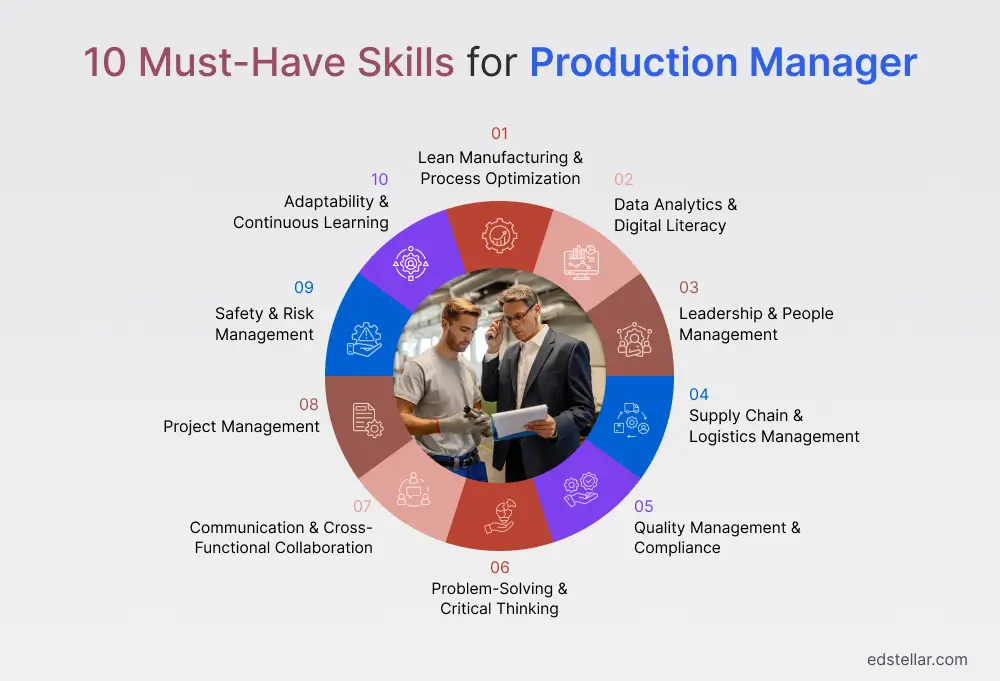
The manufacturing landscape is undergoing a seismic transformation. Production managers are at the epicenter of this challenge, where traditional expertise must converge with emerging technologies and evolving workforce dynamics
The role has expanded far beyond overseeing assembly lines; today’s production managers are strategic orchestrators who balance operational efficiency, technological innovation, and human capital development. With the Bureau of Labor Statistics projecting steady demand for industrial production managers through 2034 and median wages reaching $121,440 annually, the question isn’t whether production management remains vital, but rather which skills separate exceptional leaders from the rest.
“The most fulfilling part of my role is leading a team and seeing the direct impact of process improvements. When we implement a new strategy that enhances efficiency, improves safety, or boosts team morale, it’s rewarding to see the positive outcomes. Everyone is committed to delivering quality work, which makes problem-solving and innovation much more effective."

This comprehensive guide examines the ten essential competencies that define successful production managers in an era where manufacturing excellence demands both technical acumen and strategic vision. Whether you’re aspiring to step into this pivotal role or seeking to elevate your existing capabilities, these skills represent the foundation for driving operational success in modern manufacturing environments.
Lean manufacturing represents far more than a methodology; it embodies a fundamental philosophy that drives competitive advantage in modern production environments. Production managers who master lean principles position their organizations to eliminate waste systematically while maximizing value delivery. The market’s recognition of this imperative is evident: the Lean and Six Sigma services market was valued at $1.6 billion in 2023 and is projected to reach $4.3 billion by 2030, reflecting a 13.6% compound annual growth rate.
The practical impact of lean expertise extends beyond theoretical frameworks. According to ASQ research, organisations implementing Lean Six Sigma report defect reductions of 40–60% and significant cycle time improvements across manufacturing environments.
These improvements translate directly to bottom-line performance through reduced operational costs, improved customer satisfaction, and enhanced market competitiveness.
Production managers must develop proficiency in value stream mapping to identify and eliminate non-value-adding activities. This involves analyzing material and information flow from raw material receipt through finished product delivery, pinpointing bottlenecks, redundancies, and opportunities for improvement. Mastery of the 5S methodology, Sort, Set in Order, Shine, Standardize, Sustain, creates organized workspaces that enhance efficiency and safety while fostering a culture of continuous improvement.
The integration of Kaizen principles empowers production managers to cultivate environments where incremental improvements become embedded in daily operations. Rather than pursuing dramatic overhauls that disrupt production, successful managers facilitate small, continuous enhancements that compound over time. This approach builds organizational resilience and maintains competitive positioning in dynamic markets.
Understanding takt time calculation enables precise alignment between production pace and customer demand, preventing both overproduction waste and delivery delays. Production managers who excel in kanban system implementation establish pull-based production that responds dynamically to actual consumption patterns rather than relying on potentially inaccurate forecasts.
Organizations seeking to develop these critical capabilities find value in structured operations management training that provides practical frameworks for implementing lean principles across diverse manufacturing contexts.
The convergence of manufacturing and information technology has fundamentally redefined production management. Today’s manufacturing floors generate vast quantities of data from sensors, automated systems, and digital interfaces. Production managers must possess the analytical capabilities to transform this data deluge into actionable intelligence that drives operational excellence.
Understanding key performance indicators extends beyond simple metric tracking. Effective production managers establish comprehensive measurement frameworks that capture Overall Equipment Effectiveness (OEE), cycle time variations, quality rates, and resource utilization patterns. They leverage statistical process control to distinguish between normal process variation and signals requiring intervention, preventing both unnecessary adjustments and missed opportunities for improvement.
The World Economic Forum's Future of Jobs Report 2025 projects that nearly 40% of job skills will need to change, with AI and big data, cybersecurity, and technological literacy ranking as the three fastest-growing skill demands globally.
Production managers must develop comfort with Manufacturing Execution Systems (MES), Enterprise Resource Planning (ERP) platforms, and specialized analytics tools that provide real-time visibility into production performance.
Predictive maintenance capabilities exemplify the practical application of data analytics in production management. Rather than adhering to rigid preventive maintenance schedules or reacting to equipment failures, data-savvy managers analyze equipment performance patterns to anticipate maintenance needs. This approach minimizes unplanned downtime while optimizing maintenance resource allocation.
Digital dashboards and visualization tools enable production managers to communicate complex operational data to diverse stakeholders effectively. The ability to present production metrics, trend analyses, and performance comparisons in accessible formats facilitates informed decision-making across organizational levels.
Industry 4.0 technologies, including Internet of Things (IoT) sensors, artificial intelligence, and machine learning algorithms, are transitioning from emerging innovations to standard manufacturing infrastructure. Production managers who develop fluency in these technologies position themselves to lead digital transformation initiatives rather than merely responding to changes imposed from above.
The integration of digital literacy with traditional manufacturing expertise equips production managers to bridge the gap between operational realities and technological possibilities, ensuring that digital investments deliver measurable improvements rather than become costly distractions.
Despite increasing automation, manufacturing remains fundamentally a human endeavor. Production managers must excel at mobilizing, developing, and inspiring diverse teams working under demanding conditions.
A McKinsey analysis cited in the World Economic Forum's 2024 Frontline Talent initiative found that 41% of frontline manufacturing workers cite inadequate total compensation as a driver of attrition and job switching.
Effective leadership in production environments requires balancing operational demands with genuine concern for team member well-being and development. Production managers who invest in skill development, provide meaningful recognition, and create pathways for advancement cultivate engaged workforces that drive superior performance. This extends beyond simple task assignment to encompass coaching, mentoring, and career development planning.
Conflict resolution capabilities prove essential in high-pressure environments where tight deadlines, quality demands, and resource constraints create natural tension points. Skilled production managers address conflicts constructively, viewing disagreements as opportunities to surface underlying issues rather than merely suppressing symptoms. They establish communication norms that encourage respectful dialogue while maintaining focus on operational objectives.
Performance management in production settings requires objective assessment systems that fairly evaluate contributions while identifying development needs. Production managers must provide constructive feedback that motivates improvement without demoralizing team members. This involves celebrating successes, addressing performance gaps promptly, and creating individualized development plans aligned with both organizational needs and personal aspirations.
The multigenerational workforce presents both opportunities and challenges. Production managers must adapt communication styles, motivation approaches, and work structures to accommodate diverse preferences while maintaining cohesive team dynamics. Building psychological safety, where team members feel comfortable raising concerns, suggesting improvements, and admitting mistakes, creates learning environments that continuously enhance performance.
Developing these essential people-management capabilities is supported by comprehensive leadership training programs that provide practical frameworks for inspiring teams and driving organizational success.
Production managers operate within complex supply ecosystems where material availability, vendor performance, and logistics efficiency directly impact manufacturing success. Mastering supply chain dynamics enables proactive management of disruptions and optimizes inventory investments and transportation costs.
Understanding total cost of ownership transforms procurement from simple price comparison to a comprehensive value assessment. Production managers evaluate supplier capabilities across quality consistency, delivery reliability, responsiveness to changes, and long-term partnership potential. They recognize that the lowest-cost supplier may incur hidden costs due to quality issues, delivery delays, or inflexible minimum order quantities.
Inventory management represents a perpetual balancing act between ensuring material availability and minimizing carrying costs. Production managers who grasp Economic Order Quantity principles, safety stock calculations, and reorder point optimization prevent both costly stockouts that halt production and excessive inventory that consumes working capital and warehouse space.
Just-in-time manufacturing approaches reduce inventory waste by synchronizing material deliveries with production schedules. However, this efficiency comes with vulnerability to supply disruptions. Sophisticated production managers develop hybrid approaches that capture JIT benefits while maintaining strategic buffers for critical components with long lead times or unreliable supply chains.
Logistics optimization extends beyond selecting carriers. Production managers coordinate inbound material flow, internal material movement, and outbound product distribution to minimize handling, reduce damage risk, and accelerate throughput. They leverage technology platforms that provide real-time shipment visibility, enabling proactive management of potential delays.
Supplier relationship management evolves from transactional interactions to strategic partnerships. Production managers who cultivate collaborative relationships gain preferential treatment during capacity constraints, early notification of potential issues, and supplier willingness to invest in improvements that benefit both parties. Regular performance reviews, joint improvement initiatives, and transparent communication build trust that withstands inevitable challenges.
According to a 2024 Deloitte and Manufacturing Institute analysis, attracting and retaining talent is the primary business challenge for 65% of U.S. manufacturers a pressure that makes supply chain and cross-functional expertise among the most valued skills on production floors.
Organizations investing in comprehensive supply chain training develop production managers equipped to navigate increasingly complex global supply networks.
Quality excellence distinguishes industry leaders from competitors struggling with returns, warranty claims, and damaged reputations. Production managers serve as quality stewards, establishing systems that prevent defects rather than merely detecting them after occurrence. This proactive orientation requires a deep understanding of quality management principles, statistical tools, and regulatory requirements.
ISO 9001 and related quality management standards provide frameworks for systematic quality assurance. Production managers who implement these standards create documented procedures, establish clear responsibilities, and build continuous improvement mechanisms into daily operations. Certification demonstrates a commitment to quality, reassures customers, and opens doors to markets that require formal quality credentials.
Statistical Process Control (SPC) enables data-driven quality management. Production managers who use control charts, capability analyses, and statistical sampling identify process variations before they produce defective products. This approach minimizes waste, reduces rework costs, and prevents defective products from reaching customers.
Root cause analysis methodologies, including the Five Whys, Fishbone Diagrams, and Failure Mode and Effects Analysis, transform reactive problem-solving into a systematic investigation that addresses underlying issues. Production managers skilled in these techniques prevent recurring problems rather than repeatedly addressing symptoms.
Regulatory compliance requirements vary across industries and markets, but universally demand rigorous attention. Production managers must stay current with evolving regulations affecting their products and processes, implement compliant procedures, maintain required documentation, and prepare for audits. Non-compliance risks range from costly recalls and regulatory penalties to complete market exclusion.
Developing a quality culture is perhaps the most crucial yet challenging responsibility in quality management. Production managers who embed quality consciousness throughout their organizations empower every team member to identify potential issues, suggest improvements, and take ownership for quality outcomes. This cultural foundation proves more sustainable than supervision-dependent approaches that collapse when leadership attention shifts.
Organizations committed to quality excellence provide structured quality management training that equips production managers with essential tools and methodologies for building robust quality systems.
Manufacturing environments face continuous challenges, including equipment malfunctions, quality deviations, supply interruptions, and process inefficiencies. Production managers who excel at systematic problem-solving prevent minor issues from escalating into major disruptions while identifying improvement opportunities others overlook.
Structured problem-solving methodologies provide frameworks that prevent rushed conclusions and superficial fixes. The PDCA (Plan-Do-Check-Act) cycle guides iterative improvement efforts, while DMAIC (Define-Measure-Analyze-Improve-Control) offers a more comprehensive approach to complex challenges. Production managers who internalize these frameworks make better decisions under pressure.
Data-driven decision-making replaces intuition and assumptions with objective evidence. Production managers who gather relevant data, conduct appropriate analyses, and test hypotheses before implementing solutions generate more effective interventions with fewer unintended consequences. This disciplined approach builds credibility and secures stakeholder support for necessary changes.
Systems thinking enables production managers to recognize interconnections that create unintended consequences. A change optimizing one process area may create bottlenecks elsewhere, degrade quality, or increase costs in adjacent operations. Production managers who analyze ripple effects before implementing changes avoid solving one problem while creating others.
Risk assessment capabilities help production managers evaluate potential solutions against multiple criteria, including implementation cost, timeline, disruption risk, expected benefits, and probability of success. This comprehensive evaluation identifies optimal approaches rather than simply choosing the most obvious or politically expedient option.
Creativity and innovation distinguish exceptional problem-solvers from those who only apply standard solutions. Production managers who challenge assumptions, seek diverse perspectives, and experiment with novel approaches discover breakthrough improvements that transform operational performance. They create psychologically safe environments where team members contribute ideas without fear of criticism.
The rapid pace of manufacturing change, combined with increasing complexity, makes problem-solving and critical thinking increasingly valuable differentiators. Production managers who continuously refine these capabilities position themselves as invaluable organizational assets.
Production managers occupy critical nodes in organizational communication networks, receiving information from executive leadership, coordinating with peer functions, and directing production teams. Communication effectiveness directly impacts operational performance, influencing everything from implementation of strategic initiatives to daily production coordination.
Stakeholder management requires tailoring communication to diverse audiences with varying priorities and technical backgrounds. Production managers must translate operational details into strategic implications for executives, coordinate technical specifications with engineering teams, align production schedules with sales commitments, and provide clear direction to production workers. This communication flexibility prevents misalignment, which can lead to costly errors and missed opportunities.
Cross-functional collaboration skills enable production managers to work effectively across organizational boundaries. Manufacturing success depends on coordination with procurement, engineering, quality assurance, logistics, sales, and finance. Production managers who build productive relationships, understand peer objectives, and find mutually beneficial solutions generate superior outcomes compared to those operating in functional silos.
Written communication proficiency is essential for documentation ranging from standard operating procedures and production reports to incident investigations and improvement proposals. Clear, concise writing prevents misinterpretation while creating records that support accountability and knowledge transfer.
Presentation skills enable production managers to advocate effectively for resource investments, explain performance variances, and share best practices. Whether addressing executive leadership, presenting to peer managers, or conducting team meetings, effective presenters organize information logically, use visual aids appropriately, and adapt to audience engagement levels.
Active listening, truly understanding rather than simply waiting to speak, builds trust and surfaces information that might otherwise remain hidden. Production managers who listen attentively to frontline workers often identify opportunities for improvement and potential issues before they affect performance. Similarly, careful attention to customer feedback provides insights that drive meaningful enhancement.
Digital communication platforms add complexity and opportunity to production manager communication responsibilities. Managing email volume, participating in virtual meetings, and using collaboration platforms effectively require discipline and skill development to prevent communication overload while maximizing the benefits of these platforms.
Production managers routinely lead projects ranging from equipment installations and process improvements to new product launches and facility expansions. Project management capabilities enable systematic planning, execution, and control that deliver objectives on time and within budget.
Project scoping and planning establish clear boundaries, deliverables, timelines, and resource requirements. Production managers who invest adequate time in upfront planning identify potential issues, secure the necessary resources, and set realistic expectations, preventing downstream disappointments. Poorly planned projects frequently encounter scope creep, budget overruns, and timeline delays that undermine value delivery.
Resource allocation involves coordinating people, equipment, materials, and budget across competing priorities. Production managers must balance ongoing production demands with project requirements, ensuring neither is adversely affected. This often requires creative solutions such as phased implementations, temporary staffing, or selective outsourcing.
Risk management identifies potential project challenges and establishes mitigation strategies before problems materialize. Production managers who proactively address foreseeable risks, through contingency planning, parallel work streams, or early supplier engagement, minimize disruptions and maintain project momentum.
Stakeholder engagement throughout project lifecycles ensures alignment and secures ongoing support. Production managers provide regular progress updates, address emerging concerns promptly, and involve key stakeholders in critical decisions. This transparency builds trust and facilitates rapid problem resolution when challenges arise.
Agile methodologies offer alternatives to traditional waterfall project management, emphasizing iterative development, continuous stakeholder feedback, and adaptive planning. Production managers familiar with agile approaches can apply these principles to manufacturing projects where requirements evolve or learning emerges during implementation.
Project closure activities, including documentation, lessons-learned capture, and formal handoffs, often receive insufficient attention despite their importance to organizational learning. Effective production managers ensure projects conclude successfully, preserving knowledge for future initiatives and confirming the realization of benefits.
Manufacturing environments present inherent risks that demand unwavering attention to safety. Production managers are responsible for creating workplace conditions that protect team members from injury, ensure regulatory compliance, and minimize operational disruptions from incidents.
OSHA regulations and industry-specific safety standards establish minimum requirements that production managers must meet. However, safety excellence extends beyond compliance to encompass proactive hazard identification, comprehensive training, and cultural commitment to protecting every team member. Organizations with strong safety cultures typically demonstrate superior operational performance across multiple dimensions, recognizing that attention to safety reflects broader operational discipline.
Risk assessment methodologies enable systematic evaluation of workplace hazards. Production managers conducting Job Hazard Analyses identify task-specific risks and implement appropriate controls, elimination, substitution, engineering controls, administrative controls, or personal protective equipment. This hierarchical approach prioritizes more effective interventions over those requiring ongoing compliance.
Incident investigation processes determine root causes and prevent recurrence. Production managers who treat incidents as learning opportunities rather than occasions for blame cultivate environments in which team members report near misses and safety concerns without fear. This transparency enables proactive intervention before serious injuries occur.
Emergency preparedness encompasses planning for fires, chemical releases, severe weather, and other potential crises. Production managers develop response procedures, conduct regular drills, maintain emergency equipment, and train team members in their roles during emergencies. Effective preparation minimizes harm and accelerates recovery when incidents occur.
Safety training extends beyond initial orientations to include ongoing skill development, procedure updates, and hazard awareness. Production managers who invest in comprehensive training demonstrate a commitment to team members' well-being while building capabilities that help prevent costly incidents.
Occupational health considerations address long-term exposure risks, including repetitive motion injuries, noise-induced hearing loss, and chemical exposures. Production managers implementing ergonomic improvements, exposure monitoring, and health surveillance programs protect team members from subtle but serious health impacts.
The accelerating pace of manufacturing change renders static skill sets obsolete. LinkedIn's 2025 research projects that 70% of the skills used in most jobs will change by 2030, driven largely by AI adoption and automation with manufacturing roles facing particularly rapid transformation. Production managers who embrace continuous learning and demonstrate adaptability position themselves for sustained career success.
Technology adoption represents the most visible manifestation of required adaptability. Emerging technologies, including artificial intelligence, advanced robotics, additive manufacturing, and augmented reality, are reshaping production processes. Production managers who approach new technologies with curiosity rather than resistance discover opportunities to enhance capability and competitive positioning.
Industry trend awareness enables proactive positioning rather than reactive scrambling. Production managers who monitor emerging best practices, regulatory developments, competitive moves, and shifts in customer preferences anticipate changes that affect their operations. They participate in professional associations, attend industry conferences, and engage with thought leadership that expands perspective.
Learning agility, the capacity to extract lessons from experience and apply them to novel situations, increasingly differentiates high-potential managers from those plateauing in their development. Production managers who reflect on successes and failures, actively seek feedback, and continuously experiment with new approaches expand their effectiveness.
Growth mindset versus fixed mindset fundamentally shapes how production managers respond to challenges and setbacks. Those viewing abilities as developable through effort persist through difficulties and view feedback as helpful input. In contrast, fixed mindset individuals interpret struggles as evidence of inadequacy and avoid situations where they might appear incompetent. Manufacturing’s demanding environment rewards the resilience that growth mindsets enable.
Mentorship and knowledge sharing accelerate learning while strengthening organizational capability. Production managers who seek mentors for their own development while mentoring others create networks that multiply their impact. They document lessons learned, share best practices, and contribute to the organization's collective intelligence.
Professional development investments demonstrate commitment to continuous improvement. Whether pursuing formal certifications, attending training programs, or engaging in structured self-study, production managers who prioritize skill development remain relevant in an evolving manufacturing landscape. Organizations that support this development through training opportunities, tuition reimbursement, and dedicated learning time generate returns through enhanced capabilities and improved retention.
The role of production manager has evolved into a sophisticated blend of technical expertise, business acumen, and leadership capability. The ten skills examined throughout this guide represent essential competencies for driving manufacturing excellence in increasingly complex and competitive environments. From lean manufacturing principles that eliminate waste to adaptability that enables continuous evolution, these capabilities separate exceptional production managers from those merely maintaining status quo.
The quantitative imperative is clear: with 75% of organizations struggling to fill critical roles due to skills gaps, and with manufacturing facing potential shortfalls of 1.9 million workers by 2033, developing these ten essential skills is both a personal career investment and an organizational necessity. Production managers who systematically develop these competencies position themselves as invaluable assets, contributing to organizational resilience and competitive success.
Yet skill development rarely occurs in isolation. Structured learning experiences, combined with practical application and continuous refinement, accelerate capability building and ensure comprehensive competency development. Organizations committed to manufacturing excellence recognize that investing in production manager development generates measurable returns through improved operational performance, enhanced quality, and increased innovation.
Edstellar’s comprehensive corporate training solutions address the full spectrum of production manager skill requirements. From specialized operations management training that builds process-optimization capabilities to leadership development programs that cultivate people-management excellence, our instructor-led courses provide practical frameworks for real-world manufacturing challenges. Our flexible delivery options, both onsite and virtual, ensure training accessibility regardless of operational constraints or geographic distribution.
The manufacturing sector’s transformation presents both challenges and opportunities. Production managers who proactively develop the ten skills outlined in this guide position themselves to lead rather than follow industry evolution. Whether you’re early in your production management journey or seeking to elevate existing capabilities, systematic skill development represents the surest path to sustained success in this dynamic field.
Ready to develop these essential production manager skills within your organization? Contact Edstellar today to explore customized training solutions designed around your specific operational context and development objectives. Our experienced instructors and proven methodologies help transform production managers into strategic leaders, driving manufacturing excellence.
#On-site #Virtual #GroupTraining #Customized
Explore 2000+ industry ready instructor-led training programs.

Create dynamic leaders and cohesive teams. Learn more now!

Do a quick Skill gap analysis with Edstellar’s Free Skill Matrix tool

Unlock premium resources, tools, and frameworks designed for HR and learning professionals. Our L&D Hub gives you everything needed to elevate your organization's training approach.
Access L&D Hub Resources.svg)
.svg)
.svg)
.svg)

.svg)


.svg "Click Here to Follow on Medium")
.svg)


