Corporate Kali Linux Training Course
Edstellar's instructor-led Kali Linux training course empowers teams with essential cybersecurity skills. The training promotes a team capable of safeguarding digital assets and responding to cyber threats. Upskill professionals emerge with practical expertise in Kali Linux tools, enhancing their ability to secure networks.
(Virtual / On-site / Off-site)
Available Languages
English, Español, 普通话, Deutsch, العربية, Português, हिंदी, Français, 日本語 and Italiano
Drive Team Excellence with Kali Linux Corporate Training
Kali Linux, a Debian-based distribution, is designed for advanced Penetration Testing and Security Auditing, offering essential tools for ethical hacking, vulnerability assessment, and network security. It's crucial for organizations looking to fortify their digital defenses, providing a platform for security professionals to test and enhance systems. This training equips teams with expertise in Kali Linux, empowering them to secure systems, prevent cyber attacks, and maintain a proactive security posture.
Edstellar's Kali Linux training course provides virtual/onsite sessions tailored to organizational needs. Our emphasis on practical, hands-on exercises ensures professionals gain real-world expertise, enhancing their ability to apply Kali Linux tools effectively. Edstellar stands out with a customized curriculum, addressing specific industry challenges and promoting a dynamic, engaged learning environment.

Skills Your Employees Will Gain
These are the core, hands-on capabilities your team builds during the program.
- Penetration testingPenetration Testing is the practice of simulating cyberattacks to identify vulnerabilities in systems. this skill is important for cybersecurity roles to enhance security measures and protect sensitive data.
- Network ReconnaissanceNetwork Reconnaissance is the process of gathering information about a network to identify vulnerabilities and potential entry points. This skill is important for cybersecurity roles, as it helps professionals proactively defend against threats and enhance network security.
- Exploitation techniquesExploitation Techniques involve identifying and leveraging vulnerabilities in systems or software. This skill is important for cybersecurity roles to protect against breaches and enhance security measures.
- Vulnerability AssessmentVulnerability Assessment is the process of identifying, quantifying, and prioritizing vulnerabilities in systems. this skill is important for cybersecurity roles, as it helps protect sensitive data and mitigate risks.
- Web application testingWeb Application Testing involves evaluating the functionality, security, and performance of web applications. This skill is important for developers and QA testers to ensure reliable, user-friendly, and secure applications.
- Wireless network auditingWireless Network Auditing involves assessing and securing wireless networks to identify vulnerabilities and ensure compliance. This skill is important for IT security roles, as it protects sensitive data and enhances network reliability.
What Your Team Will Achieve After This Training
- Employ advanced penetration testing techniques to identify and exploit vulnerabilities in diverse applications and networks
- Execute comprehensive security assessments using Kali Linux tools, enhancing the team's ability to address potential threats proactively
- Develop robust cybersecurity strategies by applying practical knowledge from hands-on experience in ethical hacking scenarios
- Utilize Kali Linux for effective incident response, rapidly identifying and mitigating security breaches to minimize potential damage
- Implement secure coding practices, integrating Kali Linux insights to fortify applications against evolving cyber threats
- Promote a proactive cybersecurity culture within the team, leveraging Kali Linux training to adapt and strengthen defenses continuously
- Enhance digital forensics skills, enabling teams to investigate and respond to cyber incidents with high proficiency
Topics & Program Outline
The curriculum is organized into focused modules built by industry experts and delivered virtually or on-premise. Interactive sessions reflect the evolving demands of the workplace, keeping the learning both relevant and practical.
- Overview of Kali Linux
- Purpose and evolution
- Key features and capabilities
- Installation and setup
- System requirements
- step-by-step installation process
- GUI and terminal navigation
- User interface exploration
- Command-line basics
- File system exploration
- Understanding file structures
- Navigating directories
- Definition and scope of penetration testing
- Key objectives
- Ethical and legal considerations
- Methodologies in practice
- Common steps and procedures
- Real-world case studies
- Testing types
- Black box, white box, gray box
- Hybrid approaches
- Customized testing scenarios
- Tailoring tests to specific needs
- Industry-specific applications
- Types of penetration testing
- Black box testing
- White box testing
- Gray box testing
- Selection criteria
- Choosing the right testing type
- Considerations for different scenarios
- Hybrid approaches
- Combining testing types
- Practical implementations
- Customized testing scenarios
- Adapting methods to specific needs
- Industry-specific examples
- Advanced techniques overview
- Zero-day exploits
- Social engineering mastery
- Cryptographic Applications
- Encryption/decryption methods
- Exploiting cryptographic weaknesses
- Exploitation strategies
- Identifying targets
- Developing advanced attack plans
- Real-world applications
- Case studies
- Advanced scenarios and solutions
- Gathering intelligence
- Open-source Intelligence (OSINT)
- Information gathering tools
- Footprinting and reconnaissance
- Identifying assets
- Techniques for effective footprinting
- Passive and active reconnaissance
- Methods for passive data collection
- Active reconnaissance techniques
- Application in penetration testing
- Utilizing information in testing
- Integrating data into strategies
- Network scanning
- Types and purposes
- Identifying open ports
- Host discovery
- Live host identification
- Effective scanning techniques
- Scanning tools in Kali Linux
- Nmap and its applications
- Utilizing wireshark for analysis
- Automated scanning techniques
- Scripting with bash and python
- Using automated scanning tools
- Introduction to vulnerability assessment
- Identifying system weaknesses
- Significance in cybersecurity
- Popular vulnerability scanning tools
- Nessus and openvas
- Conducting assessments with qualys
- Customizing assessments
- Target-specific vulnerability scans
- Fine-tuning scans for accuracy
- Interpreting assessment reports
- Analyzing results
- Prioritizing and addressing vulnerabilities
- Enumeration essentials
- Extracting information from systems
- User enumeration techniques
- Service enumeration
- Identifying running services
- Enumerating system services
- Automated enumeration tools
- Using Enum4linux and Enum windows
- Streamlining enumeration processes
- Challenges and solutions in enumeration
- Overcoming common enumeration issues
- Enhancing enumeration efficiency
- Exploitation concepts
- Identifying and exploiting vulnerabilities
- gaining unauthorized access
- Exploitation frameworks
- Framework overview
- Framework application in attacks
- Post-Exploitation techniques
- Privilege escalation
- Maintaining persistent access
- Defense against exploitation
- Implementing security measures
- Patch management and vulnerability mitigation
- Fundamentals of exploit writing
- Understanding exploits
- Creating simple exploits
- Advanced exploit development
- Expanding exploit capabilities
- Real-world exploit applications
- Exploit writing tools in Kali Linux
- Using Metasploit for Exploitation
- Customizing exploits for specific targets
- Analyzing exploits
- Reverse engineering exploits
- Vulnerability research and discovery
- Privilege escalation basics
- Elevating user privileges
- Exploiting privilege vulnerabilities
- Techniques for privilege escalation
- Common methods
- Mitigation strategies
- Post-exploitation scenarios
- Maintaining persistent access
- Avoiding detection during privilege escalation
- Case studies in privilege escalation
- Real-world examples
- Analyzing notable security incidents
- Access maintenance strategies
- Persistence Mechanisms
- Backdoors and rootkits
- Evading detection
- Anti-forensic techniques
- Stealthy access methods
- Post-exploitation considerations
- Monitoring and controlling compromised systems
- Risk mitigation strategies
- Ethical implications of maintaining access
- Balancing security practices with ethical Standards
- Responsible disclosure of vulnerabilities
- Advanced sniffing techniques
- Packet analysis
- Man-in-the-middle attacks
- Protocol-based sniffing
- Exploiting protocol weaknesses
- Intercepting and analyzing traffic
- Wireless sniffing
- Analyzing wireless traffic
- Identifying vulnerabilities in wireless protocols
- Defending against sniffing attacks
- Implementing encryption and secure protocols
- Network monitoring and intrusion detection
- Understanding DOS attacks
- Types of denial-of-service attacks
- Impact and mitigation
- DOS attack tools
- Overview of tools
- Conducting DOS simulations
- Mitigation strategies
- Defending against DOS attacks
- Implementing resilient network architectures
- Legal and ethical considerations
- Compliance with regulations
- Ethical use of DOS attack techniques
- Web application testing techniques
- Identifying web vulnerabilities
- Assessing web security
- Exploiting web vulnerabilities
- Injection attacks
- Cross-Site Scripting (XSS) and Cross-Site Request Forgery (CSRF)
- Web Application testing tools
- Burp suite and oWASP zap
- Automated testing with Nikto
- Web security best practices
- Secure coding guidelines
- Web Application Firewall (WAF) implementations
- Techniques for Wireless Network Penetration
- Wireless security protocols
- Exploiting wireless vulnerabilities
- Wireless tools in Kali Linux
- Scanning and analyzing wireless networks
- Exploiting weaknesses in wireless security
- Security measures for wireless networks
- Implementing WPA3 and enterprise-level security
- Wireless Intrusion Prevention Systems (WIPS)
- Exploit concepts
- Understanding exploits
- Categories of exploits
- Client-side attack techniques
- Social engineering
- Browser exploits
- Exploiting client vulnerabilities
- Malicious payload delivery
- Drive-by downloads
- Defense mechanisms
- Antivirus and endpoint protection
- Best practices for mitigation
- Introduction to Social Engineering Toolkit (SET)
- Overview and purpose
- Installation and setup
- Social engineering attacks
- phishing
- Spear phishing
- Credential harvesting
- Password attacks
- Credential theft techniques
- Case studies
- Real-world examples
- Analyzing social engineering scenarios
- Importance of firewall testing
- Securing networks with firewalls
- Limitations and Weaknesses
- Firewall evasion techniques
- Application layer attacks
- Bypassing packet filtering
- Testing tools in Kali Linux
- Firewall testing utilities
- Assessing firewall rules
- Best Practices for firewall security
- Configuring effective firewall policies
- Monitoring and auditing
- Importance of documentation
- Logging and record-keeping
- Compliance requirements
- Report generation
- Documenting test findings
- Communicating results effectively
- Case study analysis
- Reviewing sample reports
- Improving reporting practices
- Continuous improvement
- Feedback and iterative enhancements
- Implementing lessons learned
- Data collection in cybersecurity
- Importance of data collection
- Logging and monitoring
- Evidence management
- Preserving digital evidence
- Chain of custody
- Reporting in incident response
- Documenting incident details
- Communicating findings to stakeholders
- Legal and ethical considerations
- Compliance with privacy laws
- Ethical reporting practices
Who Should Attend?
This program suits professionals at many levels across the organization, including:
- Security Engineers
- Ethical Hackers
- Penetration Testers
- IT Technicians
- Security Analysts
- System Administrators
- Cybersecurity Engineers
- Network Engineers
- Linux Administrators
- System Engineers
- Technical Support Engineers
- Managers
What are the Prerequisites?
Professionals should have a basic understanding of computer networks, operating systems, and fundamental cybersecurity concepts to take the Kali Linux training course.
Choose the Format That Fits Your Team
We design training your teams actually engage with, and deliver it the way that suits you best. Through a vetted global trainer network, Edstellar runs sessions in 10+ languages with consistent quality anywhere.


.webp)
Virtual / online: expert-led live sessions delivered anywhere, with consistency and easy scheduling.
.webp)
On-site (in-house): immersive, instructor-led learning at your office.
.webp)
Off-site: focused, instructor-led group learning away from everyday workplace distractions.
Get a Proposal Shaped to Your Needs
Need pricing for onsite, offsite, or virtual delivery? Get a proposal tailored to your team's needs.
64 hours of group training (includes VILT/In-person On-site)
Tailored for SMBs
Tailor-Made Trainee Licenses with Our Exclusive Training Packages!
160 hours of group training (includes VILT/In-person On-site)
Ideal for growing SMBs
Tailor-Made Trainee Licenses with Our Exclusive Training Packages!
400 hours of group training (includes VILT/In-person On-site)
Designed for large corporations
Tailor-Made Trainee Licenses with Our Exclusive Training Packages!
Unlimited duration
Designed for large corporations
What Sets Edstellar Apart
Experienced Trainers
Our trainers are drawn from a vetted global network and bring years of industry expertise, keeping every session practical and impactful.
Proven Quality
With a strong global track record, Edstellar is known for quality and engaging delivery.
Industry-Relevant Curriculum
Our programs are built by experts to match the demands of today's industry.
Fully Customizable
Every program can be tailored to your organization's goals.
Comprehensive Support
We provide pre- and post-session support for a complete learning experience.
Global Multi-Location & Multilingual Training Delivery
We deliver in multiple languages to support diverse global teams.
Hear from Organizations We've Trained
"Attending the Kali Linux training was transformational for my professional development. As a Principal Mobile Architect, the deep dive into advanced methodologies gave me the confidence to tackle complex challenges head-on. of hands-on exercises were immediately applicable to my work. My productivity and technical capabilities have increased dramatically since applying these concepts. This course has become foundational to my continued success.”
Harley Hawkins
Principal Mobile Architect,
Technology Consulting Services Company
"The Kali Linux training enhanced my ability to architect and implement sophisticated professional expertise strategies. Understanding industry best practices through intensive interactive labs exercises proved invaluable for organizational initiatives. Our project success rate and profitability increased dramatically within the quarter. The detailed exploration of expert-led workshops provided methodologies I leverage in every engagement.”
Martin Sanchez
Senior Frontend Engineer,
Global Technology Solutions Provider
"As a Lead Flutter Developer leading technical mastery operations, the Kali Linux training provided our team with essential practical applications expertise at scale. The comprehensive modules on practical simulations complete operational footprint. Our team delivered record-breaking results in the subsequent quarter, exceeding all targets. This course has proven invaluable for driving our organizational transformation and sustained excellence.”
Usha Ganguly
Lead Flutter Developer,
Enterprise Software Development Firm
“Edstellar’s IT & Technical training programs have been instrumental in strengthening our engineering teams and building future-ready capabilities. The hands-on approach, practical cloud scenarios, and expert guidance helped our teams improve technical depth, problem-solving skills, and execution across multiple projects. We’re excited to extend more of these impactful programs to other business units.”
Aditi Rao
L&D Head,
A Global Technology Company
Recognition That Motivates Your Team
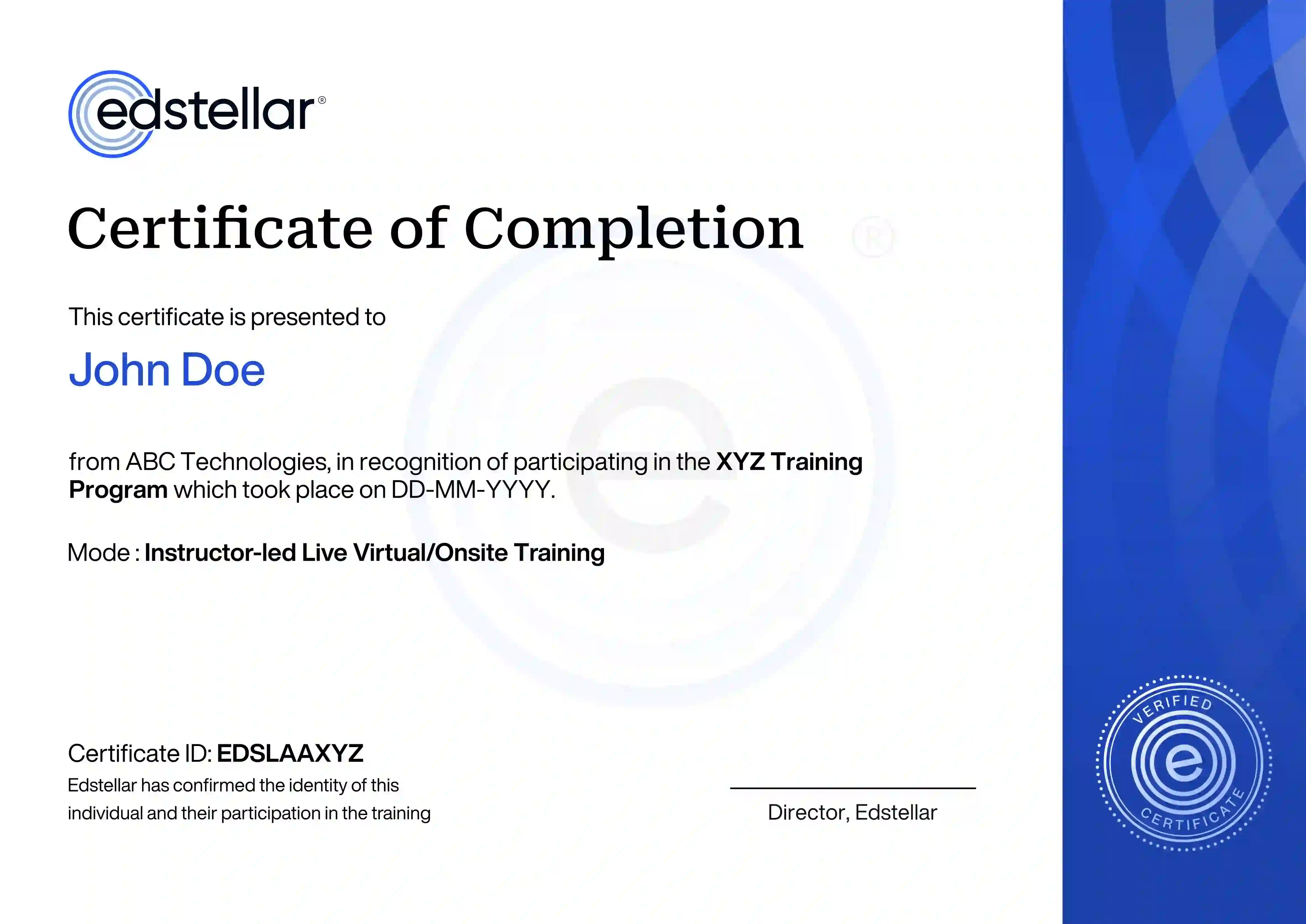
Upon successful completion of the training course offered by Edstellar, employees receive a course completion certificate, symbolizing their dedication to ongoing learning and professional development.
This certificate validates the employee's acquired skills and is a powerful motivator, inspiring them to enhance their expertise further and contribute effectively to organizational success.


Other Related Corporate Training Courses
Explore More Courses
Edstellar is a one-stop instructor-led corporate training and coaching solution that addresses organizational upskilling and talent transformation needs globally.
Marketing Excellence
Operational Excellence
Finance Excellence
HR Excellence
IT Excellence
Customer Service
Leadership Excellence
Quality Management
Software
How it WorksFAQ'sCorporate Training
CatalogStellar AI
Skill MatrixHRMS Integration
Who we ServeCEO RetreatsPricingTraining DeliveryPartner with Edstellar
CareersContact us