Corporate Project Finance Training Course
Edstellar's instructor-led Project Finance training course empowers teams with financial structuring, risk management, and analytical skills to achieve strategic investment optimization for the organization. The course equips employees to structure and secure project financing, analyze project viability, and develop financial models.
(Virtual / On-site / Off-site)
Available Languages
English, Español, 普通话, Deutsch, العربية, Português, हिंदी, Français, 日本語 and Italiano
Drive Team Excellence with Project Finance Corporate Training
Project Finance is a financing method where the lender relies primarily on the revenues generated by a single project as the source of repayment and security. This approach is vital for organizations undertaking large-scale projects as it allows for significant investments without impacting the company's balance sheet, enabling better risk management and financial stability. Project Finance training course provides employees with the skills to structure and secure project financing, analyze project viability, develop financial models, and navigate regulatory frameworks.
Edstellar's instructor-led Project Finance training course provides virtual/onsite formats tailored to organizational needs. The course is delivered by industry experts with years of practical experience. The training is essential for organizations to build a skilled finance team capable of managing large-scale projects efficiently.

Skills Your Employees Will Gain
These are the core, hands-on capabilities your team builds during the program.
- Financial ModelingFinancial Modeling is the process of creating a numerical representation of a company's financial performance. This skill is important for roles in finance, investment banking, and corporate strategy, as it aids in decision-making and forecasting.
- Capital StructuringCapital Structuring is the process of determining the optimal mix of debt and equity financing for a business. This skill is important for financial analysts and investment bankers, as it ensures efficient funding, risk management, and maximized returns.
- Cash Flow AnalysisCash Flow Analysis is the process of tracking and evaluating cash inflows and outflows to ensure financial stability. this skill is important for finance roles, as it aids in budgeting, forecasting, and strategic decision-making.
- Contract NegotiationContract Negotiation is the process of discussing terms and conditions to reach a mutually beneficial agreement. This skill is important for roles in legal, procurement, and management, as it ensures favorable terms, minimizes risks, and fosters strong business relationships.
- Project ValuationProject Valuation is the process of assessing the worth of a project through financial metrics. This skill is important for roles in finance and project management, ensuring informed investment decisions.
- Debt FinancingDebt Financing is the process of raising capital through borrowing, typically via loans or bonds. This skill is important for financial analysts and investment bankers to assess risks, structure deals, and optimize funding strategies.
What Your Team Will Achieve After This Training
- Apply advanced financial modeling techniques to develop project finance models
- Analyze project viability by assessing financial, technical, and market risks
- Develop comprehensive financial plans and forecasts to support strategic decision-making
- Implement risk mitigation strategies to manage and minimize project risks effectively
- Evaluate regulatory and compliance requirements to ensure project adherence to legal standards
Topics & Program Outline
The curriculum is organized into focused modules built by industry experts and delivered virtually or on-premise. Interactive sessions reflect the evolving demands of the workplace, keeping the learning both relevant and practical.
- Definition and key characteristics of project finance
- Detailed definition of project finance
- Key principles and characteristics
- Historical background and evolution of project finance
- Advantages and disadvantages of project finance
- Benefits to organizations and stakeholders
- Common challenges and limitations
- Project finance vs. corporate finance
- Key differences and similarities
- Scenarios where each is applicable
- Comparative analysis with examples
- Project finance life cycle and key stakeholders
- Phases of the project finance life cycle
- Identification and roles of key stakeholders
- Stakeholder management strategies
- Role of financial institutions in project finance
- Types of financial institutions involved
- Roles and responsibilities
- Impact of financial institutions on project success
- Overview of project finance structures
- Common project finance structures
- Structural components and configurations
- Advantages and use cases for each structure
- Recent trends and developments in project finance
- Emerging trends and innovations
- Technological advancements
- Future outlook and potential changes
- Project feasibility analysis
- Steps in conducting feasibility studies
- Technical, economic, and financial feasibility
- Identifying and assessing project risks
- Types of risks in project finance
- Risk identification techniques
- Risk assessment methodologies
- Risk mitigation strategies in project finance
- Risk transfer and allocation methods
- Hedging and insurance options
- Practical examples of risk mitigation
- Sensitivity analysis and scenario planning
- Importance of sensitivity analysis
- Steps to conduct scenario planning
- Tools and techniques for effective analysis
- Cash flow projections and financial modeling
- Basics of cash flow projection
- Building financial models for cash flow analysis
- Key metrics and indicators
- Quantitative and qualitative risk assessment techniques
- Quantitative risk analysis methods
- Qualitative risk assessment tools
- Combining techniques for comprehensive assessment
- Debt financing vs. equity financing
- Characteristics of debt and equity financing
- Pros and cons of each option
- Decision-making criteria for choosing financing options
- Types of project finance debt instruments
- Common debt instruments used in project finance
- Features and structures of each instrument
- Comparison of debt instruments
- Financing from commercial banks, export credit agencies, and multilateral institutions
- Role of commercial banks in project finance
- Functions of export credit agencies (ECAs)
- Contributions of multilateral institutions
- Public-private partnerships (PPPs) and concessions
- Understanding PPP models and structures
- Key elements of concession agreements
- Benefits and challenges of PPPs
- Mezzanine financing and subordinated debt
- Definition and characteristics of mezzanine financing
- Role and significance of subordinated debt
- Risk-return profile of mezzanine and subordinated debt
- Capital structure and leverage ratios
- Importance of capital structure
- Key leverage ratios in project finance
- Impact of capital structure on project success
- Role of equity investors and sponsors
- Responsibilities of equity investors
- Functions of project sponsors
- Interaction between investors and sponsors
- Negotiating debt terms and covenants
- Key terms and covenants in debt agreements
- Negotiation strategies and techniques
- Security arrangements and collateral requirements
- Types of security arrangements
- Importance of collateral in project finance
- Structuring effective security arrangements
- Role of guarantees and credit enhancements
- Types of guarantees in project finance
- Functions of credit enhancements
- Financial closing and legal documentation
- Steps in the financial closing process
- Key legal documents in project finance
- Project cash flow estimation and forecasting
- Methods of estimating project cash flows
- Techniques for accurate forecasting
- Common pitfalls and how to avoid them
- Building a robust financial model for project finance
- Key components of a financial model
- Step-by-step guide to building a model
- Sensitivity analysis and scenario testing in financial models
- Conducting sensitivity analysis in financial models
- Steps for effective scenario testing
- Interpreting and using the results
- Debt Service Coverage Ratio (DSCR) and Loan Life Coverage Ratio (LLCR)
- Definition and importance of DSCR and LLCR
- Calculation methods
- Implications for project finance
- Equity returns and Internal Rate of Return (IRR)
- Importance of equity returns in project finance
- Calculating IRR and interpreting the results
- Strategies to enhance equity returns
- Financial model auditing and validation
- Importance of financial model auditing
- Steps to audit and validate financial models
- Common issues and how to address them
- Types of project contracts (EPC, O&M, off-take agreements)
- Overview of EPC, O&M, and off-take agreements
- Key elements of each contract type
- Risk allocation in project contracts
- Importance of risk allocation
- Strategies for effective risk allocation
- Examples of risk allocation in contracts
- Contract negotiation and management
- Techniques for successful contract negotiation
- Managing contracts throughout the project lifecycle
- Resolving contract disputes
- Procurement strategies and vendor selection
- Key procurement strategies
- Criteria for selecting vendors
- Performance guarantees and penalties
- Importance of performance guarantees
- Structuring performance guarantees and penalties
- Dispute resolution in project contracts
- Common causes of contract disputes
- Methods of dispute resolution
- Importance of due diligence in project finance
- Role of due diligence in project success
- Key components of due diligence
- Legal, technical, and financial due diligence processes
- Steps in legal due diligence
- Conducting technical due diligence
- Financial due diligence best practices
- Environmental and social impact assessments
- Importance of impact assessments
- Steps to conduct environmental and social assessments
- Examples of impact assessment reports
- Regulatory and permitting due diligence
- Key regulatory and permitting requirements
- Steps for regulatory due diligence
- Identifying and mitigating project-specific risks
- Methods for identifying project-specific risks
- Strategies for risk mitigation
- Role of advisors in the due diligence process
- Types of advisors in project finance
- Responsibilities of advisors
- Overview of renewable energy project finance
- Characteristics of renewable energy projects
- Key differences from traditional project finance
- Importance of renewable energy finance
- Regulatory and policy frameworks for renewables
- Key regulations and policies for renewable energy
- Impact of regulatory frameworks on project finance
- Examples of supportive policies
- Financing structures for solar, wind, and hydro projects
- Common financing structures for each type of project
- Key components and benefits of each structure
- Renewable energy market trends and challenges
- Current trends in the renewable energy market
- Challenges faced by renewable energy projects
- Future outlook and potential solutions
- Power Purchase Agreements (PPAs) and Feed-In Tariffs (FITs)
- Importance of PPAs and FITs in renewable energy finance
- Structuring PPAs and FITs
- Examples of successful implementations
- Renewable energy project valuation techniques
- Methods for valuing renewable energy projects
- Key metrics and indicators
- Characteristics of infrastructure projects
- Key features of infrastructure projects
- Importance of infrastructure finance
- Examples of successful infrastructure projects
- Public-Private Partnership (PPP) models
- Overview of PPP models
- Key elements and structures of PPPs
- Benefits and challenges of PPPs
- Project finance considerations in public sector projects
- Unique aspects of public sector project finance
- Key considerations and challenges
- Examples of public sector project finance
- Risk allocation and revenue streams in infrastructure finance
- Importance of risk allocation in infrastructure projects
- Common revenue streams in infrastructure finance
- Strategies for effective risk and revenue management
- Infrastructure asset valuation and performance metrics
- Methods for valuing infrastructure assets
- Key performance metrics and indicators
Who Should Attend?
This program suits professionals at many levels across the organization, including:
- Financial Analysts
- Project Finance Analysts
- Corporate Finance Analysts
- Investment Analysts
- Risk Analysts
- Finance Managers
- Project Managers
- Finance Directors
- Financial Planners
- Financial Advisors
- Budget Analysts
- Financial Controllers
What are the Prerequisites?
Employees with a basic understanding of finance and accounting principles can take the Project Finance course.
Choose the Format That Fits Your Team
We design training your teams actually engage with, and deliver it the way that suits you best. Through a vetted global trainer network, Edstellar runs sessions in 10+ languages with consistent quality anywhere.


.webp)
Virtual / online: expert-led live sessions delivered anywhere, with consistency and easy scheduling.
.webp)
On-site (in-house): immersive, instructor-led learning at your office.
.webp)
Off-site: focused, instructor-led group learning away from everyday workplace distractions.
Get a Proposal Shaped to Your Needs
Need pricing for onsite, offsite, or virtual delivery? Get a proposal tailored to your team's needs.
64 hours of group training (includes VILT/In-person On-site)
Tailored for SMBs
Tailor-Made Trainee Licenses with Our Exclusive Training Packages!
160 hours of group training (includes VILT/In-person On-site)
Ideal for growing SMBs
Tailor-Made Trainee Licenses with Our Exclusive Training Packages!
400 hours of group training (includes VILT/In-person On-site)
Designed for large corporations
Tailor-Made Trainee Licenses with Our Exclusive Training Packages!
Unlimited duration
Designed for large corporations
What Sets Edstellar Apart
Experienced Trainers
Our trainers are drawn from a vetted global network and bring years of industry expertise, keeping every session practical and impactful.
Proven Quality
With a strong global track record, Edstellar is known for quality and engaging delivery.
Industry-Relevant Curriculum
Our programs are built by experts to match the demands of today's industry.
Fully Customizable
Every program can be tailored to your organization's goals.
Comprehensive Support
We provide pre- and post-session support for a complete learning experience.
Global Multi-Location & Multilingual Training Delivery
We deliver in multiple languages to support diverse global teams.
Hear from Organizations We've Trained
"The Project Finance course revolutionized how I approach my daily responsibilities. As a Lead Financial Analytics Director, understanding practical applications was essential, and this training delivered beyond all real-world experience. The knowledge gained has been immediately applicable to mission-critical projects and initiatives. The instructor's insights on real-world case studies have proven instrumental in my professional advancement.”
Coy Palmer
Lead Financial Analytics Director,
Financial Planning Solutions Provider
"The Project Finance training provided critical insights into industry best practices that enhanced my consulting capabilities. As a Principal Securities Operations Manager, I now leverage interactive labs with expertise The practical exercises on practical simulations prepared me perfectly for real-world client scenarios. We've reduced implementation timelines by 45% on comparable projects, demonstrating immediate value from this investment.”
Yao Yi
Principal Securities Operations Manager,
Financial Services Technology Firm
"As a Senior Financial Systems Manager leading strategic implementation operations, the Project Finance training provided our team with essential advanced methodologies expertise at scale. The comprehensive modules on complete operational footprint. Our team delivered record-breaking results in the subsequent quarter, exceeding all targets. This course has proven invaluable for driving our organizational transformation and sustained excellence.”
Nizam Saber
Senior Financial Systems Manager,
Treasury Management Company
“Edstellar’s Management training programs have greatly improved our teams’ ability to lead with clarity, confidence, and operational efficiency. The sessions combine practical leadership frameworks, real-world case studies, and hands-on exercises that strengthen decision-making, cross-functional collaboration, and execution excellence across departments, driving measurable improvements in overall business performance.”
Meera Rao
HR & L&D Head,
A Global Services Company
Recognition That Motivates Your Team
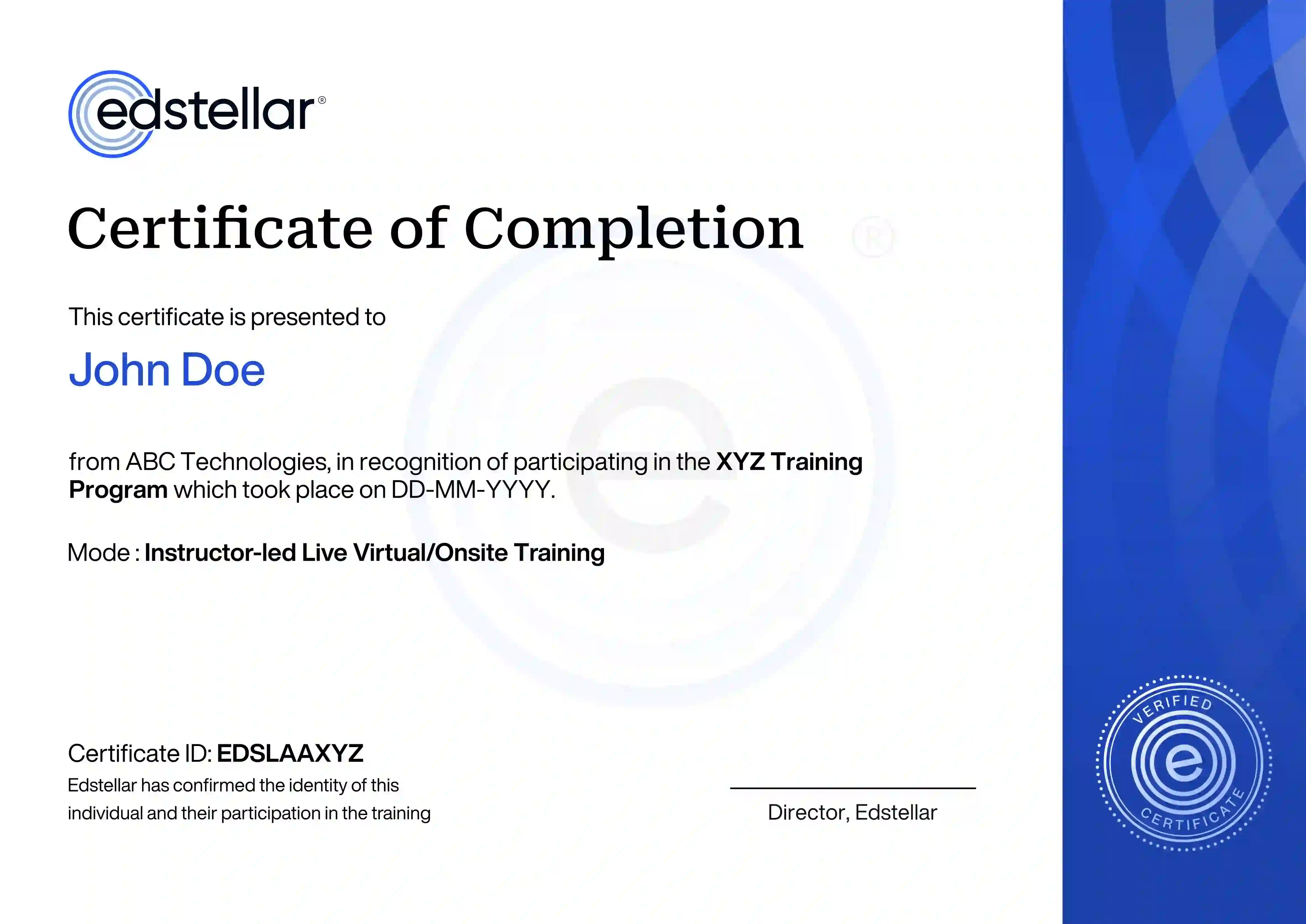
Upon successful completion of the training course offered by Edstellar, employees receive a course completion certificate, symbolizing their dedication to ongoing learning and professional development.
This certificate validates the employee's acquired skills and is a powerful motivator, inspiring them to enhance their expertise further and contribute effectively to organizational success.


Explore More Courses
Edstellar is a one-stop instructor-led corporate training and coaching solution that addresses organizational upskilling and talent transformation needs globally.
Marketing Excellence
Operational Excellence
Finance Excellence
HR Excellence
IT Excellence
Customer Service
Leadership Excellence
Quality Management
Software
How it WorksFAQ'sCorporate Training
CatalogStellar AI
Skill MatrixHRMS Integration
Who we ServeCEO RetreatsPricingTraining DeliveryPartner with Edstellar
CareersContact us