Corporate Vagrant Training Course
Edstellar's instructor-led Vagrant training course empowers teams with essential skills to achieve streamlined workflows and optimized resource utilization for the organization. The course equips employees to set up and manage development environments using Vagrant, enabling them to streamline workflows and optimize resource utilization.
(Virtual / On-site / Off-site)
Available Languages
English, Español, 普通话, Deutsch, العربية, Português, हिंदी, Français, 日本語 and Italiano
Drive Team Excellence with Vagrant Corporate Training
Vagrant is an open-source tool that simplifies the creation and management of virtualized development environments, ensuring consistency and ease of use across different operating systems. For organizations, Vagrant is essential as it streamlines workflows, optimizes resource utilization, and automates the setup and configuration of development environments, reducing the potential for inconsistencies and errors. Vagrant training course ensures teams can collaborate effectively, maintain standardized environments, and deploy applications more efficiently.
Edstellar's instructor-led Vagrant training course is delivered through virtual/onsite formats by industry experts with years of experience. The course features a tailored curriculum, practical exercises, and customization options, ensuring employees gain hands-on experience and confidence in utilizing Vagrant effectively.

Skills Your Employees Will Gain
These are the core, hands-on capabilities your team builds during the program.
- VirtualizationVirtualization is the creation of virtual versions of physical resources, like servers or storage. This skill is important for IT roles as it enhances resource efficiency, scalability, and cost-effectiveness.
- ProvisioningProvisioning is the process of preparing and equipping a system or service for use. This Skill is important for IT roles, ensuring efficient resource allocation and management.
- Configuration ManagementConfiguration Management is the process of systematically handling changes to maintain system integrity over time. This skill is important for IT roles to ensure stability, reduce downtime, and enhance security.
- Development EnvironmentsDevelopment Environments refer to the setups where software development occurs, including tools and frameworks. This skill is important for developers to ensure efficient coding, testing, and collaboration.
- Infrastructure as Code (IaC)Infrastructure as Code (IaC) is the practice of managing and provisioning infrastructure through code. This skill is important for DevOps and cloud engineering roles, as it enables automation, consistency, and scalability in deploying infrastructure.
- System AdministrationSystem Administration involves managing and maintaining computer systems and networks. This skill is important for IT roles as it ensures system reliability, security, and efficiency.
What Your Team Will Achieve After This Training
- Apply Vagrant to streamline development workflows and improve efficiency in managing virtual environments
- Analyze and optimize resource utilization using Vagrant to ensure effective use of hardware and software resources
- Develop collaborative environments with Vagrant, enabling seamless teamwork and consistent development setups
- Design and ensure consistency across development environments by implementing Vagrant configurations and scripts
- Implement efficient deployment processes using Vagrant, reducing deployment time and minimizing errors
Topics & Program Outline
The curriculum is organized into focused modules built by industry experts and delivered virtually or on-premise. Interactive sessions reflect the evolving demands of the workplace, keeping the learning both relevant and practical.
- Introduction
- Overview of Vagrant
- Benefits of using Vagrant
- Installing Vagrant and VirtualBox on Windows
- System requirements
- Step-by-step installation guide
- Common issues and troubleshooting
- Installing Vagrant and VirtualBox on OS X
- System requirements
- Step-by-step installation guide
- Common issues and troubleshooting
- Installing Vagrant and VirtualBox on Ubuntu
- System requirements
- Step-by-step installation guide
- Common issues and troubleshooting
- Vagrant up - creating your first VM
- Initializing a Vagrant environment
- Configuring the Vagrantfile
- Starting the VM
- Displaying a GUI interface
- Enabling GUI mode in Vagrant
- Accessing the VM's GUI interface
- Sharing files with the VM
- Setting up shared folders
- Accessing shared files from the VM
- Suspending the VM
- How to suspend a VM
- Resuming a suspended VM
- Halting the VM
- Properly shutting down the VM
- Differences between halting and suspending
- Destroying the VM
- Removing a VM from the system
- Implications of destroying a VM
- Windows line endings
- Understanding line endings in different OS
- Configuring Vagrant to handle Windows line endings
- Development environment overview
- Components of a web development environment
- Role of Vagrant in development environments
- The Vagrantfile
- Structure of the Vagrantfile
- Key configuration options
- Installing Nginx
- Step-by-step installation guide
- Basic configuration of Nginx
- Provisioning
- Understanding provisioning in Vagrant
- Types of provisioning scripts
- Networking
- Configuring network settings in Vagrant
- Port forwarding and private networks
- Sharing and versioning website files
- Setting up file sharing
- Version control best practices
- Vagrant share
- Sharing your Vagrant environment
- Accessing shared environments
- Vagrant status
- Monitoring the status of Vagrant environments
- Interpreting status outputs
- Sharing and versioning Nginx config files
- Managing Nginx configuration files
- Version control strategies
- Configuring synced folders
- Setting up synced folders
- Performance considerations
- Introduction
- Overview of Hubot
- Benefits of using Hubot with Vagrant
- Boxes
- Understanding Vagrant boxes
- Finding and using existing boxes
- rsync
- Configuring rsync for file synchronization
- Using rsync with Vagrant
- Initialize Hubot dev environment
- Setting up a development environment for Hubot
- Initial configuration steps
- Provision Hubot
- Automating Hubot setup
- Provisioning scripts for Hubot
- Scaffold a Hubot project
- Creating a new Hubot project
- Initial project structure
- Configure rsync synced folders
- Setting up rsync for Hubot projects
- Ensuring synchronization
- Run Hubot from the shell
- Starting Hubot
- Basic commands and usage
- Integrate HipChat
- Configuring Hubot to work with HipChat
- Testing the integration
- Configure upstart service
- Setting up Hubot as an upstart service
- Managing the service
- Run upstart service
- Starting Hubot via upstart
- Monitoring and managing the service
- Introduction
- Overview of deploying Hubot in the cloud
- Benefits of cloud deployment
- Multiple machines
- Configuring multiple Vagrant machines
- Managing multi-machine environments
- Providers
- Understanding Vagrant providers
- Setting up different providers
- Plugins
- Useful Vagrant plugins for cloud deployment
- Installing and configuring plugins
- Configuring an AWS AMI
- Setting up AWS AMIs for Vagrant
- Configuring Vagrant to use AWS
- Configuring SSH to AWS and access keys
- Setting up SSH access to AWS
- Managing AWS access keys
- Configuring rsync to AWS
- Synchronizing files with AWS using rsync
- Performance considerations
- Overriding application configuration
- Customizing application settings for cloud environments
- Launching Hubot into the cloud
- Deploying Hubot to a cloud provider
- Initial setup and configuration
- Alternative VirtualBox option
- Using VirtualBox as an alternative provider
- Pros and cons of VirtualBox for cloud environments
- Development workflow and changing Hubot
- Managing development changes in the cloud
- Release workflow and releasing our change
- Releasing changes to production
- Managing the release process
- Rolling back production
- Strategies for rolling back deployments
- Cleanup
- Cleaning up unused resources
- Managing costs and resources
- AWS considerations
- Common pitfalls and solutions
- Vagrant cygwin windows SSL bug fix
- Identifying and fixing SSL bugs in Cygwin on Windows
- Ensuring secure connections
- Introduction
- Overview of using Windows as a guest OS in Vagrant
- Benefits and challenges
- Windows guest differences
- Key differences between Windows and other guest OS
- Special considerations for Windows guests
- Finding Windows boxes
- Locating and selecting Windows boxes
- Best sources for Windows boxes
- Creating Windows boxes
- Building custom Windows boxes
- Configuration steps
- Vagrant up
- Starting a Windows VM with Vagrant
- Initial setup and configuration
- Vagrant RDP
- Setting up Remote Desktop Protocol (RDP) for Windows guests
- Accessing Windows VMs via RDP
- Provision IIS
- Installing and configuring Internet Information Services (IIS)
- Basic setup and usage
- Testing Web Deploy
- Setting up Web Deploy for IIS
- Deploying applications using Web Deploy
- Testing Web Config transformations
- Managing Web Config files
- Applying and testing transformations
- PowerShell's Desired State Configuration
- Overview of Desired State Configuration (DSC)
- Using DSC with Vagrant
- Introduction
- Overview of local development databases
- Benefits of using databases with Vagrant
- Provisioning types
- Different methods of provisioning databases
- Why Puppet?
- Advantages of using Puppet for provisioning
- Basic concepts of Puppet
- Build a standalone MongoDB server
- Setting up MongoDB with Vagrant
- Initial configuration and setup
- Package our MongoDB VM into a Vagrant box
- Creating a Vagrant box from a MongoDB VM
- Steps for packaging and distributing the box
- Maintaining the desired state with Puppet
- Ensuring configuration consistency with Puppet
- Writing and applying Puppet manifests
- Loading data sets
- Importing data into MongoDB
- Managing data sets
- Playing with MongoDB replica sets
- Setting up MongoDB replica sets
- Configuring and testing replica sets
- global-status
- Monitoring Vagrant environments with global-status
- Understanding and utilizing global-status outputs
Who Should Attend?
This program suits professionals at many levels across the organization, including:
- DevOps Engineers
- Systems Administrators
- Software Developers
- IT Infrastructure Engineers
- Automation Engineers
- Application Support Analysts
- Build Engineers
- Systems Managers
- Operations Managers
- Cloud Engineers
- Virtualization Engineers
- Network Engineers
What are the Prerequisites?
Employees with a basic understanding of software development environments can take the Vagrant course.
Choose the Format That Fits Your Team
We design training your teams actually engage with, and deliver it the way that suits you best. Through a vetted global trainer network, Edstellar runs sessions in 10+ languages with consistent quality anywhere.


.webp)
Virtual / online: expert-led live sessions delivered anywhere, with consistency and easy scheduling.
.webp)
On-site (in-house): immersive, instructor-led learning at your office.
.webp)
Off-site: focused, instructor-led group learning away from everyday workplace distractions.
Get a Proposal Shaped to Your Needs
Need pricing for onsite, offsite, or virtual delivery? Get a proposal tailored to your team's needs.
64 hours of group training (includes VILT/In-person On-site)
Tailored for SMBs
Tailor-Made Trainee Licenses with Our Exclusive Training Packages!
160 hours of group training (includes VILT/In-person On-site)
Ideal for growing SMBs
Tailor-Made Trainee Licenses with Our Exclusive Training Packages!
400 hours of group training (includes VILT/In-person On-site)
Designed for large corporations
Tailor-Made Trainee Licenses with Our Exclusive Training Packages!
Unlimited duration
Designed for large corporations
What Sets Edstellar Apart
Experienced Trainers
Our trainers are drawn from a vetted global network and bring years of industry expertise, keeping every session practical and impactful.
Proven Quality
With a strong global track record, Edstellar is known for quality and engaging delivery.
Industry-Relevant Curriculum
Our programs are built by experts to match the demands of today's industry.
Fully Customizable
Every program can be tailored to your organization's goals.
Comprehensive Support
We provide pre- and post-session support for a complete learning experience.
Global Multi-Location & Multilingual Training Delivery
We deliver in multiple languages to support diverse global teams.
Hear from Organizations We've Trained
"Attending the Vagrant training was transformational for my professional development. As a Senior Software Engineer, the deep dive into strategic frameworks gave me the confidence to tackle complex challenges head-on. The of interactive labs were immediately applicable to my work. I've successfully implemented these advanced techniques in production environments with measurable impact. This course has become foundational to my continued success.”
Earnest Crawford
Senior Software Engineer,
Global Technology Solutions Provider
"This Vagrant course transformed my approach to technical mastery solutions. The comprehensive modules on expert-led workshops were invaluable for our organizational projects. I can now confidently implement practical applications for diverse client requirements. The deep coverage of real-world case studies gave me advanced skills I immediately applied to Our project success rate and profitability increased dramatically within the quarter.”
Thierry Bonnet
Senior Software Engineer,
IT Services and Solutions Provider
"This Vagrant course provided our team with comprehensive advanced methodologies capabilities we immediately put into practice. As a Senior Software Engineer managing complex professional expertise projects, the practical significantly enhanced our delivery capacity. Our team delivered record-breaking results in the subsequent quarter, exceeding all targets. The training fundamentally improved our team's performance metrics and overall efficiency.”
Ravi Krishnan
Senior Software Engineer,
Digital Innovation Platform
“Edstellar’s IT & Technical training programs have been instrumental in strengthening our engineering teams and building future-ready capabilities. The hands-on approach, practical cloud scenarios, and expert guidance helped our teams improve technical depth, problem-solving skills, and execution across multiple projects. We’re excited to extend more of these impactful programs to other business units.”
Aditi Rao
L&D Head,
A Global Technology Company
Recognition That Motivates Your Team
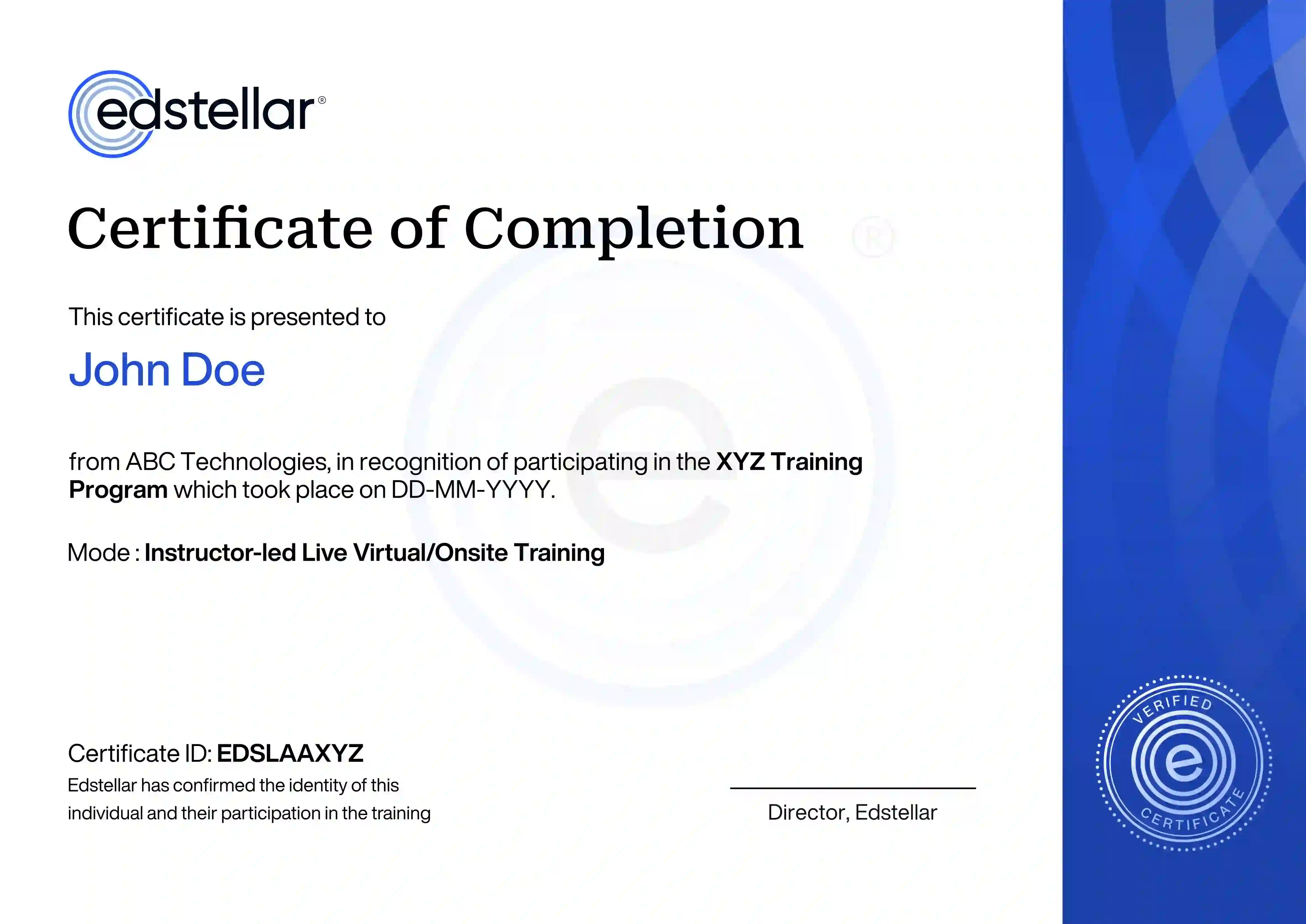
Upon successful completion of the training course offered by Edstellar, employees receive a course completion certificate, symbolizing their dedication to ongoing learning and professional development.
This certificate validates the employee's acquired skills and is a powerful motivator, inspiring them to enhance their expertise further and contribute effectively to organizational success.


Other Related Corporate Training Courses
Explore More Courses
Edstellar is a one-stop instructor-led corporate training and coaching solution that addresses organizational upskilling and talent transformation needs globally.
Learning Technology
Learning Content Design and Development
Learning Governance, Analytics & ROI
Digital Learning Ecosystem
Training Simulations, AR/VR & Case Studies
Employee Performance Support
Leadership Pipeline & Succession PlanningStrategic Workforce Planning for EnterprisesTransformation & Risk Advisory for EnterprisesDEI Consulting for EnterprisesEmployee Engagement Consulting for Enterprises
Cultural Transformation