Digital Transformation Challenges & Trends [2026 Guide]
![Digital Transformation Challenges & Trends [2026 Guide]](https://cdn.prod.website-files.com/6484144ee6dda9d4b9ab7f57/6a27f60926d658e82d5eb0b6_Harrison%20Mitchel%20(1).webp)
.svg "edstellar")

Digital transformation in 2026 is much more than adopting new technologies. It involves deeply integrating digital tools into every part of the business, reshaping organizational culture, operations, and strategy. This shift means embedding digital capabilities such as AI, cloud, and automation into daily workflows and decision-making to drive innovation and agility.
Key trends shaping digital transformation today include the rise of Enterprise Co-Pilot AI, which acts as a strategic partner across functions to boost efficiency and bridge talent gaps. Also, hybrid and multi-cloud environments power around 87% of companies, enabling scalable and secure digital ecosystems according to Flexera research 2025. Real-time data through IoT, digital twins, and edge computing helps businesses react faster and smarter.
Successful transformation depends on aligning people, processes, and technology. Leadership involvement, agile workflows, and integrating cutting-edge tools such as AI, blockchain, and AR/VR are critical to delivering real business value.
In this blog, we will explore the top digital transformation challenges organizations face in 2026 and provide expert advice on overcoming them.
Digital transformation presents unique challenges across culture, technology, and strategy, demanding careful alignment of people, processes, and systems. Organizations that invest in leadership, training, modernization, and adaptive strategies have successfully navigated these hurdles to achieve measurable impact. Some of the important challenges faced by the organization are listed below:
.webp)
Traditional organizations such as government agencies and the military often struggle with workplace culture issues that slow digital change. Their staff may resist new technology because they are used to old ways of working. Leadership gaps are common; many executives lack digital fluency and a sense of urgency, making it difficult to respond to changing market needs.
Technical debt is another big problem. Old systems and infrastructure make it hard to stay flexible and keep costs high. These organizations also face ongoing skill shortages, as many employees aren’t trained in cloud computing, AI, or agile methods.
At the lower management level, technical and digital challenges continue. Many managers hesitate to update legacy workflows. Middle managers, in particular, often fear that automation and AI will eliminate jobs, leading to anxiety and strong resistance to change across the workplace.
To succeed in digital transformation, organizations should build a culture that welcomes new ideas. This starts with investing in digital training for employees and developing leaders who are ready for change. For technical debt, the best approach is to focus on the most important old systems first. By breaking modernization into smaller, manageable modules, organizations can update technology while keeping operations running smoothly.
Bridging skill gaps means providing regular training, encouraging teams to work across different functions, and hiring people with the needed digital expertise. To manage resistance and anxiety about change, leaders should communicate honestly and involve employees early in the process. Working together on solutions helps people feel valued and makes change less stressful.
IT teams face the challenge of maintaining real-time scalability and ensuring constant availability. Multi-cloud adoption has grown rapidly, but managing such environments is complex. Security remains a top concern, as different providers have varied controls and compliance requirements.
At the same time, the reliance on hybrid IT and SaaS platforms creates integration and management hurdles. Uncertainty in delivery strategies, driven by rapid technology cycles and shifting business goals, adds to the difficulty by making long-term planning less reliable.
Another key issue is the persistence of data silos, which fragment valuable insights across departments and platforms, slowing data-driven decision-making. Choosing the right technologies also becomes a challenge, because the sheer number of options increases the risk of misalignment or vendor lock-in.
IT leaders must design resilient, scalable architectures emphasizing zero-trust security models and centralized cloud governance. Enhanced data governance dismantles data silos while layered API strategies improve hybrid environment interoperability. Regular governance reviews aid in pragmatic technology curation, balancing innovation with operational stability. Agile delivery frameworks increase adaptability amid uncertainty.
At the heart of successful digital transformation lies leadership alignment and buy-in. Transformation stalls if executives and middle management are not uniformly committed, resulting in fragmented efforts. Equally vital is employee involvement and training to build confidence and competence, particularly in adopting new digital tools and workflows.
However, organization-wide clear communication remains a continual challenge, as inconsistent messaging often fuels confusion and skepticism. Cultural integration becomes increasingly complex in global enterprises, requiring cross-geographic alignment of digital values and behaviors.
Effective change management strategies must address natural resistance to change, fostering a digital mindset by instilling curiosity, learning orientation, and agility. Sustaining transformation over time necessitates continuous cultural assessment and gap analysis to monitor progress and recalibrate efforts.
Leaders must champion agile leadership styles that embrace experimentation and feedback, fostering openness and innovation at all levels. Driving lasting behavioral change requires role modeling, incentives, and accountability mechanisms embedded in daily operations.
Organizations should maintain a structured yet flexible communication strategy focused on storytelling and transparency. Participatory training and gamified learning increase adoption, while cultural diagnostics and employee feedback loops reveal readiness levels. Talent development must emphasize agility and innovation capabilities, with leaders actively modeling desired behaviors.
Employees frequently express resistance to change, driven by uncertainty about new tools, altered workflows, and evolving job roles. Closely tied is the fear of job displacement due to automation, prompting anxiety that dampens motivation. Successful transformation depends heavily on authentic leadership buy-in, where leaders visibly support digital initiatives and demonstrate confidence in the workforce's ability to evolve.
Embedding empathy in change communication, sharing successes, providing career transition support, and involving staff in pilots reduces resistance. Leadership must actively engage on digital platforms and frontline conversations to build trust.
Outdated legacy systems impose limits on flexibility and innovation, often requiring costly and slow modernization efforts. Alongside this, pervasive data silos fracture information flows, undermining analytics capabilities and customer insights. The complex enterprise technology landscape makes technology selection a critical challenge, where improper choices cause integration failures and waste.
Bridging legacy systems with APIs while planning staged cloud migration unlocks modernization benefits with reduced risk. Data governance frameworks promote accurate, accessible information, enabling data-driven decisions. Structured vendor evaluations and pilot testing ensure technology investments align with strategic needs.
Vague or unclear ROI measurement weakens the case for sustained digital initiatives, often causing executives to retreat. A pervasive lack of strategy leads to disjointed efforts without a coherent roadmap tied to business outcomes. Additionally, process complexity within legacy workflows slows digital adoption and frustrates employees.
Defining transparent ROI metrics linked to customer impact, operational efficiency, and revenue growth strengthens buy-in. Clear, adaptable transformation roadmaps aligned with enterprise goals provide direction. Applying Lean and Agile principles to process simplification reduces friction and supports automation.
Financial constraints frequently restrict the ability to invest in cutting-edge technologies, skilled talent, and comprehensive training. Managing resource allocation between daily business operations and transformation projects presents ongoing tension. Moreover, time pressure to deliver rapid results leads to unrealistic expectations and potential burnout.
Embracing cloud’s pay-as-you-go model lowers capital expenditure barriers. Dedicated transformation teams alleviate competing demands. Clear communication of realistic timelines and incremental milestones helps align organizational energy and expectations. Leveraging strategic vendor partnerships optimizes budget and capabilities.
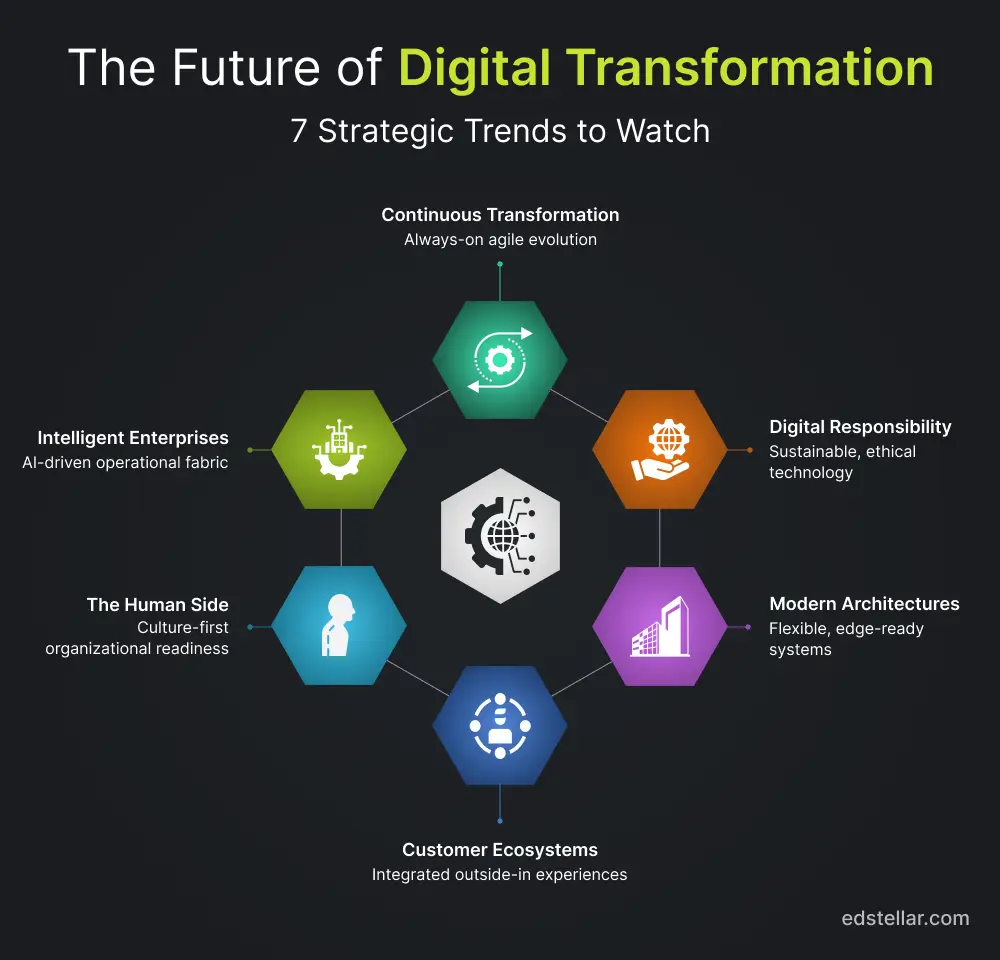
Digital transformation is no longer a one time, large scale initiative. Leading organizations now treat it as an ongoing capability embedded into daily operations. Instead of massive overhauls, companies are making smaller, agile, and iterative improvements.
The focus has shifted from simply deploying technology to building change ready cultures, skills, and systems. This continuous approach helps businesses respond faster to shifting customer expectations, market disruptions, and regulatory changes.
Artificial intelligence and automation are becoming the backbone of modern enterprises. With roughly 75 percent of companies expected to adopt AI, cloud, and advanced analytics between 2023 and 2027, workflows are becoming increasingly predictive and data driven.
However, technology alone does not guarantee success. Organizations that pair AI investments with strong change management and workforce readiness see significantly better ROI. The future belongs to intelligent enterprises where humans and machines collaborate seamlessly.
Technology rarely fails, organizations do. Studies show only about 35 percent of companies fully achieve their digital transformation goals, often due to cultural and capability gaps. Successful organizations prioritize upskilling, reskilling, and change leadership.
They build hybrid teams that bridge business and technology while fostering cultures of experimentation, transparency, and continuous learning. Transformation succeeds when people are prepared to evolve with the technology.
Digital transformation is increasingly customer led rather than operations led. Companies are redesigning experiences end to end, ensuring customer experience flows through data, supply chains, and partner networks.
At the same time, ecosystem thinking is rising, businesses are integrating with platforms, partners, and marketplaces to deliver seamless value. Organizations that design from the outside in unlock new revenue streams and stronger competitive advantage.
Flexible technology architecture is now mission critical. Organizations are adopting hybrid and multi cloud strategies to balance scalability, cost, and security. At the same time, edge computing is growing with IoT and 5G, enabling real time processing closer to where data is generated.
The goal is no longer simple cloud migration but building composable, platform based architectures that support rapid innovation and avoid legacy bottlenecks.
As digital adoption accelerates, scrutiny around responsible transformation is intensifying. Companies are investing in green IT, ethical AI, strong data governance, and privacy safeguards.
Stakeholders increasingly evaluate not just digital capability but digital responsibility. Organizations that embed sustainability and ethics into their transformation strategy reduce regulatory risk and strengthen brand trust.
The most powerful impact of digital transformation is strategic reinvention. Traditional models are giving way to platforms, subscriptions, as a service offerings, and outcome based pricing. Digital capabilities enable new revenue streams through data monetization, connected products, and ecosystem partnerships.
With the global digital transformation market projected to reach nearly 3.9 trillion dollars by 2027, companies that treat transformation as a continuous capability, rather than a one off project, are positioned to capture the greatest value.
Navigating digital transformation in 2026 requires organizations to harmonize leadership, technology, culture, and strategy overcoming hurdles with focused investment in training, agile processes, and modern digital ecosystems. By adopting expert-recommended best practices, organizations can break down silos, bridge skill gaps, and drive sustainable growth, as shown in the diverse success stories above.
Edstellar stands out as a premier digital learning partner for enterprises, offering tailored training solutions across cloud computing, AI, data analytics, and more. Their industry-aligned programs, expert instructors, and scalable delivery model empower teams to embrace change confidently, making Edstellar a catalyst for future-ready workforce development and digital transformation success.
#On-site #Virtual #GroupTraining #Customized
Explore 2000+ industry ready instructor-led training programs.

Create dynamic leaders and cohesive teams. Learn more now!


Do a quick Skill gap analysis with Edstellar’s Free Skill Matrix tool

Unlock premium resources, tools, and frameworks designed for HR and learning professionals. Our L&D Hub gives you everything needed to elevate your organization's training approach.
Access L&D Hub Resources.svg)
.svg)
.svg)
.svg)

.svg)


.svg "Click Here to Follow on Medium")
.svg)


