10 Must-Have Skills for a Robotics Engineers
.webp)

.svg "edstellar")

The robotics engineering landscape stands at a transformation threshold where artificial intelligence converges with mechanical innovation, autonomous systems reshape industrial paradigms, and human-machine collaboration becomes the operational standard. As organizations globally accelerate their adoption of intelligent automation technologies, the skill requirements for robotics engineers have evolved far beyond traditional mechanical and electrical engineering competencies.
“Robotics is a wide field with specializations across many disciplines, so there isn’t one universal path. Someone designing robotic mechanisms needs very different skills from someone building machine vision for mobile robots. That’s why aspiring robotics engineers should develop strengths outside their core discipline, ideally through projects that integrate multiple subsystems."


According to the World Economic Forum’s Future of Jobs Report 2025, 86% of employers expect AI and information-processing technologies to transform their businesses by 2030, thereby fundamentally altering the robotics ecosystem. This technological revolution creates both unprecedented opportunities and distinct challenges for robotics professionals who must navigate an increasingly complex interdisciplinary field.
The contemporary robotics engineer operates across multiple domains, designing sophisticated mechanical systems, programming intelligent algorithms, implementing machine learning models, ensuring cybersecurity protocols, and collaborating across organizational functions. This convergence demands a skill set that balances deep technical expertise with adaptive thinking, continuous learning, and strong collaboration.
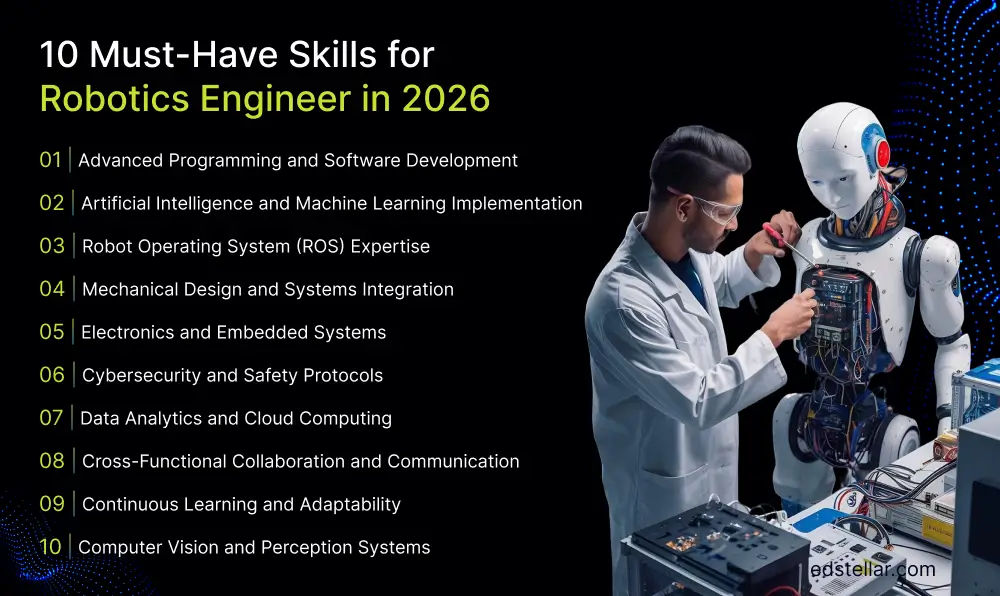
This comprehensive analysis examines the ten essential skills that will define successful robotics engineering careers through 2026 and beyond, exploring why each capability matters, how it integrates within the broader robotics ecosystem, and practical pathways for skill development that align with industry transformation patterns.
Programming competency forms the foundational bedrock on which modern robotics engineering is built. While hardware remains critical, software intelligence increasingly determines system capabilities, operational efficiency, and competitive advantage. Robotics engineers must master multiple programming languages and paradigms to architect solutions spanning embedded systems, high-level applications, and artificial intelligence frameworks.
Python dominates the robotics landscape due to its extensive library ecosystem for machine learning, computer vision, and rapid prototyping. Engineers use frameworks such as TensorFlow, PyTorch, and OpenCV to implement perception systems, develop neural networks, and process sensor data. C++ remains indispensable for performance-critical applications in which millisecond-level response times determine system success; real-time control loops, motion planning algorithms, and hardware interface drivers demand the efficiency and deterministic behavior that C++ provides.
Beyond language syntax, robotics engineers must understand software architecture principles that enable maintainable, scalable systems. Modular design patterns, object-oriented programming concepts, and functional programming paradigms each offer distinct advantages for different robotics challenges. Engineers who architect robust software frameworks accelerate development cycles, reduce debugging time, and facilitate knowledge transfer across engineering teams.
Version control systems, continuous integration pipelines, and collaborative development tools have become non-negotiable competencies. Modern robotics projects involve distributed teams working on interconnected subsystems, motion controllers, perception modules, planning algorithms, and user interfaces, each requiring coordinated evolution and rigorous testing protocols.
Artificial intelligence represents the defining technological capability reshaping robotics engineering from rule-based automation toward adaptive, learning-capable systems. The integration of machine learning algorithms enables robots to recognize patterns, make informed decisions, adapt to environmental variations, and continuously improve performance through experience.
Computer vision applications powered by convolutional neural networks allow robots to interpret visual information, identify objects, track movements, and navigate complex environments. Natural language processing capabilities facilitate human-robot interaction through voice commands and conversational interfaces. Reinforcement learning algorithms optimize robot behavior through trial-and-error, discovering solutions to manipulation tasks, motion planning challenges, and resource allocation problems that traditional programming approaches cannot address.
The practical implementation of machine learning within robotics systems demands understanding that extends beyond algorithm selection. Engineers must master data collection methodologies, annotation processes, training infrastructure requirements, and deployment constraints. Edge computing architectures bring inference capabilities directly to robotic platforms, reducing latency and enabling real-time decision-making without requiring cloud connectivity.
Transfer learning techniques allow engineers to leverage pre-trained models, dramatically reducing development time and data requirements. Fine-tuning established neural networks for specific robotics applications, such as defect detection in manufacturing or gesture recognition for collaborative robots, accelerates project timelines while maintaining performance standards.
The Robot Operating System has emerged as the de facto standard middleware framework connecting robotics hardware, sensors, algorithms, and control systems. ROS provides a comprehensive toolkit that abstracts away hardware complexity, facilitates modular development, and enables code reuse across different robotic platforms. Engineers proficient in ROS can dramatically accelerate development cycles by leveraging community-contributed packages, simulation environments, and debugging tools.
Understanding ROS architecture, the publish-subscribe communication model, parameter servers, action servers, and transform trees enables engineers to design distributed systems in which multiple processes coordinate seamlessly. Navigation stacks, manipulation pipelines, and perception frameworks built on ROS foundations provide proven solutions to common robotics challenges, allowing engineers to focus efforts on application-specific innovations rather than reinventing fundamental capabilities.
ROS 2 represents an evolutionary advancement that addresses critical limitations in the original framework, provides real-time performance guarantees, enhances security features, improves cross-platform support, and offers industrial-grade reliability. Organizations deploying robots in production environments increasingly mandate ROS 2 expertise as system requirements emphasize safety certifications, deterministic behavior, and long-term support commitments.
Simulation environments integrated with ROS, particularly Gazebo and Isaac Sim, provide robust platforms for algorithm development, testing, and validation before hardware deployment. Engineers who effectively utilize simulation workflows reduce development costs, accelerate iteration cycles, and identify potential failure modes in controlled virtual environments.
Despite the increasing emphasis on software in robotics, mechanical engineering fundamentals remain essential for designing functional, reliable robotic systems. Engineers must understand structural mechanics, material properties, actuator characteristics, and transmission systems to design robots that withstand operational stresses, maintain positional accuracy, and deliver expected performance across their lifecycle.
Proficiency in computer-aided design (CAD) tools such as SolidWorks, Fusion 360, and CATIA enables engineers to model complex assemblies, conduct interference analysis, and generate manufacturing documentation. Understanding design for manufacturability principles, minimizing part count, selecting appropriate tolerances, and choosing cost-effective materials directly impact project feasibility and scalability.
Kinematics and dynamics modeling underpin motion planning capabilities. Forward and inverse kinematic algorithms determine robot workspace limits, calculate joint trajectories, and ensure smooth motion profiles. Dynamic modeling accounts for inertial effects, friction, and external disturbances, enabling precise control and predictive maintenance.
Sensor integration is a critical systems engineering challenge at the intersection of mechanical design, electrical engineering, and software development. Mounting locations must provide optimal sensing perspectives while protecting delicate electronics from vibration, temperature extremes, and environmental contaminants. Cable routing strategies balance flexibility requirements against wear concerns and electromagnetic interference considerations.
Modern robots are complex electromechanical systems in which sensors, actuators, controllers, and power systems must operate in concert. Electronics expertise enables engineers to select appropriate components, design interface circuits, and troubleshoot system-level integration challenges. Understanding signal conditioning, analog-to-digital conversion, and communication protocols is essential for ensuring reliable data exchange between subsystems.
Microcontroller and microprocessor platforms, Arduino, Raspberry Pi, NVIDIA Jetson, and custom embedded computers, provide computational resources for real-time control, sensor processing, and decision-making. Engineers must match computational requirements to hardware capabilities, balancing processing power, power consumption, physical size, and cost constraints.
Power management and distribution challenges intensify as robots incorporate more sensors, actuators, and computing resources. Battery selection considers energy density, discharge characteristics, cycle life, and safety requirements. Voltage regulation circuits, current monitoring systems, and charging infrastructure design ensure reliable operation throughout mission durations.
Hardware-software interface understanding bridges the gap between physical systems and control algorithms. Engineers working across this boundary must master register-level programming, interrupt handling, direct memory access operations, and real-time operating system concepts that guarantee deterministic behavior for safety-critical applications.
Vision capabilities have transformed robots from blind automation systems into perceptually aware agents that interpret their environment and make informed decisions. Computer vision encompasses image acquisition, preprocessing, feature extraction, object recognition, semantic segmentation, and scene understanding, each critical for applications ranging from autonomous navigation to quality inspection.
Camera selection and configuration require understanding of resolution, frame rate, field of view, lighting conditions, and interface bandwidth limitations. Depth-sensing technologies, stereo vision, structured light, time-of-flight cameras, and LiDAR systems provide three-dimensional environmental understanding that is essential for manipulation tasks and obstacle avoidance.
Classical computer vision algorithms remain valuable for specific applications where computational efficiency, interpretability, or limited training data favor traditional approaches. Edge detection, feature matching, optical flow, and geometric transformations solve many industrial vision problems with deterministic, explainable solutions.
Deep learning has revolutionized perception capabilities, enabling robots to recognize objects in cluttered scenes, estimate poses, track movements, and understand semantic relationships. Convolutional neural network architectures, ResNet, YOLO, Mask R-CNN, and their derivatives, deliver human-level performance on many visual recognition tasks when properly trained and deployed.
As robots become increasingly networked, autonomous, and integrated into critical infrastructure, cybersecurity emerges as a paramount concern. Vulnerabilities in robot control systems, communication protocols, or software architectures create attack vectors that could compromise physical safety, data integrity, or operational continuity. Engineers must adopt a security-first mindset throughout the development lifecycle.
Secure communication protocols protect data transmission between robot components, cloud services, and remote operators. Encryption mechanisms, authentication frameworks, and access control policies prevent unauthorized access to systems. Network segmentation isolates critical control systems from less secure data networks, thereby limiting the potential impact of breaches.
Safety systems are implemented using a hierarchical approach, with mechanical safeguards, electrical interlocks, and software monitors providing redundant protection layers. Emergency stop circuits, workspace monitoring systems, and force-limiting mechanisms comply with international safety standards, such as ISO 10218 for industrial robots and ISO 13482 for service robots.
Risk assessment methodologies identify potential hazards across the robot lifecycle phases, design, manufacturing, deployment, operation, maintenance, and decommissioning. Failure mode and effects analysis, fault tree analysis, and probabilistic risk assessment techniques quantify hazard severity and likelihood, guiding the prioritization of mitigation strategies.
The proliferation of sensors and connectivity capabilities generates vast data streams that, when properly analyzed, unlock operational insights, predictive maintenance opportunities, and continuous improvement pathways. Robotics engineers increasingly require data science competencies to extract value from collected information and optimize system performance.
Time-series analysis techniques reveal patterns in operational data, such as vibration signatures indicating bearing wear, energy-consumption trends suggesting efficiency degradation, or cycle-time variations highlighting process bottlenecks. Statistical process control methodologies distinguish normal operational variation from anomalies requiring investigation.
Cloud platforms provide computational resources, storage capacity, and analytical tools that extend beyond onboard robot capabilities. Engineers designing cloud-connected robot fleets must architect data pipelines that aggregate information from distributed systems, implement analytics workflows, and deliver actionable insights to stakeholders. Edge-cloud architectures balance local processing for latency-sensitive operations with cloud-based analysis for computationally intensive tasks.
Digital twin concepts create virtual replicas of physical robots, enabling simulation-based testing, what-if scenario analysis, and predictive modeling. Engineers leverage digital twins to optimize maintenance schedules, train machine learning models, and validate software updates before deployment to production systems.
Robotics projects inherently require collaboration across diverse disciplines, including mechanical engineers, electrical engineers, software developers, data scientists, manufacturing specialists, quality assurance professionals, and domain experts from application sectors. Engineers who effectively bridge these functional areas accelerate project progress and improve solution quality.
Technical communication skills enable engineers to explain complex concepts to non-technical stakeholders, document system architectures for future maintainers, and contribute to knowledge sharing within professional communities. Clear requirements specifications, design documentation, and user manuals prevent misunderstandings that can delay projects and lead to costly redesigns.
Project management awareness helps engineers understand resource constraints, schedule dependencies, and risk mitigation strategies that influence technical decision-making. Agile methodologies adapted for robotics development balance sprint-based iteration with hardware development timelines and safety validation requirements.
Customer-centric thinking ensures engineering efforts align with user needs and business objectives. Engineers who engage with end users, observe operational contexts, and incorporate feedback into design iterations deliver solutions that succeed commercially, not just technically.
The rapid pace of technological advancement in robotics demands a commitment to continuous learning that extends throughout engineering careers. New sensors, actuators, algorithms, frameworks, and development tools emerge regularly, each potentially offering competitive advantages or solving persistent challenges. Engineers who cultivate learning agility maintain relevance as the field evolves.
Professional development pathways include formal education programs, industry certifications, online courses, conference participation, and hands-on experimentation with emerging technologies. Organizations that invest in employee skill development through structured training programs position themselves to benefit from technology transitions.
According to McKinsey’s research on AI and workforce partnerships, more than 70 percent of skills sought by employers today are used in both automatable and non-automatable work, emphasizing the importance of adaptability as automation reshapes task distribution. Engineers who view technology as a collaborative tool rather than a replacement maintain career relevance through transitions.
Experimentation mindsets encourage engineers to prototype new approaches, learn from failures, and iterate toward optimal solutions. Organizations that foster psychological safety, where experimentation is valued over perfection, accelerate innovation cycles and develop more capable engineering teams.
Cross-domain knowledge acquisition expands problem-solving capabilities. Engineers studying biomechanics gain insights for legged robot design. Those who explore cognitive science better understand the challenges of human-robot interaction. Interdisciplinary learning produces creative solutions that transcend conventional engineering boundaries.
The convergence of artificial intelligence, advanced sensors, cloud computing, and collaborative frameworks is transforming robotics from deterministic automation to adaptive, learning-capable systems that augment human capabilities across industries. Engineers who develop competencies spanning mechanical systems, electronics, software development, artificial intelligence, cybersecurity, and collaborative practices position themselves at the forefront of this transformation.
Organizations that recognize the strategic value of advanced robotics capabilities systematically invest in workforce development. Structured training programs, mentorship initiatives, and continuous learning cultures transform engineering teams from technology users into innovation drivers. Partnerships with educational institutions, participation in industry consortia, and engagement with open-source communities accelerate knowledge acquisition while building professional networks.
Edstellar’s comprehensive AI training courses equip engineering teams with the cutting-edge AI capabilities essential to modern robotics applications. The machine learning training programs provide hands-on experience with algorithms, frameworks, and deployment strategies that translate directly into robotics implementations. For organizations seeking to optimize their automation infrastructure, robotic process automation training equips them with practical skills to enhance workflows and improve efficiency.
The robotics revolution extends beyond technical capabilities to organizational transformation. Companies successfully deploying advanced robotics systems align technology investments with business strategies, engage stakeholders across functions, and maintain focus on delivering customer value. Engineers who understand this broader context and how technical decisions affect commercial outcomes advance into leadership roles that shape industry futures.
As robots transition from isolated automation islands to networked, intelligent systems that collaborate with human colleagues, the engineering profession evolves accordingly. The most successful robotics engineers of 2026 will be those who embrace this complexity, cultivate diverse skill sets, maintain learning momentum, and apply their capabilities toward solving meaningful challenges that improve productivity, enhance safety, and create sustainable competitive advantages for their organizations.
#On-site #Virtual #GroupTraining #Customized
Explore 2000+ industry ready instructor-led training programs.

Create dynamic leaders and cohesive teams. Learn more now!


Do a quick Skill gap analysis with Edstellar’s Free Skill Matrix tool

Unlock premium resources, tools, and frameworks designed for HR and learning professionals. Our L&D Hub gives you everything needed to elevate your organization's training approach.
Access L&D Hub Resources.svg)
.svg)
.svg)
.svg)

.svg)


.svg "Click Here to Follow on Medium")
.svg)


