.svg "edstellar")
.webp)
Android Development NDK Corporate Training Program for Employees
Edstellar's instructor-led Android Development NDK training equips your teams to integrate native C and C++ code into Android apps using the Native Development Kit and JNI, from performance-critical components to OpenGL ES graphics, customized to your projects and delivered onsite or virtually.
(Virtual / On-site / Off-site)
.svg)
Equip Your Developers to Build High-Performance Android Apps with the NDK
Android Development NDK is the practice of building parts of an Android app in native C and C++ using the Android Native Development Kit (NDK), a toolset that compiles native code and connects it to Java or Kotlin through the Java Native Interface (JNI). Teams reach for the NDK when an app needs maximum performance, low-latency audio, advanced graphics with the OpenGL ES API, or the reuse of existing C and C++ libraries, work that the managed runtime alone cannot deliver. With the NDK, developers build and link native libraries, bridge them to the rest of the app, and optimize the components where speed, memory, and battery matter most.
As more Android products demand native performance for games, media, computer vision, and signal processing, this program helps your teams integrate native C and C++ code into Android apps confidently and safely with the NDK and JNI. Empower your people with expert-led on-site, off-site, and virtual sessions delivered by Edstellar, a premier corporate training provider serving organizations worldwide in-person and virtually across popular languages. Built around your goals, the program turns Android Development NDK skills into lasting capabilities that lift performance across your development, platform, and product engineering teams.
By the end of the program, your team can move performance-critical work into native code, reuse proven C and C++ libraries instead of rewriting them, and ship Android apps that are faster, smoother, and more efficient. The result is measurable gains in responsiveness and battery life, fewer costly rewrites, and engineers who can confidently maintain hybrid Java or Kotlin and native codebases in production.
.svg)

- Set up the NDK toolchain with CMake and structure a hybrid Java or Kotlin and native Android project.
- Bridge managed and native code with the Java Native Interface (JNI), passing data safely across the boundary.
- Build, link, and package native shared libraries and reuse existing C and C++ codebases in Android apps.
- Optimize performance-critical components for speed, memory, and battery efficiency.
- Render advanced graphics with the OpenGL ES API and work with native audio, sensors, and low-latency processing.
- Debug, profile, and troubleshoot native crashes using LLDB, logging, and NDK tooling.
- Getting Started with Native Android
- What the Android NDK (Native Development Kit) is and when native code is the right choice
- Installing the NDK, configuring CMake, and setting up Android Studio for native builds
- Native build systems: CMake and ndk-build, and how Gradle drives them
- Project structure for hybrid Java or Kotlin and native C/C++ apps
- Building and running your first native Android app
- Crossing the Native Boundary
- Java Native Interface (JNI) fundamentals and calling conventions
- Declaring and implementing native methods from Java and Kotlin
- Passing primitives, strings, arrays, and objects across the boundary
- Managing references, threads, and the JNI environment safely
- Exception handling and avoiding common JNI pitfalls
- Reusing and Building Native Code
- Reusing existing C and C++ libraries inside Android apps
- Building shared and static native libraries
- Linking third-party libraries and managing native dependencies
- Memory management and avoiding leaks in native code
- Cross-architecture builds, ABIs, and packaging native code
- Optimizing and Rendering with Native Code
- Moving performance-critical components into native code
- Rendering advanced graphics with the OpenGL ES API
- Native audio, sensors, and low-latency processing
- Profiling CPU, memory, and battery usage of native components
- Best practices for balancing native and managed code
- Shipping Reliable Native Apps
- Debugging native code with LLDB and Android Studio
- Diagnosing native crashes, stack traces, and tombstones
- Logging and instrumentation for native components
- Testing strategies for hybrid Android applications
- Packaging, ABI splits, and shipping NDK-based apps to production
- Android Developers
- Ndk Developers
- Mobile App Developers
- Software Engineers
- Embedded Systems Engineers
- Application Developers
- IT Specialists
- System Engineers
- C/ C++ Developers
- Firmware Engineers
- Software Developers
- Managers
Participants should have working knowledge of Android app development with Java or Kotlin and be comfortable with C or C++ fundamentals, including pointers and basic memory management. Familiarity with Android Studio and command-line build tools is helpful. No prior NDK or JNI experience is required, a solid grounding in Android and C/C++ is enough to get the most from the Android Development NDK training.


.webp "Virtual Android Development NDK Training")
.webp "On-site Android Development NDK Training")
.webp "Off-site Android Development NDK Training")
64 hours of group training (includes VILT/In-person On-site)
Tailored for SMBs
160 hours of group training (includes VILT/In-person On-site)
Ideal for growing SMBs
Tailor-Made Trainee Licenses with Our Exclusive Training Packages!
400 hours of group training (includes VILT/In-person On-site)
Designed for large corporations
Tailor-Made Trainee Licenses with Our Exclusive Training Packages!
Unlimited duration
Designed for large corporations
Experienced Trainers
Our trainers are drawn from a vetted global network and bring years of industry expertise, keeping every session practical and impactful.
Proven Quality
With a strong global track record, Edstellar is known for quality and engaging delivery.
Industry-Relevant Curriculum
Our programs are built by experts to match the demands of today's industry.
Fully Customizable
Every program can be tailored to your organization's goals.
Comprehensive Support
We provide pre- and post-session support for a complete learning experience.
Global Multi-Location & Multilingual Training Delivery
We deliver in multiple languages to support diverse global teams.
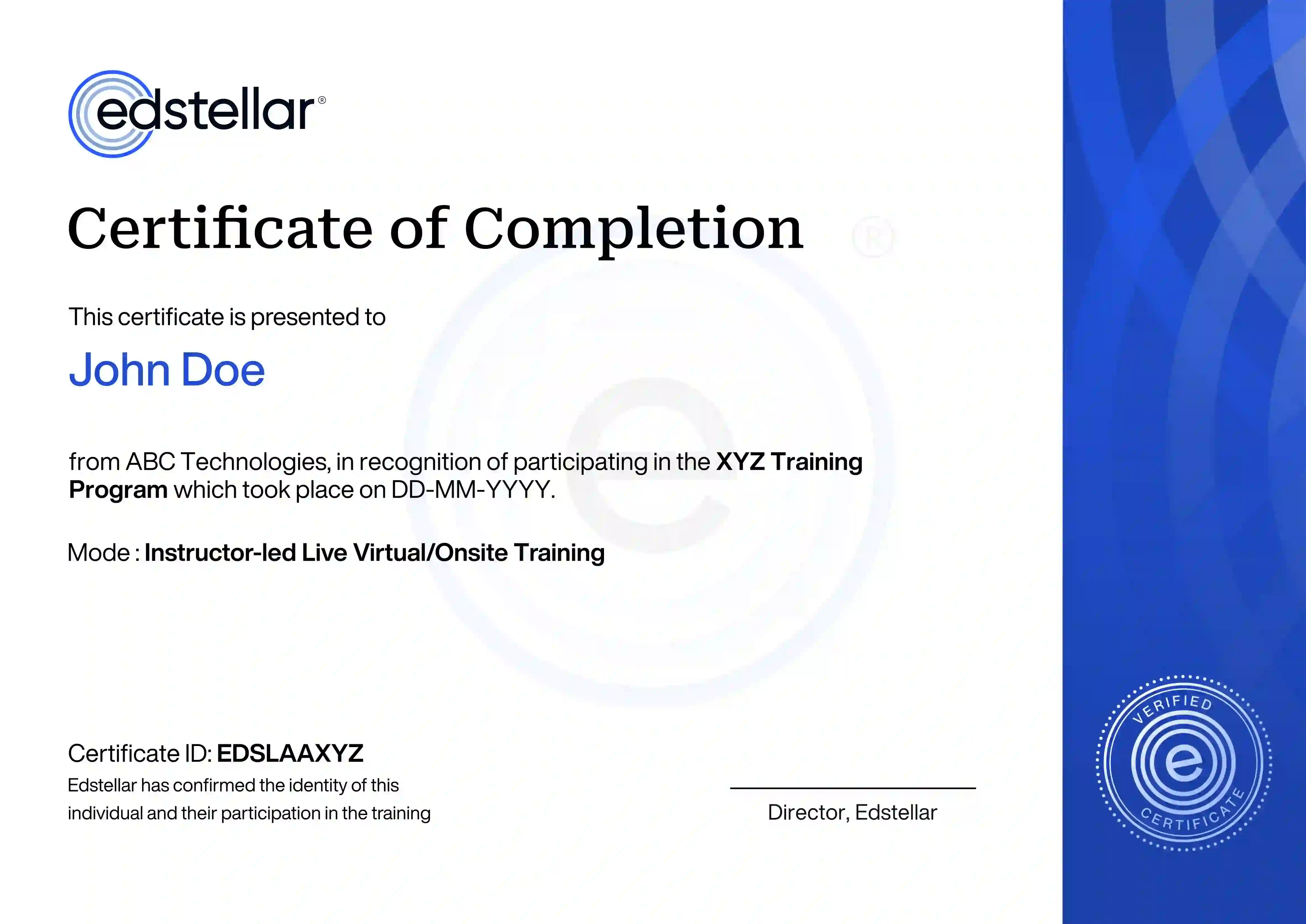
Recognition That Motivates Your Team

Frequently Asked Questions
Other Related Corporate Training Courses


Explore More Courses


.svg)
.svg)
.svg)

.svg)