

The compensation and benefits landscape has undergone a seismic transformation in recent years, fundamentally reshaping what organizations expect from their compensation and benefits managers. As businesses navigate inflation pressures, evolving workforce dynamics, and rapid technological change, these professionals have emerged as strategic architects of total rewards systems that drive organizational competitiveness and employee engagement.
The U.S. Bureau of Labor Statistics projects that employment of compensation, benefits, and job analysis specialists will grow 5 percent from 2024 to 2034, faster than the average for all occupations, underscoring the expanding strategic importance of these roles (BLS, 2024). With the median annual wage reaching $140,360 in May 2024, compensation and benefits managers command premium compensation that reflects their critical organizational impact.
According to SHRM’s 2025 State of the Workplace research, 42% of U.S. workers identified total rewards as their top priority for 2025, with 43% reporting that inflation had an extreme or significant impact on their personal financial situation (SHRM, 2025). This heightened focus on compensation excellence has elevated the compensation and benefits manager from an administrative function to a strategic business partner whose decisions directly influence talent acquisition, retention, and organizational performance.
The Strategic Evolution of Compensation & Benefits Management
Modern compensation and benefits managers operate at the intersection of human capital strategy, data science, regulatory compliance, and organizational psychology. They must balance competing priorities: attracting top talent in tight labor markets, maintaining internal equity, ensuring regulatory compliance, managing costs, and aligning compensation philosophy with organizational values and business objectives.
“One of our core promises is to help employees thrive at work and at home. When people genuinely feel cared for by their company, that care flows on to colleagues, communities, and customers. That ‘cycle of care’ is why well-being is such a critical part of our culture."


The role has expanded beyond traditional salary administration and benefits enrollment to encompass strategic workforce planning, pay equity analysis, total rewards communication, and technology implementation. As organizations increasingly recognize that compensation strategy directly impacts their ability to compete for talent, compensation and benefits managers have become essential architects of employee value propositions that differentiate their organizations in crowded talent markets.
1. Advanced Data Analytics and Compensation Modeling
Data analytics has emerged as the foundational competency for modern compensation and benefits managers. The ability to collect, analyze, and interpret complex compensation data enables these professionals to make evidence-based decisions that balance organizational financial constraints with market competitiveness and internal equity considerations.
Compensation managers must master statistical analysis, regression modeling, and predictive analytics to understand compensation trends, identify pay disparities, and forecast future compensation costs. According to Gartner research, 75% of HR leaders expect to integrate advanced compensation management tools within two years, highlighting the growing importance of analytical capabilities (Gartner, 2024).
Modern compensation analytics extends beyond basic salary surveys to encompass total rewards modeling, pay equity analysis, cost-of-living adjustments, and scenario planning. Managers leverage business intelligence platforms, compensation management systems, and data visualization tools to transform raw compensation data into actionable insights that inform strategic decision-making.
Effective compensation managers analyze market data from multiple sources, including salary surveys, competitor intelligence, and labor market reports. They assess how their organization’s compensation structure compares to market benchmarks, identify compression issues, evaluate the effectiveness of incentive programs, and model the financial impact of proposed compensation changes. These analytical capabilities enable managers to present data-driven recommendations to senior leadership, securing buy-in for compensation strategies that support organizational objectives.
2. Strategic Business Acumen and Financial Planning
Strategic thinking has become indispensable as compensation decisions increasingly influence organizational competitiveness and financial performance. Compensation and benefits managers must understand business strategy, financial management, and organizational dynamics to design total rewards programs that align with strategic priorities while remaining financially sustainable.
According to the McKinsey Health Institute’s 2025 research, enhanced employee health and well-being could generate up to $11.7 trillion in global economic value, demonstrating the strategic importance of comprehensive benefits design (McKinsey, 2025). Compensation managers must connect compensation investments to business outcomes, demonstrating return on investment through improved retention, enhanced productivity, and stronger employer brand positioning.
Strategic compensation managers develop pay-for-performance frameworks that reward behaviors aligned with organizational objectives, design variable compensation plans that drive desired business results, and create benefits packages that support workforce health, financial security, and work-life integration. They participate in strategic workforce planning discussions, anticipating future talent needs and designing compensation strategies that position their organizations to compete effectively for critical skills.
Financial acumen enables compensation managers to prepare program budgets, monitor expenditures, forecast future costs, and identify opportunities for cost optimization without compromising competitiveness or employee satisfaction. They understand how compensation costs impact overall organizational profitability and structure total rewards programs that maximize value for both the organization and employees.
3. Technology Proficiency and HR Systems Management
Technology has revolutionized compensation administration, transforming manual, time-intensive processes into streamlined, automated workflows. Modern compensation and benefits managers must be proficient with human resources information systems, compensation management platforms, benefits administration software, and data analytics tools.
The 2025 SHRM State of the Workplace research found a strong correlation between HR technology effectiveness and overall HR effectiveness, with workers rating HR departments more favorably when technology systems were effective (SHRM, 2025). Technology enables compensation managers to automate salary reviews, streamline benefits enrollment, generate compliance reports, and provide employees with self-service access to compensation information, all of which are core competencies emphasized in HR administration training programs.
Artificial intelligence and machine learning are transforming compensation management through automated pay equity analysis, predictive workforce modeling, intelligent benefits recommendations, and real-time market pricing. Compensation managers must evaluate emerging technologies, implement new systems, train users, and leverage technology to enhance efficiency and decision quality.
Proficiency with compensation management platforms like Workday, SAP SuccessFactors, and specialized tools enables managers to maintain compensation structures, model salary adjustments, analyze pay equity, and generate comprehensive reporting. Integration with other HR systems ensures data accuracy and enables holistic workforce analytics that connect compensation decisions to broader talent outcomes.
4. Regulatory Compliance and Legal Expertise
The regulatory environment surrounding compensation and benefits has grown increasingly complex, requiring compensation managers to maintain deep expertise in employment law, tax regulations, and compliance requirements. Failure to comply with compensation regulations can result in significant financial penalties, reputational damage, and legal liability.
Pay transparency legislation has proliferated across the United States, with multiple states enacting laws requiring salary range disclosure in job postings and enhanced pay equity reporting (HR Morning, 2025). Massachusetts, Vermont, and Cleveland, Ohio implemented new pay transparency laws in late 2025, joining states like California, Colorado, and New York in mandating salary disclosures. Compensation managers must ensure organizational policies and practices comply with these evolving requirements.
Beyond pay transparency, compensation managers must navigate regulations governing overtime classification, minimum wage requirements, pay equity, benefits compliance, and retirement plan administration. They stay current with federal regulations from the Department of Labor, Equal Employment Opportunity Commission, Internal Revenue Service, and state and local employment laws that vary significantly across jurisdictions.
Effective compliance management requires establishing internal controls, conducting regular pay audits, documenting compensation decisions, training managers on legal requirements, and partnering with legal counsel to address complex situations. Compensation managers serve as internal consultants, helping business leaders understand legal requirements and design compliant compensation programs that minimize organizational risk.
5. Communication and Stakeholder Management
Communication excellence distinguishes exceptional compensation and benefits managers from merely competent administrators. These professionals must translate complex compensation concepts into accessible language that resonates with diverse audiences, including senior executives, hiring managers, employees, and external vendors.
According to SHRM research, effective communication of compensation decisions builds trust, enhances perceived fairness, and strengthens employee engagement even when organizations cannot offer market-leading pay (SHRM, 2024). Compensation managers develop communication strategies that help employees understand their total rewards value, including base salary, bonuses, benefits, retirement contributions, and other perquisites.
Executive communication requires distilling complex analytical findings into compelling business narratives that secure leadership support for compensation investments. Managers present recommendations with clear financial implications, demonstrate competitive positioning, highlight retention risks, and connect compensation strategies to organizational objectives.
Employee communication demands empathy, clarity, and transparency. Compensation managers conduct total rewards statements, facilitate benefits education sessions, respond to individual compensation questions, and provide resources that help employees maximize the value of their compensation packages. They design communication materials that accommodate diverse learning styles, cultural backgrounds, and levels of financial literacy.
Vendor management represents another critical communication dimension. Compensation managers negotiate with benefits brokers, insurance carriers, retirement plan providers, and compensation consultants. They evaluate vendor proposals, manage service level agreements, resolve issues, and ensure vendors deliver promised value.
Vendor management represents another critical communication dimension. Compensation managers negotiate with benefits brokers, insurance carriers, retirement plan providers, and compensation consultants. They evaluate vendor proposals, manage service level agreements, resolve issues, and ensure vendors deliver promised value, leveraging negotiation and stakeholder-management skills frequently emphasized in talent management training.
6. Pay Equity Analysis and Diversity Focus
Pay equity has emerged as both a legal imperative and a moral obligation, requiring compensation managers to proactively identify and remediate unjustified pay disparities based on protected characteristics like gender, race, ethnicity, and age. Organizations increasingly recognize that pay equity supports diversity, equity, and inclusion objectives while mitigating legal and reputational risks.
The World Economic Forum’s Future of Jobs Report 2025 projects 170 million new jobs by 2030, emphasizing the importance of inclusive compensation practices as organizations compete for diverse talent (World Economic Forum, 2025). Compensation managers conduct regular pay equity audits using statistical methods to identify unexplained pay differences, develop remediation plans, and implement controls to prevent future disparities.
Advanced analytics enable compensation managers to assess pay equity across multiple dimensions, including department, job level, tenure, location, and demographic groups. They examine both base salary and total compensation, recognizing that inequities may manifest in variable compensation, bonuses, or promotional opportunities even when base salaries appear equitable.
Addressing pay equity requires more than statistical analysis. Compensation managers must examine underlying processes that generate inequities, including inconsistent starting salary negotiations, biased performance evaluations, unequal access to high-visibility projects, and concentrated representation in lower-paying roles. They partner with talent management teams to ensure hiring, promotion, and development practices support equitable outcomes.
7. Change Management and Organizational Development
Compensation program changes frequently generate employee anxiety, resistance, and confusion. Effective compensation managers possess strong change management capabilities that help organizations implement new compensation structures, transition to new benefits platforms, modify incentive programs, and communicate changes in ways that build rather than erode employee trust.
According to Gartner’s 2024 survey, 73% of HR leaders reported that their employees are fatigued from change, highlighting the importance of skillful change management (Gartner, 2024). Compensation managers must assess organizational readiness, identify stakeholders, anticipate concerns, and design implementation strategies that minimize disruption while achieving desired outcomes.
Successful change management begins with stakeholder analysis to understand how compensation changes affect different employee groups and identify potential sources of resistance. Managers develop communication plans that explain the rationale for changes, articulate benefits, address concerns, and provide resources to help employees navigate transitions.
Implementation planning encompasses timeline development, system configuration, process documentation, training delivery, and contingency planning. Compensation managers coordinate across multiple functions, including payroll, human resources, finance, and information technology, ensuring seamless execution of compensation program changes.
Post-implementation evaluation enables managers to assess whether changes achieved intended objectives, identify unintended consequences, gather stakeholder feedback, and refine programs based on actual experience. This continuous improvement mindset ensures compensation programs evolve to meet changing organizational needs and employee expectations.
8. Vendor Management and Benefits Administration
Benefits administration has grown increasingly complex as organizations offer expanded benefits portfolios including health insurance, retirement plans, wellness programs, mental health resources, financial planning services, and work-life benefits. Compensation and benefits managers must select, implement, and manage relationships with multiple external vendors while ensuring seamless employee experiences.
The 2025 SHRM Employee Benefits Survey revealed that 88% of employers listed health-related benefits as “extremely important” or “very important” for their workforces, emphasizing the strategic significance of benefits selection and management (SHRM, 2025). Managers evaluate vendor proposals, negotiate pricing, assess service quality, and manage vendor performance to ensure employees receive excellent service and value.
Effective vendor management requires understanding benefits markets, evaluating vendor capabilities, negotiating contracts, establishing performance metrics, and resolving service issues. Compensation managers maintain relationships with insurance brokers who provide market intelligence and vendor recommendations, retirement plan advisors who ensure fiduciary compliance, and technology platforms that enable benefits enrollment and administration.
Benefits administration extends beyond vendor management to encompass benefits design, cost management, compliance oversight, and employee communication. Managers analyze utilization data, identify cost drivers, design wellness programs that improve health outcomes while managing costs, and educate employees about available benefits and how to maximize value.
9. Market Intelligence and Competitive Analysis
Compensation competitiveness requires continuous market monitoring to ensure pay and benefits programs remain aligned with external labor markets. Compensation managers must gather competitive intelligence, analyze market trends, participate in salary surveys, and translate market data into actionable compensation strategies.
According to the BLS, compensation managers monitor market conditions and government regulations to ensure their organization’s pay rates remain current and competitive (BLS, 2024). This market intelligence informs decisions about salary structures, merit increase budgets, incentive plan design, benefits offerings, and total rewards positioning.
Compensation benchmarking involves participating in salary surveys, analyzing competitor compensation practices, assessing labor market trends, and understanding how supply and demand dynamics affect compensation requirements for critical roles. Managers identify which competitors to benchmark against, recognizing that relevant competitors vary by role, geography, and industry.
Market intelligence extends beyond salary data to encompass benefits trends, variable compensation practices, perquisites, and emerging rewards innovations. Compensation managers monitor developments like remote work compensation strategies, skills-based pay models, cryptocurrency compensation, and novel benefits offerings that may influence employee expectations and organizational competitiveness.
Building Excellence Through Continuous Development
The evolving complexity of compensation and benefits management requires continuous professional development. Successful compensation managers invest in certifications like Certified Compensation Professional (CCP), Strategic Compensation Certification, or WorldatWork credentials that demonstrate expertise and commitment to professional excellence. They participate in professional associations, attend industry conferences, engage in peer learning networks, and stay current with emerging trends and best practices.
Organizations that recognize the strategic importance of compensation management invest in developing their compensation teams through targeted training programs that build analytical capabilities, regulatory knowledge, technology proficiency, and strategic thinking. These investments generate returns through improved compensation decision quality, enhanced compliance, greater efficiency, and stronger employee satisfaction with total rewards programs.
Leveraging Technology and Training to Develop Critical Skills
Organizations seeking to develop compensation management capabilities should consider comprehensive training approaches that combine theoretical knowledge with practical application. Edstellar’s compensation and benefits training provides structured skill development covering compensation strategy design, data analysis techniques, regulatory compliance, benefits administration, and stakeholder communication.
Professional development should also encompass related areas, including HR administration, payroll management, and specialized learning through a payroll management course, as well as HR compliance to ensure compensation managers possess comprehensive human resources expertise. Cross-functional training in data analytics, financial management, and strategic planning further enhances compensation managers' ability to contribute strategically.
Is your compensation team equipped with the skills needed to navigate today's complex total rewards landscape? Edstellar offers comprehensive, instructor-led compensation and benefits training that develops the analytical, strategic, technical, and interpersonal capabilities essential for compensation excellence. Our customized training programs address your organization's specific challenges, combining practical tools with strategic frameworks that deliver immediate value. Connect with Edstellar today to explore how our human resource training programs can elevate your compensation management capabilities and transform your total rewards strategy into a competitive advantage.
Conclusion
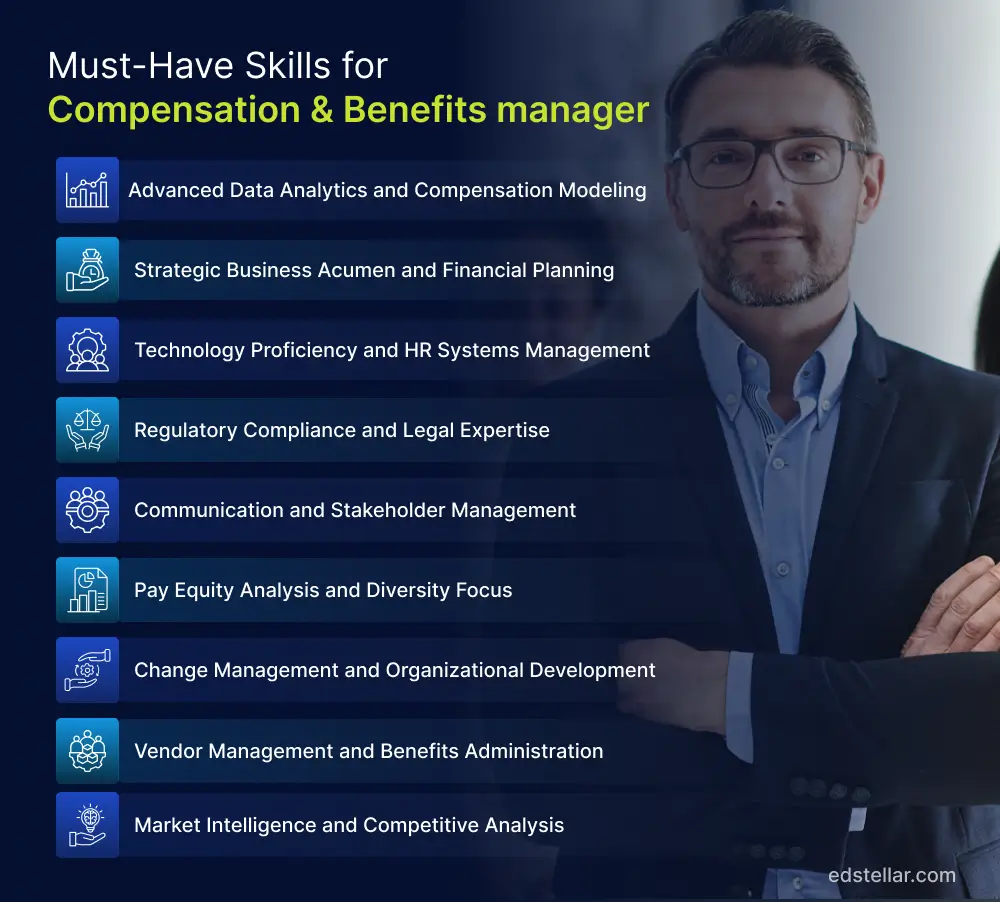
The nine skills outlined above represent the comprehensive competency framework required for compensation and benefits management excellence in 2025 and beyond. As organizations navigate inflation pressures, talent shortages, regulatory complexity, and technological transformation, compensation managers must continuously develop these capabilities to remain effective strategic partners.
The integration of advanced analytics, strategic thinking, technology proficiency, regulatory expertise, communication excellence, pay equity focus, change management, vendor oversight, and market intelligence enables compensation managers to design and implement total rewards programs that attract, retain, and engage top talent while maintaining financial sustainability.
Organizations that invest in developing these skills within their compensation teams position themselves to compete effectively for talent, ensure compliance, control costs, and build employee value propositions that differentiate them in crowded labor markets.