

The organizational landscape is undergoing unprecedented transformation. As businesses navigate digital disruption, demographic shifts, and evolving workforce expectations, organizational development (OD) specialists have emerged as critical architects of sustainable change. These professionals are no longer simply facilitators of training programs, they are strategic partners who shape organizational culture, drive performance improvement, and build adaptive workforces capable of thriving amid uncertainty.
According to the U.S. Bureau of Labor Statistics, employment of training and development specialists is projected to grow 11 percent from 2024 to 2034, much faster than the average for all occupations. This accelerated growth reflects organizations’ intensifying need for professionals who can bridge the gap between business strategy and human capability.
But what separates exceptional OD specialists from the rest? The answer lies in a sophisticated blend of technical proficiency, strategic thinking, and human-centered skills. As the World Economic Forum’s Future of Jobs Report 2025 reveals, 39% of workers’ core skills are expected to change by 2030, placing OD specialists at the forefront of organizational adaptation.
This article examines the eight essential competencies that define high-performing organizational development specialists in 2026 and beyond. Drawing from primary research by LinkedIn, SHRM, the World Economic Forum, and the Bureau of Labor Statistics, we’ll explore how these skills translate into measurable business impact and provide a strategic framework for professional development in this dynamic field.
Understanding the Evolving Role of OD Specialists
Before examining specific competencies, it’s crucial to understand how the OD specialist role has transformed. Traditional responsibilities centered on training coordination and program administration have expanded to encompass strategic workforce planning, cultural transformation, and business performance optimization.
LinkedIn’s 2025 Workplace Learning Report reveals that only 36% of organizations qualify as “career development champions” with robust programs that yield business results. This finding underscores the critical need for OD specialists who can design, implement, and measure initiatives that directly impact organizational outcomes.
Modern OD specialists serve as change agents, data interpreters, learning architects, and strategic advisors, often simultaneously. They must navigate complex stakeholder relationships, translate business objectives into development initiatives, and demonstrate return on investment through rigorous metrics.
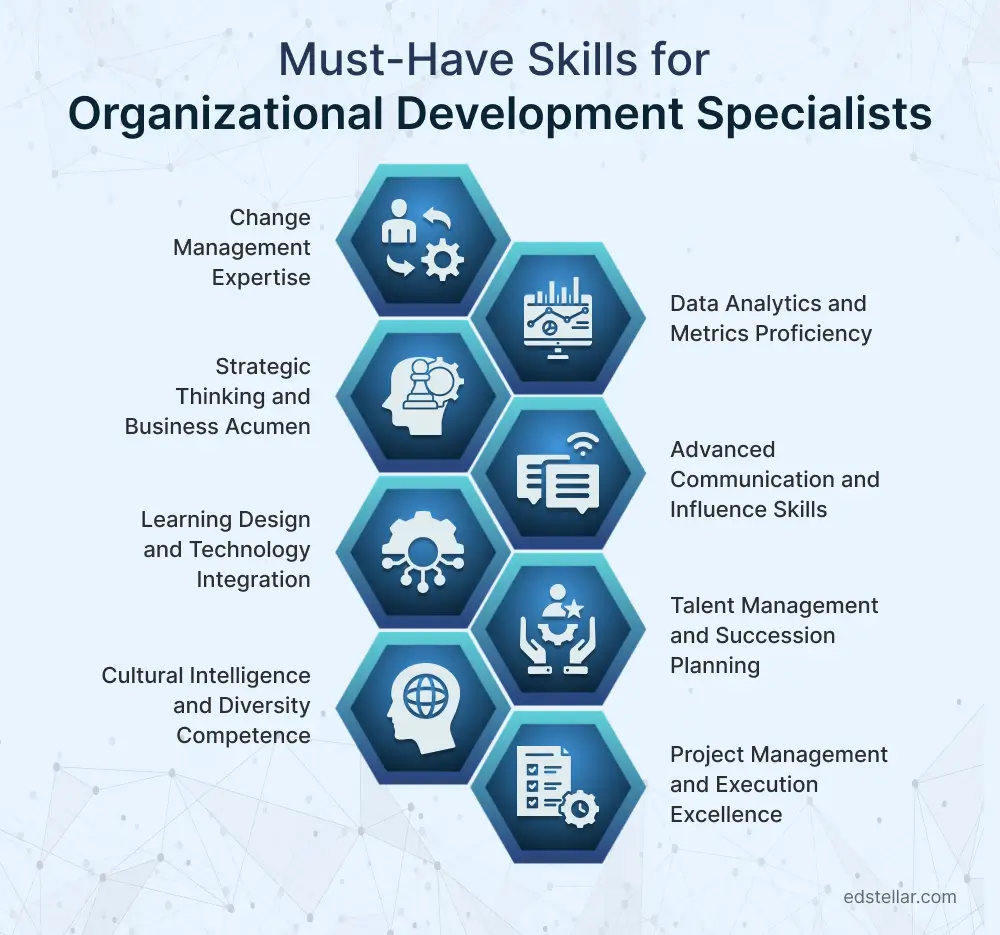
1. Change Management Expertise
Change management stands as the cornerstone competency for organizational development specialists. As businesses face increasing pressure to adapt quickly, the ability to design, lead, and sustain organizational change initiatives has become non-negotiable.
The World Economic Forum’s Future of Jobs Report 2025 identifies “resilience, flexibility, and agility” as the second most important core skill for organizations, with 67% of employers considering it essential. For OD specialists, this translates into practical expertise in change frameworks, stakeholder engagement strategies, and resistance management techniques.
Effective change management training enables OD specialists to:
- Assess organizational readiness for transformation initiatives
- Develop comprehensive communication plans that address stakeholder concerns
- Design interventions that accelerate adoption and minimize disruption
- Measure change effectiveness through quantitative and qualitative indicators
Real-world application of change management expertise requires understanding the human dimensions of transition. According to research from SHRM’s 2025 Talent Trends, 28% of organizations now require new skills for full-time roles, creating sustained change pressure that OD specialists must navigate.
The most effective OD specialists approach change management as both an art and a science, combining structured methodologies with emotional intelligence and situational awareness. They recognize that successful change isn’t simply about implementing new processes; it’s about shifting mindsets, behaviors, and organizational culture in sustainable ways.
2. Data Analytics and Metrics Proficiency
The evolution of organizational development from intuition-based practice to evidence-driven discipline has fundamentally transformed what makes an effective OD specialist. Today’s professionals must be fluent in data collection, analysis, and interpretation to demonstrate value and inform strategic decisions.
LinkedIn’s platform data reveals that business strategy, the ability to set goals and adjust to changing market forces, is the skill most likely to show net depletion at organizations experiencing talent attrition. This finding emphasizes the critical importance of OD specialists who can use hr data analytics to identify skill gaps, predict workforce trends, and quantify program impact.
Essential data competencies for OD specialists include:
- Conducting thorough training needs assessments using multiple data sources
- Designing measurement frameworks that align with business objectives
- Analyzing learning engagement metrics to optimize program delivery
- Translating complex data insights into actionable recommendations for leadership
The World Economic Forum reports that analytical thinking remains the most sought-after core skill among employers, with seven out of 10 companies considering it essential in 2026. For OD specialists, this means going beyond basic reporting to provide predictive insights and strategic recommendations.
Advanced OD practitioners leverage data to demonstrate return on investment, track skill development over time, and identify correlations between learning initiatives and business performance indicators. They understand that effective metrics balance quantitative rigor with qualitative insight, capturing both the “what” and the “why” of organizational development outcomes.
[Infographic Placeholder: Visual representation of key OD metrics framework, showing the connection between training inputs, engagement metrics, skill development indicators, and business performance outcomes]
3. Strategic Thinking and Business Acumen
Organizational development specialists who lack strategic thinking capabilities risk becoming order-takers rather than strategic partners. The ability to align development initiatives with broader business objectives separates tactical program administrators from strategic OD professionals who drive measurable organizational impact.
According to SHRM’s 2025 Talent Trends report, organizations with flexible work arrangements report less difficulty recruiting than those without (22% versus 29%). This finding illustrates how strategic workforce decisions directly impact business outcomes, a connection that effective OD specialists must recognize and leverage.
Strategic thinking in organizational development encompasses:
- Understanding industry dynamics, competitive pressures, and market trends
- Translating executive vision into actionable development roadmaps
- Identifying skill gaps that pose strategic risks to business objectives
- Designing scalable interventions that balance immediate needs with long-term capability building
The most effective OD specialists think like business leaders rather than training coordinators. They ask questions such as: How will this development initiative improve operational efficiency? Which capabilities will drive competitive advantage? Where should we invest limited resources for maximum impact?
This business-oriented mindset enables OD specialists to speak the language of executives, secure budgets for critical initiatives, and position organizational development as a value creation function rather than a cost center. It also allows them to prioritize development investments based on strategic importance rather than simply responding to the loudest stakeholders.
4. Advanced Communication and Influence Skills
Communication serves as the connective tissue of organizational development work. From conducting needs assessments to delivering training programs to presenting metrics to executives, OD specialists must master multiple communication modalities and adapt their approach to diverse audiences.
The World Economic Forum’s Future of Jobs Report 2025 identifies “leadership and social influence” as experiencing the most substantial increase in importance, with a 22 percentage-point rise in the share of respondents identifying it as a core skill compared to the 2023 edition of the report.
For OD specialists, advanced communication competencies include:
- Crafting compelling narratives that connect development initiatives to business outcomes
- Facilitating difficult conversations about performance, capability gaps, and organizational change
- Presenting data-driven insights in accessible formats for non-technical stakeholders
- Building coalitions across functional areas to drive adoption of new initiatives
Effective communication in organizational development extends beyond clarity to encompass influence and persuasion. OD specialists must often advocate for investments in development programs, navigate organizational politics to secure stakeholder buy-in, and inspire employees to embrace learning opportunities and behavioral changes.
LinkedIn’s 2025 Workplace Learning Report found that only 15% of employees say their manager helped them build a career plan in the past six months, a decline of 5 percentage points from 2024. This erosion in manager support underscores the critical role of OD specialists in equipping leaders with the communication skills necessary to coach, mentor, and develop their teams effectively.
The best OD practitioners recognize that communication is not simply about transmitting information but about creating understanding, building relationships, and catalyzing action. They tailor their messaging to resonate with different stakeholder groups while maintaining consistency in core messages across the organization.
5. Learning Design and Technology Integration
The rapid evolution of learning technologies has fundamentally transformed how organizational development specialists design and deliver development experiences. Today’s OD professionals must be fluent in instructional design principles, familiar with diverse learning modalities, and capable of leveraging technology to create engaging, effective learning experiences at scale.
According to SHRM’s 2025 Talent Trends, AI adoption in HR tasks climbed to 43% in 2025, up from 26% reported by HR professionals in 2024. This dramatic increase reflects the growing importance of technology integration skills for OD specialists who must evaluate, implement, and optimize AI-powered learning solutions.
Core competencies in learning design and technology include:
- Applying adult learning principles and instructional design frameworks to create effective programs
- Evaluating and implementing learning management systems, content authoring tools, and collaboration platforms
- Designing blended learning experiences that combine synchronous and asynchronous elements
- Leveraging AI and automation to personalize learning pathways and improve engagement
The World Economic Forum identifies “technological literacy” as the fourth-fastest growing skill, reflecting the imperative for professionals across all functions to develop digital fluency. For OD specialists, this means not only using technology but understanding how to strategically deploy it to address specific learning challenges and business needs.
Effective OD practitioners recognize that technology is an enabler rather than a solution in itself. They focus on learning outcomes first, then select appropriate technologies to support those outcomes. This learner-centered approach ensures that development initiatives remain focused on human needs rather than being driven by technological capabilities.
6. Talent Management and Succession Planning
Organizational development specialists play a pivotal role in identifying, developing, and retaining critical talent. The integration of OD practices with broader talent management strategies enables organizations to build sustainable leadership pipelines and maintain competitive advantage through human capital.
LinkedIn’s research reveals that career development champions are 42% more likely to be frontrunners in generative AI adoption compared to all others. This correlation underscores how robust talent development practices create organizational capacity for transformation and innovation.
Essential talent management competencies for OD specialists include:
- Conducting talent assessments to identify high-potential employees and capability gaps
- Designing career development frameworks that create clear pathways for advancement
- Building succession planning processes that ensure continuity in critical roles
- Creating internal mobility programs that retain talent while addressing evolving business needs
The Bureau of Labor Statistics data shows that training and development specialists held about 452,300 jobs in 2024, with the largest concentrations in professional services, healthcare, and educational services. This distribution reflects the universal importance of talent development across industries and organizational types.
Effective talent management requires OD specialists to think systematically about workforce capability over time. Rather than focusing exclusively on immediate skill gaps, they must anticipate future needs, design development pathways that build readiness for emerging roles, and create cultures that value continuous learning and growth.
The most sophisticated OD practitioners integrate talent management with organizational strategy, ensuring that development investments align with business priorities and that high-potential employees receive experiences that prepare them for increasing responsibility. They also recognize that effective talent management is fundamentally about creating conditions where people can do their best work and realize their potential.
7. Cultural Intelligence and Diversity Competence
As organizations become increasingly global and diverse, organizational development specialists must possess sophisticated cultural intelligence and the ability to design inclusive development programs that serve all employees effectively. This competency has evolved from a “nice-to-have” to a strategic imperative that directly impacts organizational performance.
Cultural intelligence in organizational development encompasses:
- Understanding how cultural backgrounds shape learning preferences, communication styles, and workplace behaviors
- Designing development programs that are accessible, relevant, and engaging for diverse employee populations
- Recognizing and addressing systemic barriers that limit development opportunities for underrepresented groups
- Creating inclusive facilitation practices that ensure all voices are heard and valued
The World Economic Forum notes that “empathy and active listening” rank among the top 10 core skills, reflecting the critical importance of understanding diverse perspectives and experiences. For OD specialists, this translates into practical competencies such as conducting culturally sensitive needs assessments, adapting program content for different contexts, and evaluating initiatives for equitable impact across demographic groups.
Research shows that diverse, inclusive organizations consistently outperform their peers on innovation, decision-making quality, and financial performance. OD specialists who embed diversity, equity, and inclusion principles into their practice enable their organizations to realize these benefits while creating work environments where all employees can thrive.
The most effective OD practitioners approach cultural intelligence as an ongoing learning journey rather than a static competency. They seek to understand unfamiliar cultural contexts, challenge their own assumptions and biases, and continuously refine their practice to better serve diverse stakeholder groups.
8. Project Management and Execution Excellence
The most brilliantly designed organizational development initiative will fail without disciplined execution. Project management competencies enable OD specialists to translate strategic vision into operational reality, coordinate complex initiatives involving multiple stakeholders, and deliver results on time and within budget.
Essential project management skills for OD specialists include:
- Developing comprehensive project plans with clear objectives, timelines, and resource requirements
- Coordinating cross-functional teams and managing stakeholder expectations throughout project lifecycles
- Identifying and mitigating risks that could derail development initiatives
- Monitoring progress against milestones and making course corrections as needed
According to SHRM’s 2025 Talent Trends, 69% of organizations report struggling to fill roles, reflecting 2016 levels after peaking in 2022. This persistent talent challenge places additional pressure on OD specialists to execute development initiatives efficiently and demonstrate tangible results that address capability gaps.
Effective project management in organizational development requires balancing competing demands, quality versus speed, comprehensiveness versus simplicity, and standardization versus customization. OD specialists must make pragmatic decisions that optimize outcomes given real-world constraints while maintaining focus on strategic objectives.
The best OD practitioners approach project management as both a discipline and an adaptive practice. They follow structured methodologies that provide consistency and control while remaining flexible enough to respond to changing circumstances, emerging insights, and stakeholder feedback.
Developing These Essential Skills: A Strategic Framework
Building competency across these eight skill areas requires intentional effort, structured learning experiences, and sustained practice. Organizational development specialists should approach their own development with the same rigor they apply to designing programs for others.
A comprehensive development framework includes:
Formal Education and Certification: Professional credentials such as ATD’s Certified Professional in Talent Development (CPTD) provide structured learning pathways that cover foundational competencies. The ATD Certification Handbook outlines skills required to perform effectively in talent development, offering a comprehensive competency model for professionals at all career stages.
On-the-Job Learning: The most powerful skill development often occurs through real-world application. OD specialists should seek stretch assignments that push them beyond their comfort zones, such as leading enterprise-wide initiatives, presenting to executive teams, or implementing new technologies.
Peer Learning and Networking: Professional communities provide opportunities to learn from practitioners facing similar challenges, share best practices, and stay current on emerging trends. Organizations like ATD and SHRM offer conferences, webinars, and local chapters that facilitate peer connection.
Continuous Feedback and Reflection: Regular feedback from stakeholders, combined with structured reflection on both successes and failures, accelerates skill development. Effective OD specialists actively solicit input on their performance and use it to refine their practice.
Strategic Skill Investments: Given the breadth of required competencies, OD specialists must prioritize their development efforts based on current capabilities, career aspirations, and organizational needs. Self-assessment tools and developmental feedback can inform these prioritization decisions.
Case Study: Transformation Through Comprehensive OD Capability
A global financial services organization recognized that traditional training approaches were insufficient to address the pace of change in their industry. They redesigned their organizational development function around the eight competencies outlined in this article, investing in both new talent and upskilling existing team members.
Challenge: The organization faced simultaneous pressures from digital transformation, regulatory change, and shifting customer expectations. Their existing OD team focused primarily on training delivery with limited strategic impact.
Solution: Over 18 months, the organization implemented a comprehensive transformation of their OD function:
- Hired data analysts to build robust metrics and reporting capabilities
- Partnered with business units to ensure alignment between development initiatives and strategic priorities
- Invested in advanced learning technologies including AI-powered adaptive learning platforms
- Established talent management processes that connected individual development to succession planning
- Created cultural intelligence resources to support their increasingly global workforce
Results:
- 34% improvement in skill proficiency scores across targeted competency areas
- 28% reduction in time-to-productivity for new employees
- 42% increase in internal promotion rates, reducing external recruitment costs
- Executive satisfaction scores for OD services improved from 6.2 to 8.7 out of 10
Key Takeaways: The transformation succeeded because leadership recognized organizational development as a strategic function requiring sophisticated capabilities. By developing their OD specialists across all eight competency areas, they created a team capable of driving measurable business impact rather than simply coordinating training logistics.
The Business Case for Investing in OD Specialist Development
Organizations that invest in developing sophisticated organizational development capabilities realize substantial returns. Research demonstrates clear connections between mature OD functions and key business outcomes:
Talent Retention: LinkedIn data shows that organizations with high scores on their Career Development Index have significantly higher promotion rates and more engaged learners. This translates directly into reduced turnover costs and improved organizational continuity.
Agility and Adaptability: The World Economic Forum reports that employers expect 39% of workers’ core skills to change by 2030. Organizations with capable OD specialists are better positioned to navigate this disruption through proactive reskilling and upskilling initiatives.
Competitive Advantage: As the Bureau of Labor Statistics notes, continuous training and upskilling will increase demand for training and development specialists as the skills relevant to many occupations evolve. Organizations that develop superior OD capabilities can adapt more quickly to market changes than competitors.
Innovation and Transformation: LinkedIn’s 2025 Workplace Learning Report reveals that career development champions are 42% more likely to be frontrunners in generative AI adoption. This correlation illustrates how mature OD functions create organizational capacity for innovation.
For individual OD professionals, investing in these competencies translates into enhanced career prospects, greater organizational impact, and increased job satisfaction. The Bureau of Labor Statistics reports a median annual wage of $65,850 for training and development specialists in 2024, with the highest 10 percent earning more than $120,190, compensation that reflects the strategic value of highly skilled practitioners.
Emerging Trends Shaping OD Competency Requirements
While the eight competencies outlined in this article represent enduring foundations for OD excellence, several emerging trends are reshaping what it means to be an effective organizational development specialist:
Artificial Intelligence Integration: The rapid adoption of AI in learning and development creates both opportunities and requirements for OD specialists. According to SHRM, AI adoption in HR tasks climbed to 43% in 2025, up from 26% in 2024. OD specialists must develop AI literacy, understanding both the capabilities and limitations of these technologies, to leverage them effectively while maintaining focus on human-centered development.
Skills-Based Talent Strategies: Organizations are increasingly moving away from role-based talent management toward skills-based approaches that emphasize capability rather than job titles. This shift requires OD specialists to develop sophisticated competency frameworks, design skill assessment tools, and create development pathways that build specific capabilities rather than preparing people for predefined roles.
Hybrid and Distributed Work: The sustained shift toward hybrid work models has fundamentally changed how development programs are designed and delivered. OD specialists must master virtual facilitation techniques, design asynchronous learning experiences, and create development opportunities that work equally well for remote and on-site employees.
Employee Experience Focus: Organizations increasingly recognize that development opportunities significantly impact employee experience and engagement. OD specialists are expanding their scope to consider how development initiatives contribute to broader employee experience outcomes, requiring competencies at the intersection of learning, culture, and talent management.
These trends don’t replace the foundational competencies outlined earlier but rather extend and apply them in new contexts. The most effective OD specialists embrace continuous learning as they navigate these evolving expectations.
Overcoming Common Development Challenges
Building comprehensive capability across eight skill areas presents challenges that OD specialists must recognize and address:
Time Constraints: LinkedIn’s research reveals that lack of time is a significant barrier to development, with 50% of respondents saying managers lack proper support. OD specialists face the same challenge, balancing immediate work demands with long-term skill development requires intentional prioritization and organizational support.
Resource Limitations: Not all organizations provide robust professional development budgets for their OD staff. Creative approaches include leveraging free resources from professional associations, pursuing stretch assignments that build skills through application, and creating informal learning partnerships with colleagues.
Rapidly Changing Requirements: The pace of change in organizational development practice means that competency requirements continually evolve. OD specialists must develop learning agility, the ability to quickly acquire and apply new knowledge, as a meta-competency that enables continuous adaptation.
Measuring Development Progress: Unlike technical skills that lend themselves to objective assessment, many OD competencies involve judgment, interpersonal effectiveness, and strategic thinking that are more difficult to measure. Creating developmental feedback mechanisms and seeking input from diverse stakeholders can provide insight into growth areas.
The most successful OD specialists approach these challenges as opportunities to model the learning mindset they encourage in others. They demonstrate vulnerability in acknowledging development needs, seek help from mentors and peers, and persist through the inevitable setbacks that accompany ambitious professional growth.
Building Your OD Career: Next Steps
For professionals aspiring to excel as organizational development specialists or those seeking to advance their existing practice, consider these concrete next steps:
Conduct a Skills Assessment: Honestly evaluate your current capabilities across the eight competency areas outlined in this article. Identify specific strengths to leverage and development priorities to address.
Create a Development Plan: Based on your assessment, design a structured plan that includes specific learning objectives, development activities, timelines, and success measures. Share this plan with your manager to secure support and accountability.
Seek Developmental Assignments: Volunteer for projects that stretch your capabilities in priority areas. Leading a change initiative, implementing new technology, or presenting to executives can provide powerful learning experiences that accelerate skill development.
Invest in Formal Learning: Consider professional certifications, graduate programs, or specialized training courses that provide structured learning pathways. Edstellar offers comprehensive change management training and organizational development consulting services that can support your development journey.
Build Your Professional Network: Connect with other OD practitioners through professional associations, conferences, and online communities. These relationships provide learning opportunities, career support, and perspectives that enrich your practice.
Practice Continuous Reflection: Establish regular habits of reflection on your work, soliciting feedback from stakeholders, and adjusting your approach based on what you learn. This practice of continuous improvement is fundamental to sustained growth as an OD professional.
Conclusion: The Strategic Imperative of OD Excellence
The eight competencies explored in this article, change management expertise, data analytics proficiency, strategic thinking, advanced communication, learning design, talent management, cultural intelligence, and project management, represent the foundation for excellence in organizational development practice. Together, they enable OD specialists to serve as strategic partners who drive measurable business impact rather than simply coordinating training programs.
As the World Economic Forum projects that 39% of workers’ core skills will change by 2030, the role of organizational development specialists becomes increasingly critical. Organizations need professionals who can assess capability gaps, design interventions that build required skills, and measure the impact of development investments on business outcomes.
The business case for investing in OD specialist development is clear. Research from LinkedIn, SHRM, and the Bureau of Labor Statistics demonstrates that organizations with mature organizational development capabilities outperform peers on talent retention, adaptability, innovation, and financial performance. For individuals, developing these competencies translates into enhanced career prospects, greater organizational impact, and the satisfaction of enabling others to realize their potential.
Yet building comprehensive capability across these eight areas requires sustained effort, strategic prioritization, and organizational support. The most successful OD specialists approach their own development with the same rigor they apply to designing programs for others, conducting thorough needs assessments, creating structured development plans, seeking diverse learning experiences, and measuring their progress over time.
As you reflect on your own development journey, remember that excellence in organizational development is not a destination but a continuous pursuit. The field will continue evolving, requiring adaptation and new capabilities. By building a strong foundation across these eight essential competencies, you position yourself not only to navigate current challenges but to lead your organization confidently into an uncertain future.
The organizations that will thrive in the decades ahead will be those that can learn, adapt, and evolve faster than their competitors. As an organizational development specialist, you have the opportunity to be the architect of that capability, designing the systems, programs, and cultures that enable your organization to meet whatever challenges emerge. That is both the profound responsibility and the extraordinary opportunity of this profession.
Ready to elevate your organizational development capabilities? Edstellar offers customized organizational development consulting and change management training programs designed to build the competencies that drive measurable business impact. Our experienced instructors work with your team to develop practical skills in change leadership, data analytics, strategic planning, and more. Contact us today to discuss how we can support your organizational development journey.