18 Essential Skills Every Full Stack Developers Must Master in 2026
.webp)
.svg "edstellar")

Are you ready to future-proof your development career or build a high-performing tech team? The demand for full-stack developers has never been stronger, and neither have the expectations.
According to the U.S. Bureau of Labor Statistics, employment for web developers and digital designers is projected to grow 7% from 2024 to 2034, much faster than the average for all occupations. With median annual wages of $127,566, full-stack developers command premium compensation, but only those equipped with the right blend of technical expertise and soft skills do.
The landscape has evolved dramatically. Today’s full-stack developers must navigate an ecosystem where Node.js and React dominate frontend frameworks with 48.7% and 44.7% adoption, Python sees a 7-percentage-point surge in backend usage, and DevOps tools like Docker and Kubernetes have become non-negotiable skills.
“The constant challenges in tech keep me on my toes and push me to keep learning. What excites me most is using that skill to build systems that genuinely help people."


This comprehensive guide reveals the 18 essential skills that define successful full-stack developers, from cutting-edge technical capabilities to the soft skills that a major portion of employers prioritize. Whether you’re charting your career path or building corporate training programs, these insights will help you stay ahead of the curve.
The full-stack developer role has evolved from a “jack of all trades” position into a strategic powerhouse that organizations actively pursue for digital transformation initiatives. In 2024, job postings for full-stack development roles rose by 42%, signaling accelerated hiring across industries.
What defines a full-stack developer today? These professionals possess end-to-end application development capabilities, seamlessly working across:
The market signals are clear: demand for full-stack developers is rising. It is expected to stay strong as companies push digital transformation, ship products faster, and prefer engineers who can work across the stack from UI to APIs to deployment.
Why the surge in demand? Organizations recognize that full-stack developers:
Overall demand for software builders isn’t slowing down. The U.S. Bureau of Labor Statistics projects employment for software developers, quality assurance analysts, and testers to grow 15% from 2024 to 2034, much faster than the average for all occupations. It also estimates about 129,200 openings each year on average over the decade, driven not only by growth but also by ongoing replacement needs as workers change roles or retire.
Frontend development forms the user-facing foundation of every digital product. In 2026, mastering frontend technologies isn’t optional; it’s the gateway to full-stack credibility.
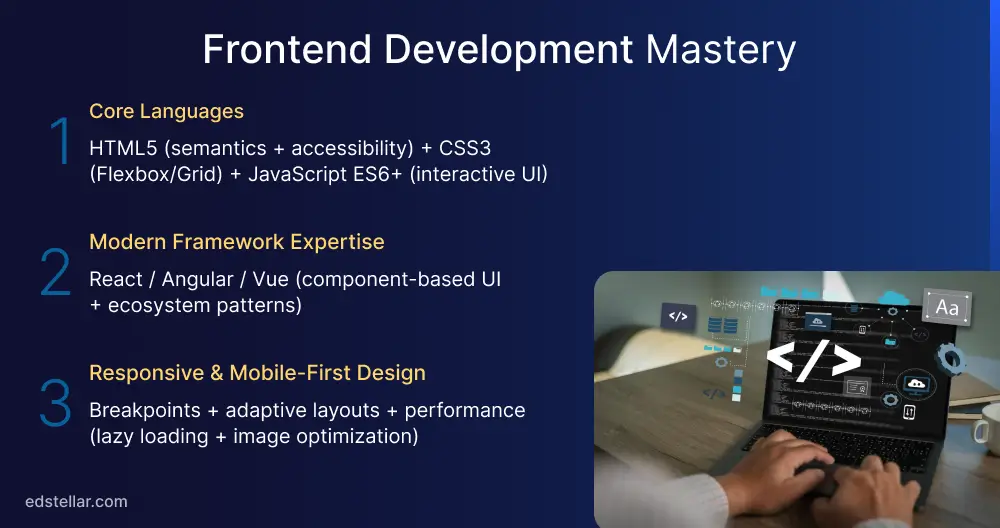
Every full-stack journey begins with the triumvirate of web development:
JavaScript has maintained its position as the most popular programming language in the Stack Overflow Developer Survey every year since 2013, except in 2013 and 2014. Its versatility across frontend and backend (Node.js) makes it indispensable.
The framework landscape has consolidated around three major players, each with distinct strengths:
Node.js and React dominate among developers, making them the most in-demand frameworks, with more than 126,000 jobs offered globally. Its component-based architecture and vast ecosystem make it ideal for:
Angular holds 17.1% market share, favored by enterprises for its comprehensive, opinionated framework approach. It’s the go-to choice for:
Vue.js commands 15.4% market share, maintaining its position as the third major framework, with 87,000 job offers. Its progressive framework design appeals to:
According to the State of JavaScript report, React received 8,548 responses showing active usage, followed by Vue.js (3,976) and Angular (3,642).
With more than 62.45% of internet traffic originating from mobile devices, responsive design has transitioned from a best practice to a fundamental requirement.
Full stack developers must master:
The number of smartphone users jumped from 4.8 billion in 2024 to 5.78 billion in 2025, underscoring the need for mobile-optimized experiences.
While frontend captures user attention, backend development powers the logic, data, and functionality that make applications truly valuable. Modern full-stack developers must command server-side technologies with the same confidence they bring to frontend work.
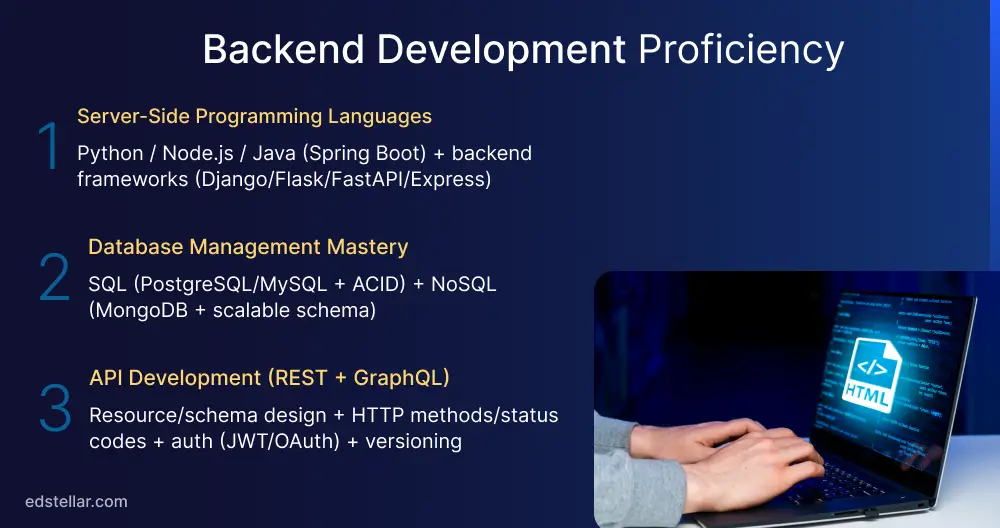
The backend language landscape has experienced significant shifts, with Python emerging as the clear winner:
Python saw a remarkable 7-percentage-point increase from 2024 to 2025, solidifying its position as the go-to language for AI, data science, and back-end development. Its advantages include:
Node.js remains the most widely used web framework, enabling JavaScript developers to work across the entire stack. It remains dominant for:
Java continues serving enterprise environments, particularly through the Spring Boot framework, which ranks among the top backend frameworks. Its strengths include:
Data persistence and retrieval form the backbone of every application. Full stack developers must navigate both relational and NoSQL database paradigms:
PostgreSQL has become the most popular database for the second consecutive year, used by 49% of developers in 2024, up from 33% in 2018, when it first appeared in the survey. This open-source relational database offers:
MongoDB leads the NoSQL space, favored for:
MySQL maintains relevance despite PostgreSQL’s rise, particularly in:
Application Programming Interfaces (APIs) enable different software components to communicate. Full stack developers must master both established and emerging API paradigms:
REST APIs are used by 85% of organizations, making RESTful design a fundamental skill. Key competencies include:
The line between development and operations has blurred to the point of irrelevance. Modern full-stack developers don’t just write code; they deploy, monitor, and scale it in production environments. DevOps capabilities have shifted from “nice-to-have” to essential skills, with 83% of IT decision-makers now adopting them to generate greater business value.
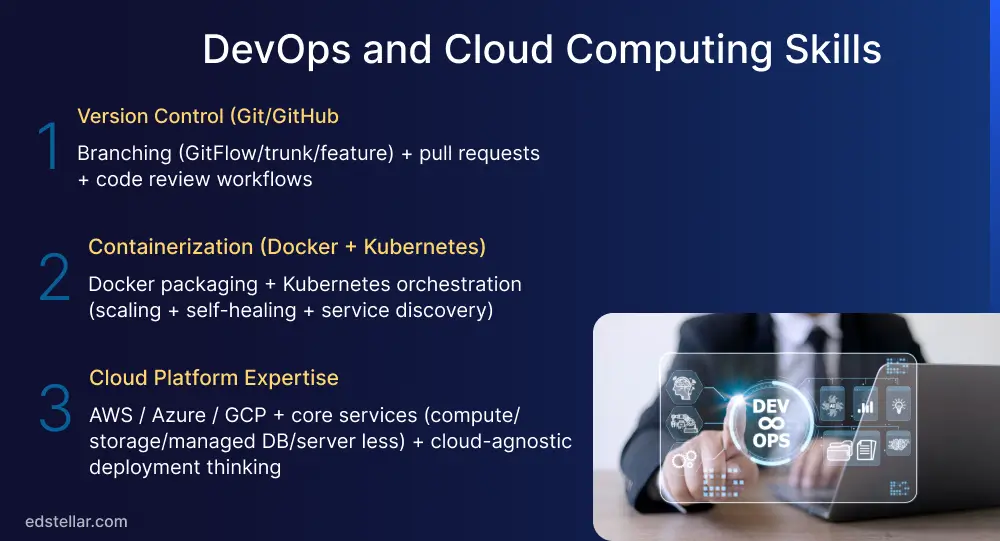
Version control isn’t just about backing up code; it’s the foundation of collaborative development. 85% of developers believe Git has made collaboration easier, and 99% of open-source projects use some form of version control, with Git being overwhelmingly dominant.
Full stack developers must master:
GitHub hosts approximately 100 million developers across countries, including the United States, France, and Indonesia.
Containerization has revolutionized application deployment, with Docker and Kubernetes leading the charge:
Docker commands a dominant 42.77% share in the DevOps tech stack, making it the single most in-demand DevOps skill. Containerization enables:
Kubernetes accounts for 28.02% of the DevOps skills market, enabling the orchestration of containerized applications at scale. Essential Kubernetes capabilities include:
Cloud computing knowledge separates junior developers from production-ready professionals. The major cloud providers each command significant market share:
AWS maintains steady usage with a consistent share compared to 2023, while Azure climbed from 26% to 28% usage, and Google Cloud increased from 24% to 25%.
AWS (12.1% DevOps skill demand) remains the market leader with 31% cloud computing market share. Key services include:
Microsoft Azure appeals to enterprises with existing Microsoft infrastructure, offering:
Google Cloud Platform (GCP) excels in:
Full-stack developers should develop cloud-agnostic thinking while gaining hands-on experience with at least one major platform.
Technical prowess opens doors, but soft skills determine how far you’ll walk through them. The most successful full-stack developers combine coding expertise with human-centered capabilities that enable effective collaboration, clear communication, and innovative problem-solving.
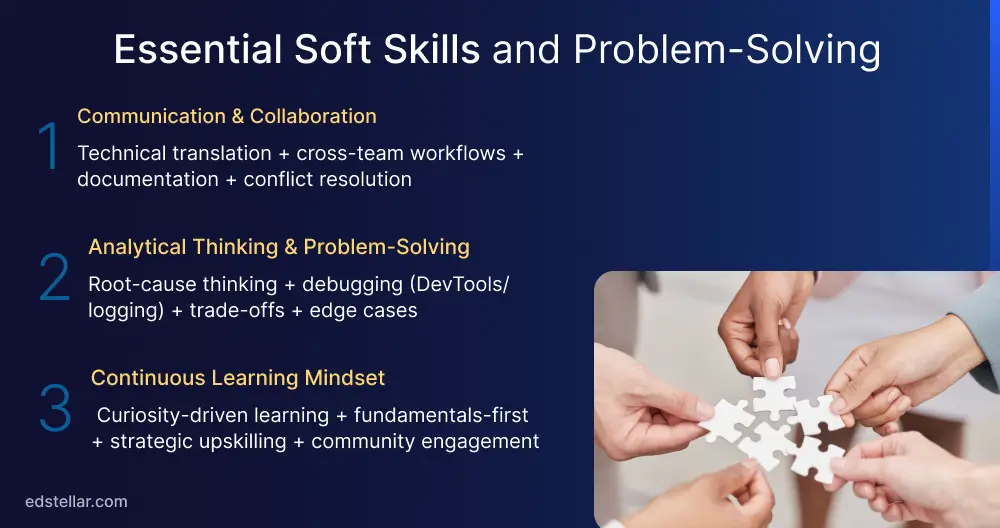
Full-stack developers operate at the intersection of multiple teams, including frontend specialists, backend engineers, designers, product managers, and business stakeholders.
Critical communication competencies include:
Technical Translation: The ability to explain complex technical concepts to non-technical stakeholders. When you can articulate why a particular architecture decision impacts business outcomes, you become invaluable to leadership.
Cross-Functional Collaboration: Modern development follows Agile methodologies, where 36% of IT organizations employ Agile frameworks (second only to DevOps at 49%). This requires:
Conflict Resolution: Disagreements about technical approaches are inevitable. Top developers navigate these diplomatically, focusing on data-driven decisions rather than ego-driven arguments.
An exploratory study published in the ACM Digital Library emphasizes that, in addition to technical skills, Software Engineering roles increasingly emphasize soft skills, including communication, teamwork, and negotiation.
David Leaser says, 91.2% of employers list problem-solving as the most crucial skill for hires, surpassing even specific technology expertise. This isn’t surprising; technologies change, but analytical thinking remains constant.
Debugging Mastery forms the core of problem-solving ability. Research shows that incorporating analytical thinking processes in programming tasks can increase error resolution speed by up to 30%.
Expert debugging involves:
Critical Thinking extends beyond fixing bugs to:
The technology landscape evolves relentlessly. Frameworks that dominate today may become legacy tomorrow. Full stack developers must cultivate:
Curiosity-Driven Learning: Rather than simply completing tasks, investigate why solutions work. Understanding fundamentals enables you to adapt when specific technologies change.
Strategic Skill Acquisition: Not every new framework deserves attention. Focus on:
Community Engagement:
68% of IT teams now have upskilling programs in place, up from just 30% in 2020, recognizing that continuous learning has become an organizational strategy, not just individual responsibility.
Code that works on a developer’s machine but fails in production isn’t truly functional. Full-stack developers must embed quality assurance and security consciousness throughout the development lifecycle, not as afterthoughts, but as fundamental practices.
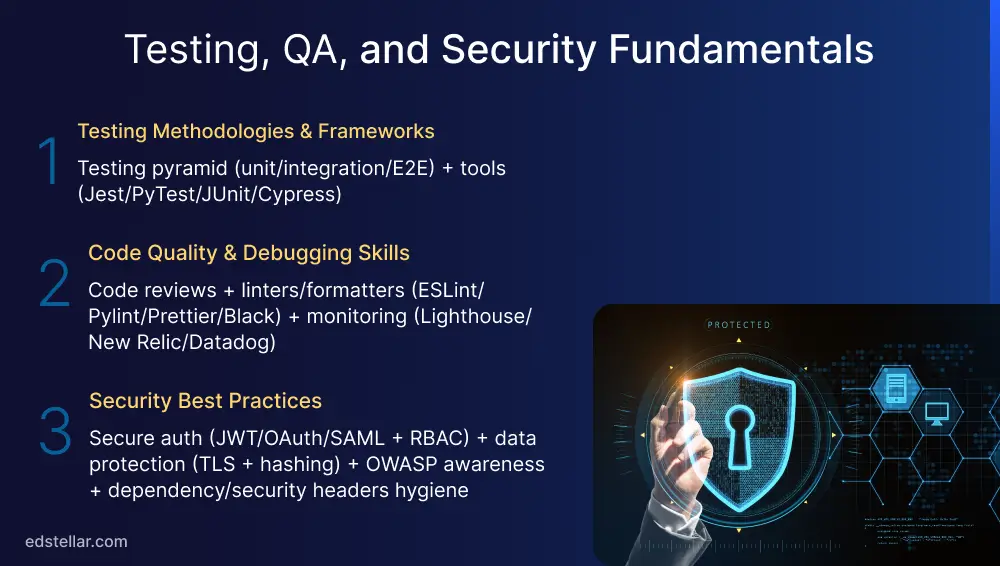
Modern development embraces a testing pyramid approach: unit tests form the foundation, integration tests validate component interactions, and end-to-end tests simulate user journeys.
Unit Testing validates individual functions and components in isolation. Popular frameworks include:
Integration Testing ensures that different modules work together correctly and catches issues that unit tests miss. This includes:
End-to-End (E2E) Testing simulates real user scenarios across the full stack. Tools such as Cypress, Selenium, and Playwright automate browser interactions to verify end-to-end workflows.
Full-stack testing helps ensure software is thoroughly tested, reducing the likelihood of defects and improving overall software quality. Covering every layer from the user interface to the backend, it ensures that all components work in harmony, resulting in a more stable and reliable product.
Quality assurance extends beyond formal testing to encompass:
The best full-stack engineers are adept with debugging tools and skilled at using online resources such as Stack Overflow and GitHub to troubleshoot issues efficiently.
Security cannot be bolted on after development; it must be woven throughout. The rise of DevSecOps reflects this shift, with the market valued at $3.73 billion in 2021 and forecast to reach $41.66 billion by 2030 at a CAGR of 30.76%.
Essential security competencies include:
Authentication and Authorization:
Data Protection:
Vulnerability Awareness:
29% of developers test their code for security vulnerabilities as part of their DevOps activities, reflecting growing security consciousness in development workflows.
While mastering current technologies is essential, forward-thinking full-stack developers keep one eye on the horizon. Understanding emerging trends enables strategic career decisions and positions you as an innovator rather than merely a maintainer of existing systems.
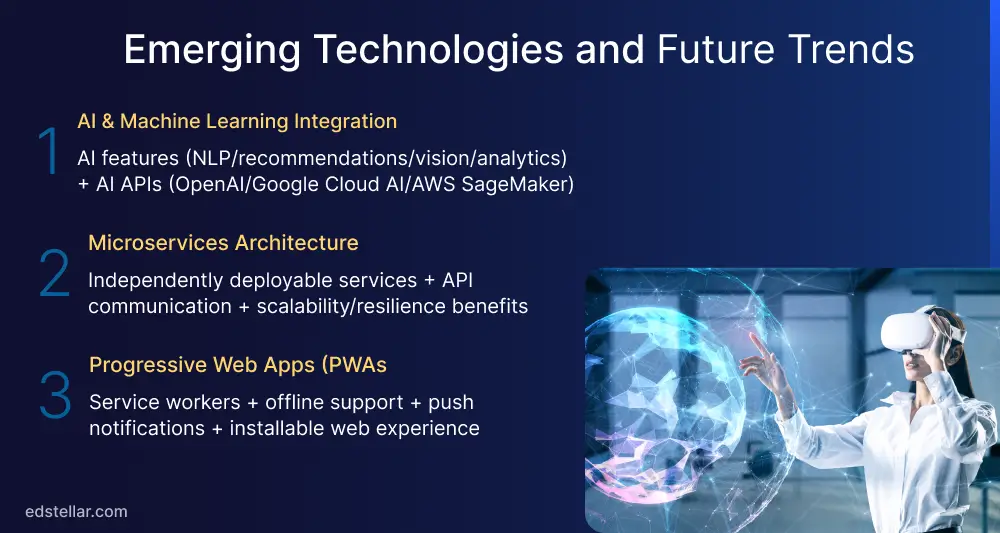
Artificial Intelligence is no longer confined to specialized data science teams. Full-stack developers increasingly integrate AI capabilities into applications:
AI-Powered Features:
Full-stack developers don’t need to become AI researchers, but understanding how to integrate pre-trained models and AI APIs (OpenAI, Google Cloud AI, AWS SageMaker) adds significant value.
Monolithic applications are giving way to microservices, independently deployable services that communicate through APIs. This architectural pattern offers:
PWAs bridge the gap between web and native mobile applications, offering:
The full-stack developer role in 2026 demands more than technical versatility; it requires strategic thinking, continuous learning, and the ability to translate technology into business value. From React’s 39.5% frontend dominance to Docker’s 42.77% DevOps ubiquity, from Python’s AI-driven surge to the 91.2% employer prioritization of problem-solving skills, the data tells a clear story: success belongs to those who balance technical depth with soft skill excellence.
The market validates this multidimensional approach. With 7% employment growth projected through 2034, median salaries exceeding $127,000, and a 27% worldwide market expansion through 2028, full-stack development offers exceptional career prospects for those equipped with the right capabilities.
#On-site #Virtual #GroupTraining #Customized
Explore 2000+ industry ready instructor-led training programs.

Create dynamic leaders and cohesive teams. Learn more now!


Do a quick Skill gap analysis with Edstellar’s Free Skill Matrix tool

Unlock premium resources, tools, and frameworks designed for HR and learning professionals. Our L&D Hub gives you everything needed to elevate your organization's training approach.
Access L&D Hub Resources.svg)
.svg)
.svg)
.svg)

.svg)


.svg "Click Here to Follow on Medium")
.svg)


