How Organizations Avoid Peter Principle Promotion Fails
.webp)

.svg "edstellar")

A promotion is supposed to be a reward. Yet in many organizations, it quietly becomes the moment a career starts to stall. One day, someone is the person everyone depends on; the next day, they’re in a bigger role, with higher visibility, and suddenly, the same strengths don’t produce the same results.
This isn’t just an individual problem. It’s a systems problem that scales fast, because promotions are one of the few talent decisions that reshape performance, culture, and retention all at once. It’s also why leadership development remains a persistent boardroom priority. McKinsey reports that nearly two-thirds of executives cite it as their top talent concern.
If you want a quick historical snapshot of how widely this thinking spread, the BBC Archive video captures the concept in its original cultural moment.
“In a hierarchy, every employee tends to rise to his level of incompetence."

Watch: 1974: Are YOU at your level of INCOMPETENCE? | The Peter Principle | BBC Archive
In this article, we’ll unpack how this pattern plays out inside real promotion systems, why it’s so hard to spot early, and what it costs when organizations keep repeating it. We’ll also walk through practical ways to redesign promotions so people don’t just move up, they actually succeed once they get there.
Let’s dive in.
The Peter Principle is the tendency for employees to be promoted based on their current performance rather than their suitability for the next role. As the Corporate Finance Institute explains, this often means people keep moving up until they reach a position where their skills no longer translate to what the theory calls their “final placement.”
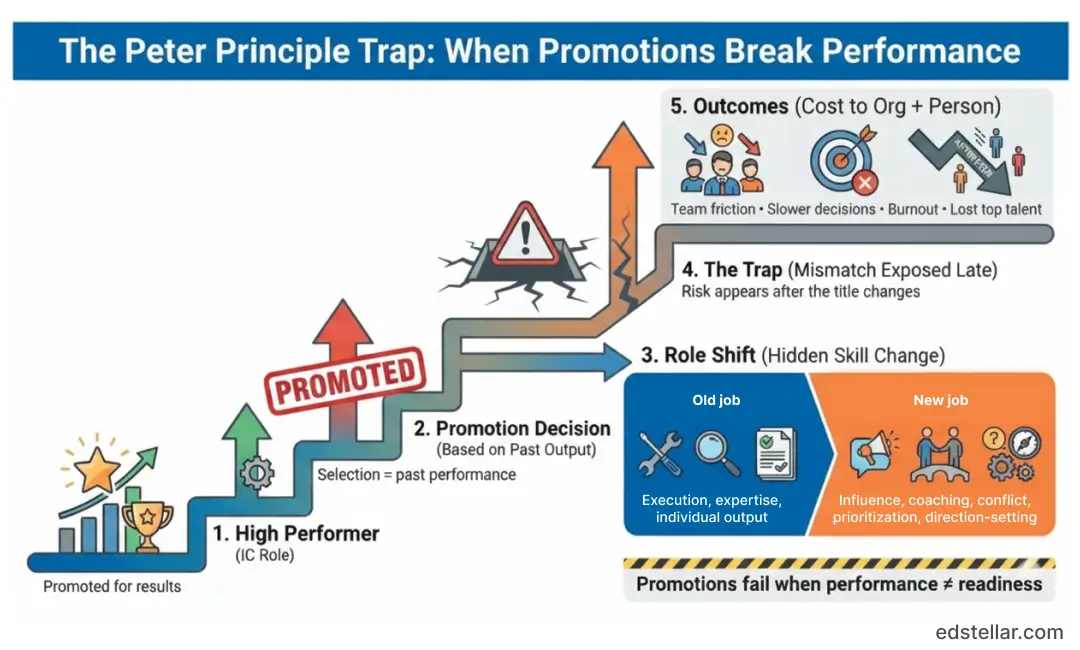
What makes this a trap is that the risk is usually invisible at the moment of promotion. Leaders see a consistent high performer and assume the next role is simply “more of the same.” But the higher level often demands different capabilities, negotiation, conflict resolution, prioritization, coaching, and setting direction skills that may not have been required (or even visible) in the previous role.
In other words, the failure isn’t random. It’s a predictable pattern: promoting the best performers without testing for next-level skills increases the odds of a mismatch, and that mismatch is where performance starts to break.
High performers often struggle after promotion for one central reason: the skills that made them successful in their current role are not the skills required in the next one. That skill gap is the engine behind the Peter Principle.
A widely cited study in The Quarterly Journal of Economics (covering 131 companies) found that organizations routinely promoted the highest-performing salespeople despite having no evidence of their managerial ability. A Forbes contributor warns that this mistake costs twice: client performance drops, and the promoted employee is “at greater risk of under-performing” in a very different role. A Yale study of 50,000 salespeople supports this: top reps often became poor managers.
Beyond skill mismatch and flawed selection criteria, high performers also struggle because they often haven’t been developed for leadership before the promotion happens. Many employees spend years mastering specialized tasks without ever being placed in situations that build coaching and mentoring ability, conflict management, cross-functional influence, or long-horizon thinking. When they’re suddenly promoted, they face team politics, interpersonal friction, and accountability for outcomes they don’t directly control, without the training or support to navigate these dynamics.
Another compounding factor is the lack of honest, developmental feedback. High performers are routinely praised for results, but rarely receive clear insight into gaps in leadership communication, empathy, delegation, or strategic thinking. Without tools such as 360° feedback or leadership simulations, both the employee and the organization stay blind to readiness risks until performance breaks.
Avoiding the Peter Principle isn’t about “being careful” with promotions. It requires a repeatable system that predicts success at the next level, builds readiness before the jump, and supports performance after the move. Use this step-by-step sequence.
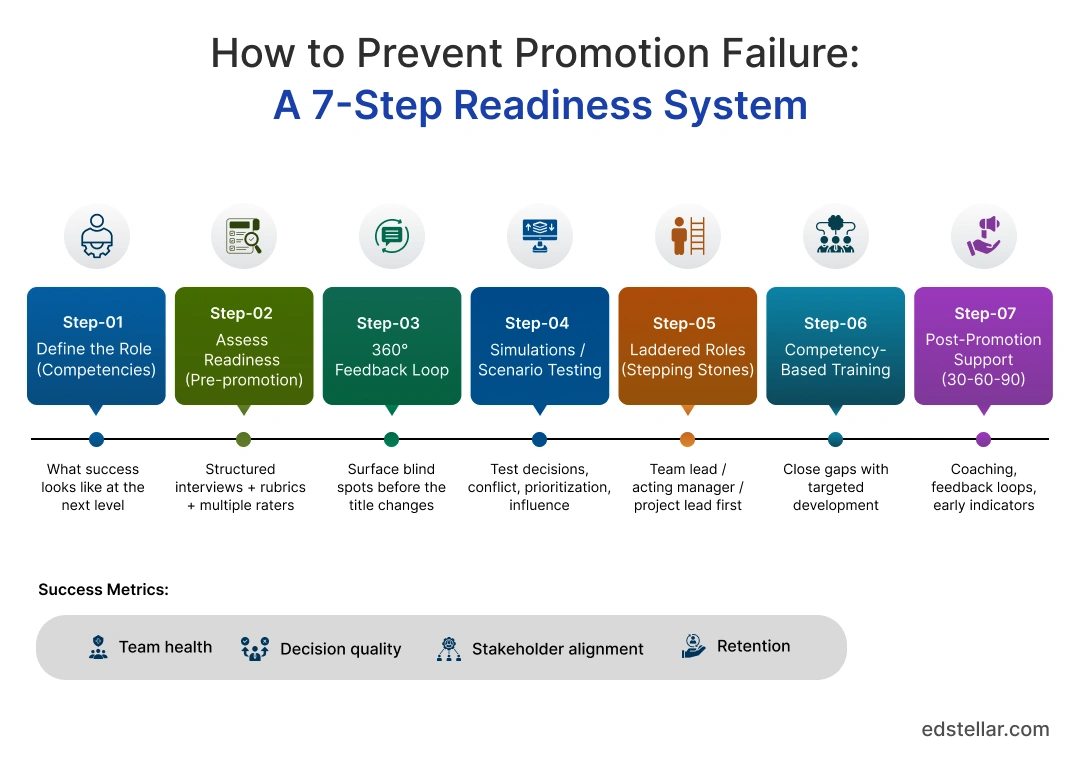
Start by translating the promoted role into observable competencies, not vague traits like “leadership presence.”
If you don’t define the target, you’ll keep promoting based on the last role’s scoreboard.
Don’t assume readiness, assess it.
This step is where most organizations fail: they promote outcomes, not capabilities.
Before you confirm the promotion, run a structured 360° feedback process to surface blind spots.
This is also where coaching matters. CHRO South Africa emphasizes that a comprehensive 360° feedback and performance management program keeps the lens focused on development, making promotion “mistakes” far less likely.
Before you hand someone a leadership title, test whether they can operate in leadership conditions.
A study published via MDPI highlights how simulations can provide a realistic preview of a leader’s job and strengthen decision-making and self-awareness. The point isn’t to “catch people out.” It’s to reduce preventable mismatch by seeing how someone performs when the job is fundamentally different.
Most promotion failures happen because the jump is too big and too sudden. Fix that structurally.
This converts leadership from a one-time promotion into a staged progression.
Assessment identifies gaps. Training closes them before the role demands them.
“The single biggest way to impact an organization is to focus on leadership development There is almost no limit to the potential of an organization that recruits good people, raises them up as leaders, and continually develops them."


Competency-based programs work best when they map directly to the framework in Step 1 and target the real demands of the next role (coaching, influencing, strategy, decision quality, etc.). This is where structured corporate leadership training becomes a practical lever, not a perk.
Edstellar supports this approach through modular, instructor-led leadership programs aligned to defined competencies, so progress is measurable and tied to role readiness rather than generic learning hours.
Even a strong promotion decision can fail without post-promotion scaffolding.
Bottom line: Promotions become reliable when you run them like a system: define → assess → get 360 feedback → simulate → transition through laddered roles → train to competencies → support after promotion. That’s how you stop rewarding the wrong indicators and start building leaders who actually thrive at the next level.
The Peter Principle is common, but entirely preventable. Effective promotions require more than applauding past performance; they demand clear role expectations, readiness assessments, and intentional development. As Jack Welch put it, “When you become a leader, it’s not about you anymore. It’s all about them.” That shift in responsibility is precisely why leadership capability must be built before someone steps into a bigger role.
Organizations that consistently avoid promotion failure rely on structured systems: leadership frameworks, 360° feedback, simulations, and coaching. Leadership development isn’t a perk; it’s the antidote to the Peter Principle, turning promotions into confident, evidence-based decisions.
This is where Edstellar becomes a strategic partner. With 2,000+ instructor-led programs, along with tools like the Skill Management Platform, Skill Matrix, and Stellar AI, Edstellar helps organizations identify gaps, build targeted competencies, and develop future-ready leaders. When prepared intentionally, high performers don’t rise to incompetence; they rise to excellence. Edstellar ensures that every step up is a step forward.
#On-site #Virtual #GroupTraining #Customized
Explore 2000+ industry ready instructor-led training programs.

Create dynamic leaders and cohesive teams. Learn more now!

Do a quick Skill gap analysis with Edstellar’s Free Skill Matrix tool

Unlock premium resources, tools, and frameworks designed for HR and learning professionals. Our L&D Hub gives you everything needed to elevate your organization's training approach.
Access L&D Hub Resources.svg)
.svg)
.svg)
.svg)

.svg)


.svg "Click Here to Follow on Medium")
.svg)


