Payroll Manager Skills, Roles & Responsibilities

.svg "edstellar")

The payroll management function has undergone a profound transformation in recent years, evolving from a purely transactional back-office role into a strategic business partner that directly impacts organizational success. As enterprises navigate an increasingly complex landscape of technological disruption, regulatory changes, and shifting workforce expectations, payroll managers find themselves at the intersection of compliance, technology, and human capital management.
This evolution reflects a broader organizational mindset shift, one that views payroll not merely as an administrative necessity, but as a critical function that influences employee experience, regulatory standing, and operational efficiency.
At the heart of this shift is the convergence of artificial intelligence, automation, and expanding global operations, forces that have fundamentally redefined what it means to manage payroll in a modern enterprise. The modern payroll manager now operates where precision meets strategy, compliance converges with technology, and employee trust hinges on flawless execution.
Balancing traditional responsibilities with emerging demands, today's payroll professionals must bring technical proficiency, analytical thinking, and cross-functional collaboration to every aspect of their work.
The data underscores the urgency of this transformation. Research from the World Economic Forum's Future of Jobs Report 2025 reveals that 39% of workers' existing skill sets will be transformed or become outdated between 2025 and 2030, placing unprecedented pressure on payroll professionals to continuously adapt and upskill.
Meanwhile, the U.S. Bureau of Labor Statistics projects that employment of human resources specialists, which includes payroll management roles, will grow 6% from 2024 to 2034, faster than the average for all occupations, generating approximately 58,400 new positions. Adding further complexity, SHRM's 2024 research on payroll technology trends highlights that globalization, generative AI, and on-demand pay are actively reshaping payroll operations, requiring managers to develop competencies that extend far beyond traditional calculation and compliance tasks.
Exceptional payroll management today demands a sophisticated blend of technical proficiency, analytical acumen, technological literacy, and strategic thinking. This comprehensive guide examines the essential skills, roles, and responsibilities that define high-performing payroll managers today and in the years ahead, providing actionable insights grounded in authoritative research and industry best practices.
“The onboarding process, which used to take an average of 23 hours per week, now takes just 30 minutes - a 98% reduction. Manual data entry has also been reduced by nearly 40 hours per week, thanks to bulk upload capabilities. Plus, we’ve moved from a standalone payroll machine to a fully online process that can even be run remotely if needed. That flexibility is a huge leap forward."


At the foundation of effective payroll management lies comprehensive mastery of payroll processing mechanics. This fundamental competency encompasses the entire compensation administration lifecycle, from gross-to-net calculations and statutory deductions to tax withholdings and benefits administration.
According to ADP’s 2024 Global Payroll Survey, payroll accuracy remains a persistent challenge, with organizations achieving a global mean accuracy of 78%, a marginal improvement from 75% the previous year. This statistic underscores the critical importance of processing precision, particularly as 32% of organizations report requiring two or more pay cycles to rectify errors, directly impacting employee financial well-being and organizational reputation.
Exceptional payroll managers demonstrate meticulous attention to detail across multi-faceted processing dimensions, including managing diverse payment frequencies, handling off-cycle payments, processing retroactive adjustments, and administering various compensation structures. The complexity intensifies for organizations operating across multiple jurisdictions, where managers must navigate varying statutory requirements, tax treaties, and localized compliance obligations.
Modern payroll processing demands proficiency in calculating complex compensation elements, including overtime differentials, shift premiums, commission structures, bonus calculations, and equity compensation. Managers must also expertly handle garnishments, voluntary deductions, benefit contributions, and loan repayments while ensuring mathematical accuracy and regulatory compliance.
The evolving nature of compensation structures, with ADP research indicating that 31% of organizations plan to introduce new payment methods over the next three years, including mobile wallets, earned wage access, and cryptocurrency options, necessitates continuous skill development in emerging payment modalities.
Edstellar’s Payroll Management Training Course equips professionals with comprehensive processing capabilities, covering everything from fundamental calculations to advanced scenarios involving complex compensation structures and multi-jurisdictional processing requirements.
Regulatory compliance is the cornerstone of payroll integrity, requiring managers to maintain up-to-date expertise across a broad and ever-evolving legal landscape. The regulatory environment governing payroll spans federal, state, and local jurisdictions, each imposing distinct requirements for tax withholdings, reporting obligations, record retention, and employee classifications.
Effective payroll managers maintain comprehensive knowledge of the Fair Labor Standards Act (FLSA), including overtime provisions, minimum wage requirements, and exempt versus non-exempt classifications. They navigate complex tax regulations, including federal income tax, Social Security, Medicare, the Federal Unemployment Tax Act (FUTA), the State Unemployment Tax Act (SUTA), and various local tax obligations.
Beyond tax compliance, managers must understand the Affordable Care Act (ACA) reporting requirements, wage garnishment regulations, paid leave mandates, and retirement plan contribution rules. The proliferation of state and local wage transparency laws, pay equity legislation, and predictive scheduling ordinances adds layers of complexity requiring continuous monitoring and adaptation.
The SHRM 2024 Payroll Technology Trends research emphasizes that regulatory compliance has become more critical as organizations expand globally, with compliance concerns ranking among the top priorities for payroll transformation initiatives. Managers must proactively track legislative changes, interpret regulatory guidance, implement process modifications, and ensure the timely filing of all statutory returns.
Organizations seeking to strengthen compliance capabilities can leverage Edstellar’s Payroll and Tax Fundamentals Training to build foundational knowledge and stay current with evolving regulatory requirements.
The digital transformation of payroll operations has elevated technological proficiency from a desirable competency to an absolute necessity. Today’s payroll managers must demonstrate fluency across comprehensive Human Capital Management (HCM) platforms, specialized payroll software, time and attendance systems, benefits administration tools, and emerging automation technologies.
LinkedIn’s 2025 Workplace Learning Report emphasizes that technology skills are evolving rapidly, with digital capabilities becoming increasingly critical to business operations. The report notes that 71% of learning and development professionals are exploring, experimenting, or integrating AI into their work, reflecting the broader technological shift affecting payroll operations.
Modern payroll technology ecosystems integrate multiple systems, requiring managers to navigate enterprise resource planning (ERP) platforms, cloud-based payroll solutions, applicant tracking systems, performance management tools, and financial accounting software. Proficiency in these technologies enables seamless data flow, reduces manual intervention, minimizes errors, and provides real-time visibility into payroll operations.
According to ADP's 2025 Global Payroll Survey, nearly two-thirds of organizations have already automated data collection (60%) and payroll-to-business-system reconciliations (54%), yet 94% still report seeking greater integration across payroll, HR, benefits, and finance platforms.
Artificial intelligence and machine learning technologies are revolutionizing payroll functions through predictive analytics, anomaly detection, intelligent automation, and natural language processing capabilities. Payroll managers must understand the capabilities and limitations of these technologies and implement them strategically to enhance accuracy, efficiency, and decision-making quality.
Edstellar offers specialized training in various HRMS platforms, including SAP HCM Training, Workday Training, and PeopleSoft HRMS Training, enabling payroll professionals to develop platform-specific expertise aligned with their organizational technology stack.
The transformation of payroll from a transactional function to a strategic business partner hinges on managers’ abilities to extract actionable insights from payroll data. Advanced analytical capabilities enable payroll managers to identify trends, forecast costs, optimize resource allocation, and inform executive decision-making with data-driven recommendations.
Exceptional payroll managers leverage analytics to track key performance indicators, including payroll accuracy rates, processing cycle times, cost per paycheck, error resolution timeframes, and regulatory compliance metrics. They conduct variance analysis comparing actual versus budgeted labor costs, analyze overtime patterns and trends, evaluate the financial impact of benefits programs, and assess workforce cost distribution across departments, locations, and projects.
Predictive analytics capabilities enable proactive decision-making through labor cost forecasting, headcount planning scenarios, benefits utilization modeling, and retirement eligibility projections. These insights inform strategic workforce planning, budget development, and resource optimization initiatives.
The evolution toward data-driven payroll management requires proficiency in business intelligence tools, data visualization platforms, statistical analysis methods, and dashboard development. Managers must translate complex datasets into compelling narratives that resonate with diverse stakeholder groups, from frontline supervisors to executive leadership.
Organizations investing in analytical capabilities position payroll as a strategic function that drives business value beyond administrative processing. Edstellar’s HR Analytics and Reporting Training equips professionals with comprehensive skills in data analysis, visualization, and strategic reporting.
While technical proficiency forms the foundation of payroll management, communication excellence distinguishes truly exceptional practitioners. Payroll managers serve as vital bridges between employees, leadership, external vendors, regulatory agencies, and cross-functional business partners, requiring sophisticated interpersonal skills.
The BLS Occupational Outlook Handbook identifies communication skills as essential for human resources specialists, emphasizing that listening and speaking abilities enable professionals to convey information effectively and respond to questions and concerns from employers, applicants, and employees.
Effective communication in payroll management encompasses multiple dimensions, including explaining complex compensation and benefits structures in accessible language; addressing employee inquiries with empathy and clarity; presenting payroll data and insights to executive audiences; collaborating with IT professionals on systems integration projects; and negotiating with vendors and service providers.
Payroll managers frequently handle sensitive conversations involving compensation discrepancies, tax issues, garnishment notices, and benefits administration challenges. These interactions require exceptional emotional intelligence, active listening skills, diplomatic problem-solving, and the ability to maintain confidentiality while building trust.
Cross-functional collaboration requires adaptability in communication styles when partnering with finance teams on general ledger integration, coordinating with HR on organizational changes that affect payroll, working with legal counsel on compliance matters, and engaging with facilities management on time and attendance implementation.
The shift toward global payroll operations introduces additional communication complexities, including navigating cultural differences, overcoming language barriers, accommodating time zone challenges, and understanding regional business practices. ADP research indicates that 47% of payroll leaders report increased volumes of employee queries, emphasizing the importance of effective communication capabilities.
Edstellar’s Business Communication Training helps professionals develop essential interpersonal skills, including stakeholder management, presentation skills, and conflict-resolution techniques.
Payroll operations present complex challenges requiring analytical thinking, creative problem-solving, and sound judgment. Exceptional payroll managers demonstrate the ability to diagnose root causes of recurring issues, design systematic solutions, evaluate alternative approaches objectively, and implement sustainable process improvements.
The World Economic Forum’s Future of Jobs Report 2025 identifies problem-solving as one of the most critical emerging skills for the future workforce, underscoring its importance across business functions, including payroll management.
Problem-solving in payroll management encompasses a range of scenarios, from resolving calculation discrepancies and system integration failures to addressing regulatory compliance gaps and vendor performance issues. Managers must rapidly assess situations, gather relevant information, analyze contributing factors, develop viable solutions, and implement corrective actions while minimizing disruption to payroll operations and employee experience.
Critical thinking skills enable managers to challenge assumptions underlying existing processes, identify inefficiencies and improvement opportunities, anticipate potential risks and develop mitigation strategies, and evaluate the broader implications of decisions beyond immediate payroll impacts.
The increasing complexity of compensation structures, including equity grants, performance-based bonuses, international assignments, and flexible benefit programs, demands sophisticated analytical capabilities. Managers must understand intricate tax implications, navigate regulatory requirements, design scalable processing solutions, and communicate complex concepts to diverse stakeholders.
According to ADP's 2024 Global Payroll Survey, 62% of organizations are actively reviewing how to operate payroll with fewer people, up five percentage points from the prior year, highlighting the growing premium placed on efficiency-focused problem-solving and process optimization skills.
Edstellar’s Decision Making Training equips professionals with structured frameworks for analytical thinking, systematic problem-solving, and strategic decision-making aligned with organizational objectives.
In an era characterized by escalating cybersecurity threats and stringent data protection regulations, payroll managers must serve as vigilant guardians of highly sensitive employee information. Payroll systems contain extensive personal data, including Social Security numbers, bank account details, salary information, tax records, and benefit enrollment selections, making them prime targets for cyberattacks and data breaches.
According to ADP, 60% of global business leaders report that a security breach has impacted their payroll operation between one and five times, underscoring why data security now ranks as the top planned improvement area globally, cited by 38% of organizations in ADP's 2024 survey.
Effective data security management requires a comprehensive understanding of encryption methodologies, access control protocols, audit trail requirements, incident response procedures, and disaster recovery planning. Managers must implement robust security frameworks incorporating multi-factor authentication, role-based access controls, regular security audits, employee security awareness training, and vendor security assessments.
Regulatory compliance adds additional complexity, with managers navigating requirements under the General Data Protection Regulation (GDPR) in Europe, California Consumer Privacy Act (CCPA) in the United States, and numerous other jurisdiction-specific privacy laws. These regulations impose strict obligations regarding data collection, processing, retention, and deletion, with substantial penalties for non-compliance.
Beyond technical safeguards, payroll managers must cultivate a security-conscious culture by providing regular training on phishing awareness, social engineering tactics, password hygiene, secure remote access practices, and incident-reporting protocols. ADP's 2024 Global Payroll Survey found that 52% of organizations now have detailed payroll protection plans in place worldwide, up from 46% the prior year, yet 99% acknowledge that data security has become more important underscoring the gap between awareness and preparedness.
Organizations seeking to enhance data protection capabilities can leverage Edstellar’s Data Privacy and Security Training to build comprehensive security competencies across technical, procedural, and cultural dimensions.
Payroll managers increasingly lead complex transformation initiatives that encompass system implementations, process redesigns, compliance migrations, and organizational restructuring. These undertakings demand sophisticated project management capabilities and change leadership skills to navigate technical complexities, stakeholder expectations, resource constraints, and organizational resistance.
Effective project management in payroll contexts requires comprehensive planning, including scope definition, timeline development, resource allocation, budget management, and risk assessment. Managers must coordinate cross-functional teams involving IT professionals, HR specialists, finance personnel, vendors, and subject matter experts while maintaining clear communication, managing dependencies, and tracking deliverables against established milestones.
Change management competencies enable payroll managers to assess organizational readiness for transformation, develop stakeholder engagement strategies, design comprehensive communication plans, create targeted training programs, and implement feedback mechanisms to address concerns and resistance.
Major payroll initiatives, such as system conversions, organizational mergers and acquisitions, and regulatory compliance projects, present unique challenges that require meticulous planning, thorough testing, comprehensive training, and phased implementation. ADP research indicating that 33% of organizations cite digitalization as a key driver for payroll transformation underscores the prevalence of technology-driven change initiatives.
Successful project execution requires agile methodologies that accommodate evolving requirements, iterative development, continuous stakeholder feedback, and rapid problem resolution. Managers must balance competing priorities, manage scope creep, address technical constraints, and maintain team momentum through project complexities.
Edstellar’s comprehensive Project Management Training equips professionals with essential frameworks, tools, and techniques to lead successful transformation initiatives.
The evolution of payroll from administrative function to a strategic business partner demands sophisticated business acumen and a strategic perspective. Exceptional payroll managers understand how their work connects to broader organizational objectives, influences financial performance, impacts employee engagement, and shapes competitive positioning.
Business acumen encompasses understanding financial statements and cost structures; interpreting labor market dynamics and competitive compensation practices; recognizing the impact of business decisions on payroll operations; and articulating payroll’s contribution to organizational success in financial terms.
Payroll managers with a strategic orientation proactively identify opportunities to optimize processes, drive technology innovation, reduce costs, and enhance services. They develop business cases that demonstrate return on investment for proposed initiatives, quantifying benefits through metrics such as processing efficiency gains, error-reduction impacts, compliance risk mitigation, and employee experience improvements.
The shift toward value demonstration requires payroll managers to position their function as a revenue enabler rather than a cost center, emphasizing contributions to talent acquisition and retention, workforce productivity and engagement, regulatory risk mitigation, and operational agility that supports business growth.
ADP survey findings that 30% of organizations name improved employee experience as a key driver for payroll transformation reflect growing recognition of payroll’s strategic role in overall talent management and organizational success.
Edstellar’s Strategic Planning Training helps payroll professionals develop a business perspective, strategic thinking, and the ability to position payroll as a value-generating function.
The most critical competency for modern payroll managers is the commitment to continuous learning and professional development. The rapid pace of technological innovation, regulatory change, and business transformation demands continuous skill development and adaptability to remain effective and relevant.
The World Economic Forum’s Future of Jobs Report projects that 39% of existing skills will be transformed or become obsolete between 2025 and 2030.
Continuous learning encompasses multiple dimensions, including technical skill development in emerging technologies and methodologies, regulatory knowledge maintenance through monitoring legislative changes and guidance, professional certification pursuit through organizations such as the American Payroll Association, industry engagement via conferences, webinars, and professional networks, and cross-functional exposure to finance, HR, and broader business operations.
The integration of artificial intelligence and automation into payroll operations requires ongoing skill development in AI literacy and applications in payroll contexts, data science fundamentals for analytics and reporting, change management for technology implementations, and strategic thinking to identify innovation opportunities.
Adaptability complements learning by enabling payroll managers to embrace change positively, adjust approaches based on feedback and results, remain resilient amid uncertainty and ambiguity, and experiment with innovative solutions to persistent challenges.
Organizations committed to developing payroll talent can leverage Edstellar’s comprehensive portfolio of HR Training Programs covering technical competencies, soft skills, leadership capabilities, and emerging technology applications.

Regulatory compliance has emerged as one of the most complex and consequential responsibilities for payroll managers today. The regulatory environment surrounding payroll has become increasingly complex, with jurisdictions frequently changing tax codes, labor laws, and reporting requirements.
Payroll managers must maintain comprehensive knowledge of federal, state, and local regulations while ensuring their organizations remain compliant across multiple jurisdictions.
This responsibility extends beyond mere knowledge of current regulations. Payroll managers must establish proactive compliance frameworks that anticipate regulatory changes and implement necessary adjustments before deadlines.
According to the World Economic Forum’s Future of Jobs Report 2025, geoeconomic fragmentation and increased government regulations rank among the top drivers of business transformation, with 34% of surveyed employers identifying geopolitical tensions as key drivers of organizational change. This trend directly impacts payroll operations, particularly for multinational organizations navigating diverse regulatory environments.
The compliance landscape in 2026 encompasses various domains, including wage and hour laws, tax withholding requirements, benefits administration, and data privacy regulations. Payroll managers must coordinate with legal, finance, and human resources departments to ensure comprehensive compliance across all these areas.
They serve as the primary liaison between their organizations and regulatory agencies, managing audits, responding to inquiries, and implementing corrective actions when necessary.
Furthermore, the rise of remote and hybrid work arrangements has added layers of complexity to compliance management. Payroll managers must now navigate multi-state and multi-country employment regulations, determining appropriate tax withholdings, benefit eligibility, and labor law applicability based on where employees physically work. This requires a sophisticated understanding of nexus rules, reciprocal agreements between jurisdictions, and the interplay between different regulatory frameworks.
Organizations increasingly rely on payroll managers to provide strategic guidance on compliance matters, incorporating regulatory considerations into business decisions about expansion, workforce planning, and compensation structures.
This strategic dimension of compliance management represents a significant evolution from the traditionally reactive approach to regulatory adherence. Payroll professionals who anticipate regulatory trends and position their organizations advantageously demonstrate the strategic value of modern payroll management to enterprise operations.
The digital transformation of payroll operations represents perhaps the most dramatic shift in the profession's modern history. Modern payroll managers serve as technology champions, driving the adoption and optimization of advanced payroll systems that leverage artificial intelligence, machine learning, and automation. This role requires technical proficiency that extends well beyond traditional payroll knowledge, encompassing system architecture, data analytics, and process automation.
According to research from the World Economic Forum, 86% of employers expect AI and information-processing technologies to transform their businesses by 2030, the highest impact among all technological trends. For payroll operations, this transformation manifests through intelligent automation of routine tasks, predictive analytics for workforce planning, and enhanced employee self-service capabilities.
Payroll managers must evaluate, select, and implement technology solutions that align with organizational needs and ensure seamless integration with existing enterprise systems, including HRMS, accounting software, and time-tracking platforms. This responsibility demands an understanding of API connectivity, data migration protocols, and system security requirements. The ability to assess vendor capabilities, negotiate service agreements, and manage implementation timelines has become essential to the payroll manager’s skill set.
The technology leadership role extends to change management and user adoption. Payroll managers must design training programs that enable payroll team members to effectively use new systems while supporting employees navigating self-service portals and mobile applications. They serve as the bridge between technical capabilities and operational requirements, translating business needs into system specifications and ensuring that technology investments deliver measurable value.
Cybersecurity considerations have become paramount as payroll systems house sensitive employee data, including social security numbers, banking information, and compensation details. Payroll managers must collaborate with IT security teams to implement robust security protocols, conduct regular vulnerability assessments, and establish incident response procedures. The increasing sophistication of cyber threats targeting payroll systems demands constant vigilance and proactive security measures.
Looking toward emerging technologies, progressive payroll managers are exploring applications of blockchain for secure record-keeping, natural language processing for employee inquiries, and predictive analytics for compensation benchmarking. Organizations that leverage advanced analytics through their corporate training for data analytics teams gain competitive advantages in workforce planning and cost optimization.
The transformation of payroll from a cost center to a value generator hinges significantly on the analytical capabilities that modern payroll managers bring to their organizations. In 2026, payroll managers serve as custodians of rich workforce data that, when properly analyzed, provides actionable insights for strategic decision-making across the enterprise. This analytical responsibility represents a fundamental expansion of the payroll function, positioning it as a critical source of business intelligence.
Payroll data encompasses comprehensive information about labor costs, overtime patterns, turnover indicators, compensation trends, and workforce demographics. Sophisticated payroll managers leverage this data to identify patterns and trends that inform strategic initiatives around talent retention, compensation planning, and organizational efficiency. The ability to extract meaningful insights from payroll data and communicate these findings to senior leadership distinguishes strategic payroll managers from their transactional counterparts.
Advanced analytics capabilities enable payroll managers to conduct predictive modeling that forecasts future labor costs based on historical trends, planned hiring initiatives, and market conditions. These forecasts prove invaluable for budget planning, enabling finance leaders to allocate resources with greater accuracy. Payroll managers who develop proficiency in data visualization tools can present complex information in accessible formats that facilitate executive decision-making.
Integrating payroll data with other enterprise data sources enables comprehensive workforce analytics to address questions on recruitment effectiveness, compensation equity, benefits utilization, and productivity metrics. Payroll managers increasingly collaborate with HR analytics teams to develop holistic views of workforce dynamics, identify correlations between compensation structures and performance outcomes, and uncover disparities that require attention.
Compliance reporting is another dimension of analytical responsibility, with payroll managers generating reports that demonstrate regulatory compliance, support internal audits, and provide documentation for external examinations. The ability to quickly generate accurate reports across multiple dimensions, by department, location, employment classification, or time period, has become essential for modern payroll operations.
Organizations seeking to strengthen their analytical capabilities often invest in data analytics training for their payroll teams, recognizing that these skills translate directly to competitive advantages. The payroll function’s unique position as steward of comprehensive workforce data makes it an invaluable source of business intelligence when managers possess the analytical skills to unlock these insights.
The employee experience dimension of payroll management has gained unprecedented prominence as organizations recognize the direct correlation between payroll accuracy, timeliness, and employee satisfaction. Today's payroll managers serve as service delivery leaders, ensuring employees receive accurate compensation on schedule and have access to the information and support they need regarding their pay.
Modern employees expect transparency and accessibility in their payroll interactions. They seek immediate access to pay statements, tax documents, and compensation information through intuitive digital platforms. Payroll managers must design and oversee service delivery models that meet these expectations while maintaining efficiency and accuracy. This includes implementing self-service portals that empower employees to update information, access historical records, and resolve routine inquiries without direct intervention from payroll staff.
Communication skills have become equally important as technical proficiency for payroll managers. They must effectively explain complex topics such as tax withholdings, benefit deductions, and year-end tax documents to diverse employee populations with varying levels of financial literacy. The ability to translate technical payroll concepts into clear, accessible language is a hallmark of exceptional payroll service delivery.
Proactive communication represents the best practice in modern payroll operations. Rather than waiting for employees to discover issues or have questions, effective payroll managers implement communication strategies that provide advance notice of changes, explain the implications of new policies, and offer resources for common questions. This proactive approach reduces inquiry volumes while enhancing employee confidence in payroll accuracy.
The service delivery responsibility extends to establishing clear channels for issue resolution. Payroll managers must implement ticketing systems or helpdesk solutions to ensure employee questions receive timely responses and to provide visibility into issue trends that may indicate systemic problems requiring attention.
Response time metrics, first-contact resolution rates, and employee satisfaction scores have become key performance indicators for payroll service delivery.
For organizations with global operations, payroll managers must navigate cultural differences and regional preferences in service delivery. What constitutes excellent service in one region may differ significantly from expectations elsewhere, requiring cultural sensitivity and localized approaches. Organizations investing in customer service excellence programs for their payroll teams often see measurable improvements in employee satisfaction.
The complexity of modern payroll operations has led many organizations to engage external vendors for specialized capabilities, making vendor management a critical responsibility for payroll managers. In 2026, payroll managers serve as strategic procurement leaders, evaluating vendor capabilities, negotiating service agreements, and managing ongoing relationships that directly impact payroll accuracy and efficiency.
Payroll vendors span a broad spectrum including core payroll processors, tax filing services, time and attendance providers, benefits administration platforms, and specialized solutions for international payroll, compliance management, or employee payments. Payroll managers must assess which functions warrant external expertise versus in-house management, balancing considerations of cost, risk, capability, and strategic importance.
The vendor selection process requires rigorous evaluation of multiple factors, including system capabilities, integration requirements, security protocols, service level agreements, pricing structures, and vendor financial stability. Payroll managers must develop detailed requirements specifications that capture organizational needs while creating evaluation frameworks that enable objective comparison across competing solutions.
The ability to negotiate favorable terms, encompassing not only pricing but also implementation support, ongoing service levels, and exit provisions, directly impacts the total cost and value of vendor relationships.
Once vendors are selected, effective contract management becomes essential. Payroll managers must monitor vendor performance against established service-level agreements, document issues, and escalate concerns when performance falls short of contractual commitments. Regular business reviews with key vendors provide a forum to address challenges, discuss enhancements, and ensure alignment between vendor capabilities and evolving organizational needs.
The vendor management responsibility extends to ensuring business continuity. Payroll managers must verify that vendors maintain adequate disaster recovery capabilities and business continuity plans that protect organizational interests in the event of vendor system failures or other disruptions. Establishing contingency plans that ensure payroll processing continues despite vendor issues demonstrates the risk-management dimension of this responsibility.
Managing vendor relationships also involves serving as the voice of the customer, communicating organizational feedback to vendors, and advocating for product enhancements that address identified needs. Progressive payroll managers participate in vendor advisory councils and user groups, leveraging these forums to influence product roadmaps while learning best practices from peer organizations.
The strategic partnership dimension of vendor management increasingly involves collaboration around innovation. Payroll managers work with vendors to pilot new capabilities, provide feedback during beta testing, and serve as reference customers for solutions that deliver value. These collaborative relationships position organizations to benefit from emerging capabilities while contributing to the evolution of payroll technology.
The interconnected nature of modern business operations has elevated cross-functional collaboration to a defining characteristic of effective payroll management. Payroll managers today function as organizational integrators, building partnerships with stakeholders across finance, human resources, information technology, and operations to ensure seamless coordination and shared success.
The relationship between payroll and human resources exemplifies this collaborative imperative. Payroll managers must work closely with HR teams to ensure that employee data flows accurately between systems, compensation changes are implemented correctly, and benefits administration aligns with payroll processing. Regular touchpoints between payroll and HR leaders help prevent issues and identify opportunities for process improvements that benefit both functions.
Similarly, the payroll-finance relationship requires constant coordination around general ledger posting, budget forecasting, accrual management, and financial statement preparation. Payroll managers must ensure payroll data integrates accurately with accounting systems and provides financial leaders with the information they need to make decisions. The ability to speak the language of finance, including concepts such as variance analysis and cost center allocation, enhances the payroll manager’s effectiveness in this relationship.
Information technology partnerships prove essential for system integration, security management, and infrastructure support. Payroll managers must collaborate with IT teams on system implementations, troubleshooting, security protocols, and disaster recovery planning. Establishing clear communication channels and mutual understanding of priorities prevents friction and ensures technology investments deliver intended benefits.
The change leadership dimension of cross-functional collaboration becomes particularly important during organizational transformations. Whether implementing new payroll systems, restructuring payroll operations, or adapting to regulatory changes, payroll managers must navigate the human dimension of change while maintaining operational continuity. This requires skills in stakeholder management, communication planning, training design, and change reinforcement.
According to the World Economic Forum’s Future of Jobs Report 2025, 85% of surveyed employers plan to prioritize upskilling their workforce by 2030, reflecting the recognition that workforce capabilities must evolve alongside technological and operational changes. Payroll managers who invest in developing their teams while fostering collaborative relationships position their organizations for sustained success.
Effective cross-functional collaboration also involves translating payroll expertise into language and frameworks that resonate with diverse stakeholders. When discussing payroll matters with executive leadership, successful payroll managers frame issues in terms of business impact, risk mitigation, and strategic advantage rather than technical details. This translation capability enables payroll managers to secure the necessary resources and support while elevating the payroll function's profile.
Organizations that recognize the strategic importance of collaboration often invest in leadership development programs to strengthen the collaborative and influencing skills of their payroll leaders. These investments yield returns through improved cross-functional coordination, faster resolution of complex issues, and enhanced organizational agility.
The evolution of payroll management from a primarily transactional function to a strategic business partner reflects the broader transformations reshaping modern enterprises. In 2026, payroll managers navigate a complex landscape that demands far more than traditional processing capabilities, requiring a sophisticated blend of technical proficiency, regulatory expertise, analytical acumen, and exceptional leadership.
The six key roles explored in this article, strategic compliance and regulatory oversight, technology integration and digital transformation leadership, data analytics and strategic workforce insights, employee experience and service delivery excellence, vendor management and strategic partnerships, and cross-functional collaboration and change leadership, collectively define the scope of modern payroll management responsibilities. These roles demand that payroll managers operate not just as processors but as strategic leaders who influence organizational direction and workforce outcomes.
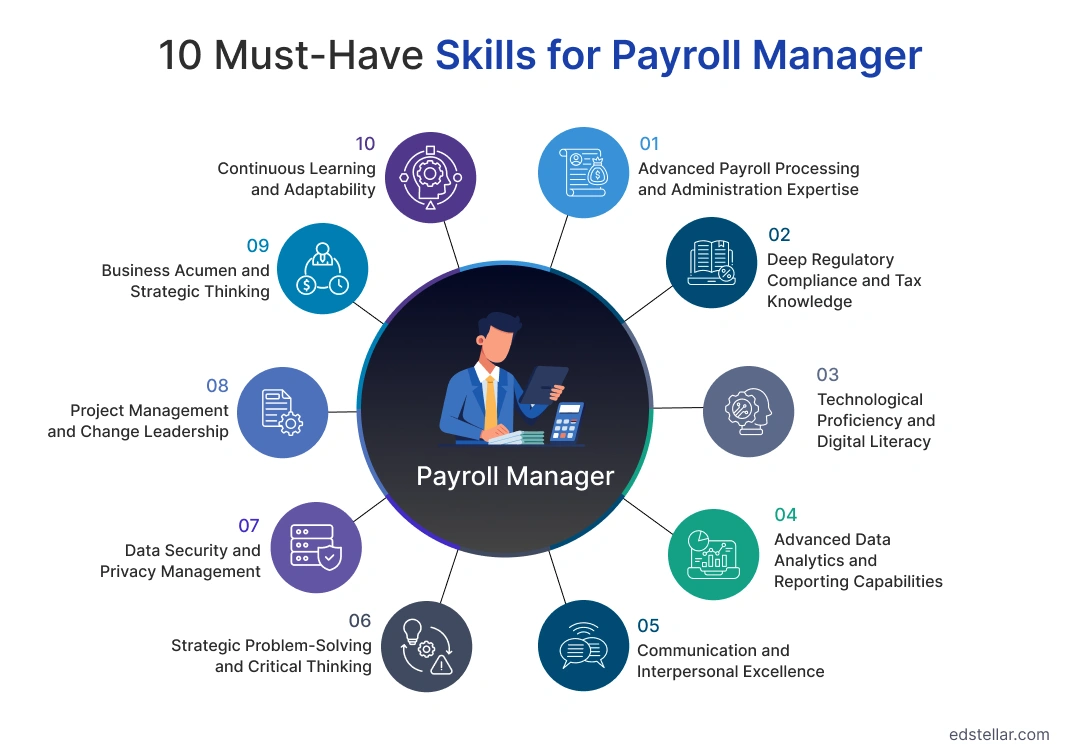
Fulfilling these expanded responsibilities requires mastery of ten essential competencies: advanced processing expertise, regulatory compliance knowledge, technological proficiency, analytical capabilities, communication excellence, problem-solving abilities, data security management, project leadership, business acumen, and a continuous learning commitment. Together, these skills equip payroll professionals to manage the operational precision their role demands while contributing meaningfully to broader business strategy.
Research from authoritative sources, including the World Economic Forum, the Bureau of Labor Statistics, SHRM, ADP, and Deloitte, consistently reinforces the strategic importance of payroll operations and the rapidly evolving skill requirements for professionals in this field. With employment in payroll management projected to grow 6% through 2034 and skills transformation expected to affect 39% of existing competencies by 2030, the need for proactive professional development has never been more urgent.
The path to payroll management excellence requires intentional investment that combines formal education, professional certifications, practical experience, and continuous learning.
Organizations that develop these competencies within their payroll teams through targeted corporate training, advanced technology implementation, and a culture of continuous improvement gain competitive advantages that extend well beyond the payroll function, driving operational efficiency, regulatory confidence, data-driven decision-making, and enhanced employee experience across the enterprise.
As regulatory complexity increases, technological capabilities expand, and employee expectations evolve, payroll managers who master the intersection of precision, strategy, technology, and people management will be the ones who transform payroll into a genuine value creator, leading their organizations toward sustainable competitive advantage in the dynamic landscape of modern workforce management.
#On-site #Virtual #GroupTraining #Customized
Explore 2000+ industry ready instructor-led training programs.

Create dynamic leaders and cohesive teams. Learn more now!

Do a quick Skill gap analysis with Edstellar’s Free Skill Matrix tool

Unlock premium resources, tools, and frameworks designed for HR and learning professionals. Our L&D Hub gives you everything needed to elevate your organization's training approach.
Access L&D Hub Resources.svg)
.svg)
.svg)
.svg)

.svg)


.svg "Click Here to Follow on Medium")
.svg)


