

Employee engagement has plummeted to a decade low, with only 31% of U.S. employees engaged in 2024, according to Gallup’s latest research. This alarming decline represents approximately 8 million fewer engaged employees compared to 2020, costing the global economy an estimated $438 billion in lost productivity. In this challenging landscape, Employee Engagement Managers have become critical architects of organizational success, tasked with reversing this trend and building workplaces where people thrive.
The role of an Employee Engagement Manager has evolved far beyond organizing team-building activities. Today, these professionals must navigate hybrid work complexities, manage generational expectations, leverage data analytics, and foster psychological safety, all while driving measurable business outcomes. Another Gallup research reveals that organizations with highly engaged teams see 23% higher profitability and 78% less absenteeism, making the mastery of engagement skills a business imperative rather than a “soft” concern.
“Our goal at Airbnb is to turn ‘belong anywhere’ into a workplace reality, creating flexible spaces and experiences that help employees choose how they work, connect, and feel they belong."


This article explores the essential skills that distinguish exceptional Employee Engagement Managers in 2026 and beyond. Whether you’re stepping into this role or looking to elevate your impact, these competencies will help you build the connected, motivated workforce that every organization needs to succeed.
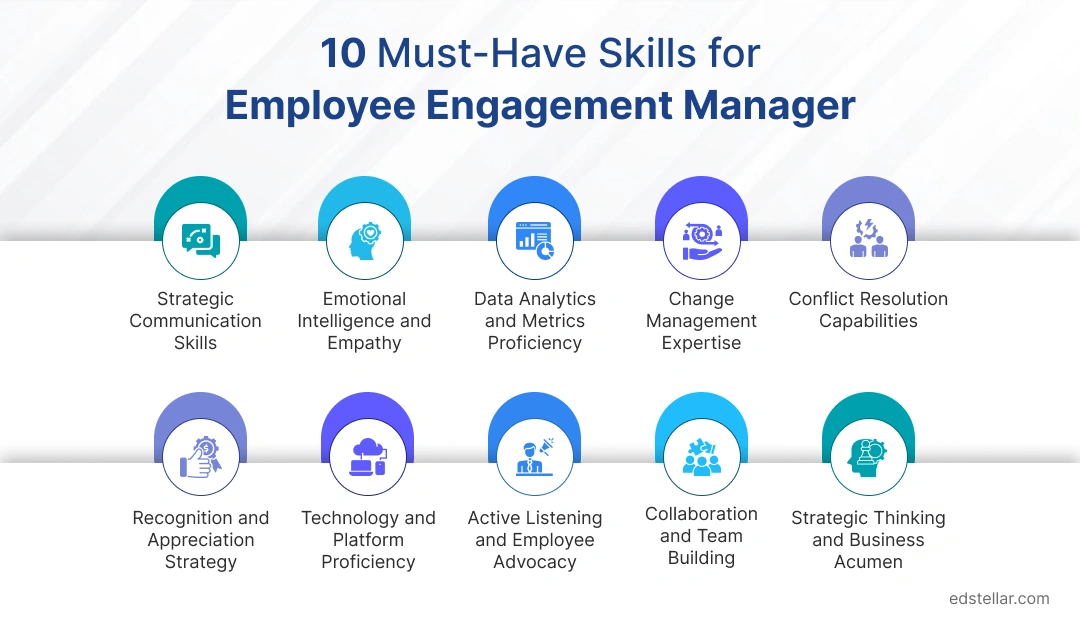
1. Strategic Communication Skills: The Foundation of Engagement
Communication stands as the cornerstone of employee engagement, yet it’s a skill that many organizations struggle to master effectively. The impact of strong communication skills cannot be overstated: research shows that employees who spend six hours per week with their leader are 29% more inspired and 30% more engaged than those with only one hour of weekly interaction, according to Leadership IQ’s study of over 32,000 employees.
The challenge intensifies when considering transparency. SHRM data reveals that 85% of employees feel more engaged when their leaders communicate transparently, yet only 56% of employees believe senior leaders make the effort to listen to staff, a figure that dropped from 65% in 2023. This communication gap directly correlates with the engagement decline we’re witnessing.
Why It Matters
Employee Engagement Managers must excel at translating organizational strategy into compelling narratives that resonate with diverse audiences. They need to craft clear, consistent messages across multiple channels while adapting their approach for different workforce segments, from frontline workers to senior executives. The ability to communicate context, rationale, and expectations clearly addresses one of the most significant engagement declines of 2024: only 46% of employees clearly know what is expected of them at work, down 10 percentage points from March 2020, according to Gallup research.
Key Components
- Multi-Channel Messaging: Deliver consistent messages through town halls, digital platforms, emails, and face-to-face conversations
- Audience Segmentation: Tailor communication styles for different generational cohorts, remote vs. on-site workers, and organizational levels
- Storytelling: Connect company initiatives to employee impact through compelling narratives
- Feedback Loops: Create two-way communication channels that encourage dialogue rather than one-way broadcasting
- Crisis Communication: Navigate sensitive topics and organizational changes with transparency and empathy
2. Emotional Intelligence and Empathy: Leading with Heart
Emotional intelligence has emerged as the #1 leadership skill for 2024, according to Forbes research. This isn’t merely a trending soft skill; it’s a quantifiable driver of team success. Studies show that emotional intelligence accounts for 58% of performance across various job roles, and leadership effectiveness depends 67% on a leader’s emotional intelligence capabilities.
The workplace landscape of 2024 demands heightened emotional awareness. With 70% of team engagement depending on the manager, and manager engagement itself dropping from 30% to 27% in 2024, according to Gallup, the ability to recognize and manage emotions, both your own and others’, has become critical for survival in engagement roles.
Why It Matters
Employee Engagement Managers with high emotional intelligence create psychologically safe environments where employees feel valued and understood. Research from the Center for Creative Leadership’s 2024 findings demonstrates that when leaders learn to set and manage emotional boundaries, team engagement increases by up to 71%. Furthermore, 42% of organizations enhanced their emphasis on emotional intelligence in 2026 compared to 2024, according to the HBR Global Leadership Development study.
For Employee Engagement Managers, emotional intelligence means detecting early signs of burnout, understanding the unique motivators of different team members, and responding to workplace tensions before they escalate into crises. With only 24% of employees feeling psychologically safe at work in 2024, according to Achievers Workforce Institute, this skill directly addresses a fundamental engagement barrier.
Key Components
- Self-Awareness: Recognize your own emotional triggers and biases
- Self-Regulation: Manage stress and remain composed during challenging situations
- Social Awareness: Read the room and understand unspoken emotional undercurrents
- Empathy: Genuinely understand employee perspectives and challenges
- Relationship Management: Build trust through consistent, authentic interactions
3. Data Analytics and Metrics Proficiency: Making Engagement Measurable
The age of intuition-based engagement strategies has ended. Modern Employee Engagement Managers must be fluent in data analytics to diagnose problems, measure impact, and demonstrate ROI. McKinsey research indicates that 60% of HR roles now demand proficiency in technology tools, including data analytics and AI platforms, a significant shift from previous years.
The importance of data-driven engagement strategies is underscored by research showing that organizations that use multiple feedback channels and frequently survey employees report significantly higher engagement levels, according to Achievers research. However, the key isn’t just collecting data; it’s transforming insights into actionable strategies.
Why It Matters
Data literacy enables Employee Engagement Managers to move beyond anecdotal evidence and identify patterns that reveal the true drivers of engagement within their organization. By analyzing pulse surveys, exit interviews, performance metrics, and engagement platform data, these professionals can pinpoint which initiatives deliver results and which fall flat.
The business case is compelling: organizations in the top quartile for engagement see 23% higher profitability, 18% higher productivity, and 51% lower turnover, according to Gallup. Employee Engagement Managers who can connect their initiatives to these outcomes become strategic business partners rather than administrative functions.
Key Components
- Survey Design and Analysis: Create meaningful pulse surveys that capture actionable insights
- Predictive Analytics: Identify flight risks and engagement trends before they become crises
- Dashboard Creation: Visualize engagement metrics for leadership consumption
- Correlation Analysis: Understand which engagement drivers most impact retention and performance
- Benchmarking: Compare internal metrics against industry standards and best practices
- ROI Calculation: Demonstrate the financial impact of engagement initiatives
4. Change Management Expertise: Guiding Through Transformation
Change has accelerated to unprecedented levels, with 85% of senior executives noting an explosive increase in organizational change projects over the past five years. Yet only 34% of change initiatives succeed, according to change management research. This gap creates both a challenge and an opportunity for skilled Employee Engagement Managers.
The human cost of poor change management is staggering. Nearly two-thirds (64%) of professionals globally feel overwhelmed by how quickly work is changing, with 68% searching for more support than ever before, according to LinkedIn’s 2024 research. Furthermore, only 27% of employees agree their leadership is trained to lead teams through change, a critical skill gap that Employee Engagement Managers must address.
Why It Matters
Change management capability directly influences engagement outcomes. Research shows that employees are 57 times more likely to view change as positive when it’s people-centered, according to O.C. Tanner’s 2024 Global Culture Report. Employee Engagement Managers serve as the critical bridge between organizational strategy and employee experience during transformation.
The stakes are high: 31% of CEOs have been fired for poor change management, and while 64% of employees possess the skills necessary to support successful change, only 25% effectively adapt their work methods when change is introduced, according to change management statistics.
Key Components
- Change Readiness Assessment: Evaluate organizational and individual capacity for transformation
- Stakeholder Mapping: Identify champions, resisters, and those on the fence
- Communication Planning: Develop comprehensive change narratives that address the “why” and “what’s in it for me”
- Resistance Management: Address concerns proactively and convert skeptics into supporters
- Adoption Monitoring: Track behavior changes and adjust strategies based on feedback
- Sustaining Change: Ensure new behaviors become embedded in organizational culture
5. Conflict Resolution Capabilities: Turning Tension into Opportunity
Workplace conflict management has emerged as one of the most critical, and most lacking, skills among managers today. DDI’s assessment of more than 70,000 manager candidates globally found that 49% fail to demonstrate effective conflict management skills, while only 12% show high proficiency in this area. These gaps have profound implications: 98% of organizations recognize the urgent need for better conflict resolution training and leadership upskilling, according to Workplace Peace Institute’s 2024 research.
The workplace has become increasingly polarized due to political tensions, generational divides, and challenges posed by hybrid work. Without strong conflict resolution capabilities, Employee Engagement Managers risk letting minor disagreements spiral into productivity-killing disputes that drive turnover and damage team cohesion.
Why It Matters
Poorly managed conflict creates ripple effects throughout organizations, stifling productivity, creativity, and morale, ultimately driving higher turnover. However, 95% of participants in conflict resolution training experience noticeable improvement in the work environment, according to HR Trends 2024 research. When handled effectively, conflict can lead to innovation and stronger team dynamics.
The specific skill gaps that contribute to conflict management failures include: 61% of manager candidates struggle to clarify core issues, 65% have difficulty offering support and resources, and 60% struggle to empower others to take ownership of conflicts, according to DDI’s 2024 research.
Key Components
- Early Detection: Recognize tension signals before they escalate into full-blown conflicts
- Neutral Mediation: Facilitate difficult conversations without taking sides
- Root Cause Analysis: Look beyond surface-level disagreements to address underlying issues
- De-Escalation Techniques: Lower emotional temperatures and create space for productive dialogue
- Win-win Solutions: Guide parties toward mutually beneficial resolutions
- Follow-Up: Ensure conflicts remain resolved and relationships are repaired
“Task conflict can be constructive when it brings diversity of thought, preventing us from getting trapped in overconfidence cycles."

6. Recognition and Appreciation Strategy: Fueling Motivation
Recognition is one of the most powerful yet underutilized drivers of employee engagement. Despite its proven impact, only one in three U.S. workers strongly agrees they received recognition or praise for doing good work, according to Gallup’s analysis. This recognition gap has serious consequences: 37% of employees identify recognition as the most significant factor driving their engagement at work.
The ROI of recognition is remarkable. When managers recognize and appreciate employee performance, employee engagement increases by 60%, according to Tower Watson research. Furthermore, employees who strongly agree that recognition is an important part of their organization’s culture are 3.7 times more likely to be engaged at work, according to Forbes research.
Why It Matters
Recognition directly addresses a fundamental human need: to feel valued and appreciated. Recent research from the Center for Workforce Transformation shows that about 2 in 3 employees feel valued by their organizations and regularly recognized for doing a great job. However, this also means one-third of employees feel undervalued, a significant engagement risk.
The consistency of recognition matters tremendously. 45% of employees recognized monthly or more are highly engaged at work, compared to much lower engagement among those receiving infrequent recognition, according to Achievers. Employee Engagement Managers must design recognition programs that are timely, specific, authentic, and equitable.
Key Components
- Peer-to-Peer Recognition Programs: Enable employees to celebrate each other’s contributions
- Manager Training: Teach leaders to deliver meaningful, specific praise
- Milestone Celebrations: Acknowledge work anniversaries, project completions, and personal achievements
- Values-Based Recognition: Connect praise to organizational core values
- Public and Private Appreciation: Balance visibility with individual preferences
- Recognition Equity: Ensure all roles and contributions receive appropriate acknowledgment
7. Technology and Platform Proficiency: Leveraging Digital Tools
The digital transformation of employee engagement has accelerated dramatically. HR technology has evolved from simple survey tools to sophisticated AI-powered platforms that predict turnover, personalize employee experiences, and automate routine engagement activities. Employee Engagement Managers who can’t navigate these platforms risk falling behind in a rapidly digitizing workplace.
Gartner listed AI trust, risk, and security management as its top HR technology trend for 2024, reflecting growing pressure to implement AI-driven engagement solutions responsibly. Meanwhile, employee experience platforms, data analytics tools, and automation technologies have become table stakes for modern engagement strategies.
Why It Matters
Technology proficiency enables Employee Engagement Managers to scale their impact beyond what’s humanly possible through manual efforts alone. Engagement platforms can automatically pulse employee sentiment, identify at-risk employees, facilitate peer recognition, and provide real-time feedback, all while generating insights that inform strategy.
The technology landscape for engagement includes employee experience platforms (like Culture Amp and Perceptyx), recognition tools, collaboration software, learning management systems, and people analytics dashboards. Mastery of these tools allows engagement professionals to work smarter, not harder, while delivering personalized experiences that employees increasingly expect.
Key Components
- Platform Selection: Evaluate and recommend engagement technology investments
- Data Integration: Connect engagement platforms with HRIS, performance management, and other systems
- User Adoption: Drive employee and manager utilization of engagement tools
- Analytics Interpretation: Extract meaningful insights from platform-generated data
- AI Literacy: Understand how artificial intelligence can enhance engagement strategies while managing risks
- Digital Employee Experience: Create seamless, intuitive digital touchpoints throughout the employee journey
8. Active Listening and Employee Advocacy: Being the Voice of Employees
Active listening has emerged as a strategic leadership skill that separates exceptional Employee Engagement Managers from average ones. Research indicates that effective listening can elevate employee morale and enhance workplace productivity, according to the 2024 Edelman research cited in Forbes. Yet too many organizations treat listening as a passive activity rather than a deliberate, strategic practice.
The listening gap is real and consequential. Only 56% of employees believe senior leaders make the effort to listen to staff, down from 65% in 2023, according to recent research. This decline in perceived listening correlates directly with falling engagement levels.
Why It Matters
Employee Engagement Managers serve as crucial conduits between the workforce and leadership. Through active listening, they surface concerns, identify systemic issues, and advocate for employee needs at decision-making tables. This advocacy role builds trust and demonstrates that employee voices matter, a critical component of engagement.
Leaders who listen well create company cultures where people feel heard, valued, and engaged. Employees who experience such environments report higher job satisfaction, stronger commitment, and greater willingness to contribute discretionary effort. Active listening also provides early warning signals about potential problems before they metastasize into full-blown crises.
Key Components
- Structured Listening Programs: Implement stay interviews, pulse checks, and skip-level meetings
- Focus Proups and Town Halls: Create safe spaces for honest dialogue
- Feedback Synthesis: Translate employee input into actionable recommendations for leadership
- Closing the Loop: Communicate back to employees what was heard and what actions will be taken
- Employee Advisory Councils: Establish formal mechanisms for employee representation
- Psychological Safety Creation: Foster environments where people feel comfortable speaking truth to power
9. Collaboration and Team Building: Strengthening Connections
The hybrid work era has fundamentally transformed how teams collaborate. With 60% of remote-capable employees wanting hybrid arrangements and only 10% preferring fully on-site work, according to Gallup research, Employee Engagement Managers must master both virtual and in-person collaboration strategies.
The collaboration challenge intensifies when considering that 78% of remote employees report high engagement, compared to 72% of on-site employees. Yet, hybrid workers face unique challenges around inclusion, visibility, and connection, according to 2024 remote work statistics. Employee Engagement Managers must design experiences that foster genuine connection regardless of physical location.
Why It Matters
Human connection drives engagement. Currently, only 39% of employees feel strongly that someone at work cares about them as a person, down from 47% in March 2020, according to Gallup. This decline in workplace relationships directly correlates with falling engagement levels.
Collaboration skills enable Employee Engagement Managers to break down silos, facilitate cross-functional teamwork, and create the interpersonal bonds that make work meaningful. In 2024, 49% of employees reported that learning and development focused on conducting effective hybrid meetings, according to hybrid workplace research, highlighting the ongoing need for facilitation skills in mixed work environments.
Key Components
- Virtual Facilitation: Lead engaging remote meetings that drive participation
- Hybrid Meeting Best Practices: Ensure on-site and remote participants have equal voice and visibility
- Team-Building Design: Create experiences that build authentic relationships rather than forced fun
- Cross-Functional Collaboration: Connect employees across departments and locations
- Inclusive Practices: Ensure diverse perspectives are heard and valued
- Community Building: Foster belonging through employee resource groups, social events, and shared experiences
10. Strategic Thinking and Business Acumen: Connecting Engagement to Business Outcomes
The most impactful Employee Engagement Managers think like business leaders, not just HR practitioners. They understand that engagement isn’t an end unto itself, it’s a means to achieve strategic objectives like innovation, customer satisfaction, profitability, and competitive advantage. Leaders in 2024 must develop strong strategic thinking and innovation skills to navigate a rapidly shifting landscape successfully.
Business acumen enables Employee Engagement Managers to speak the language of the C-suite, demonstrating how engagement initiatives directly contribute to the bottom line. Without this capability, engagement efforts risk being viewed as “nice to have” rather than strategic imperatives.
Why It Matters
Strategic thinking elevates the Employee Engagement Manager from tactical executor to strategic advisor. By understanding business priorities, market dynamics, and competitive pressures, these professionals can design engagement strategies that directly support organizational goals rather than operating in an HR silo.
The business case for engagement is clear: organizations with engaged workforces see 10% higher customer loyalty, 23% higher profitability, and 21% less turnover for normally high-turnover organizations, according to Gallup. Employee Engagement Managers with strategic thinking skills can connect their initiatives to these outcomes in ways that resonate with business leaders.
Key Components
- Business Model Understanding: Grasp how your organization creates and captures value
- Financial Literacy: Read P&L statements and understand key business metrics
- Strategic Alignment: Connect engagement initiatives to organizational objectives and KPIs
- Competitive Analysis: Understand how engagement practices compare to industry peers
- Scenario Planning: Anticipate future workforce trends and prepare accordingly
- ROI Storytelling: Articulate the business impact of engagement investments in compelling ways
How Edstellar Can Transform Your Employee Engagement Capabilities
Mastering these ten essential skills requires more than reading articles; it demands structured learning, practical application, and ongoing development. This is where Edstellar’s corporate training solutions create transformational impact.
Edstellar’s Approach to Building Engagement Excellence
Edstellar recognizes that effective Employee Engagement Managers need both foundational knowledge and advanced capabilities. Our comprehensive training portfolio addresses every skill outlined in this article through:
Customized Learning Pathways: Rather than one-size-fits-all programs, Edstellar designs training journeys tailored to your organization’s unique engagement challenges, industry context, and workforce demographics. Whether you’re building foundational skills or advancing to strategic mastery, our modular approach meets you where you are.
Instructor-Led Training Excellence: Our network of 5,000+ qualified and certified instructors brings real-world engagement expertise to every session. These practitioners have navigated the challenges you face, from reversing declining engagement scores to managing change initiatives to resolving complex workplace conflicts. Their insights transform theory into practice.
Technology-Enabled Learning: Through our innovative Training Management Platform, you can plan, schedule, track, and analyze your team’s development progress. This ensures your investment in engagement skills development delivers measurable results aligned with your business objectives.
Holistic Skill Development: Edstellar’s training portfolio spans the full spectrum of engagement capabilities:
- Leadership & Management Development: Build the emotional intelligence, communication, and strategic thinking skills that distinguish exceptional engagement leaders
- Behavioral Training: Develop the interpersonal effectiveness required for conflict resolution, active listening, and relationship building
- Technical Training: Master the data analytics, HR technology platforms, and digital tools that modern engagement requires
- Functional Training: Learn specialized engagement methodologies, from recognition program design to change management frameworks
Why Organizations Choose Edstellar for Engagement Training
- Global Reach, Local Relevance: Whether you need to upskill engagement managers across multiple countries or focus on a single location, Edstellar delivers training in the format, language, and cultural context that resonates with your workforce.
- Scalable Solutions: From training individual engagement professionals to developing entire HR departments, our scalable delivery model grows with your needs.
- Measurable Impact: Edstellar’s training evaluation framework helps you demonstrate the ROI of engagement skills development through pre- and post-assessments, application tracking, and business impact metrics.
- End-to-End Support: From initial consultation through post-training reinforcement, Edstellar’s team partners with you throughout the learning journey to ensure skills transfer from classroom to workplace.
Taking the Next Step
The data is clear: employee engagement has reached critical lows, and organizations need skilled professionals who can reverse this trend. The ten skills outlined in this article represent your roadmap to becoming that transformational leader, but knowledge alone isn’t enough. You need structured development, expert guidance, and practical application opportunities.
Edstellar stands ready to partner with you in building world-class engagement capabilities. Our proven approach has helped organizations across industries elevate their engagement practices, retain top talent, and create workplaces where people thrive.
Ready to transform your employee engagement impact? Contact Edstellar today to discuss how our customized training solutions can develop the skills your organization needs to build a highly engaged, high-performing workforce.
Conclusion
The role of Employee Engagement Manager has never been more critical, or more challenging. With engagement at decade lows, generational tensions rising, hybrid work creating new complexities, and business pressures intensifying, organizations need engagement professionals who possess a comprehensive skillset spanning communication, emotional intelligence, data analytics, change management, conflict resolution, recognition strategy, technology proficiency, active listening, collaboration, and strategic thinking.
These skills aren’t innate, they’re developed through deliberate practice, structured learning, and real-world application. The engagement managers who invest in mastering these capabilities will become indispensable strategic partners who drive measurable business results while creating workplaces where people feel valued, connected, and motivated to contribute their best work.
The future belongs to organizations that prioritize engagement not as an HR initiative but as a business strategy. By developing the skills outlined in this article and partnering with training providers like Edstellar who understand the practical realities of engagement work, you position yourself and your organization for sustainable success in an increasingly competitive talent landscape.
The engagement crisis is real, but so is the opportunity to make a difference. Which of these skills will you develop first?