10 Most In-Demand Skills in Norway for 2026

.svg "edstellar")

Norway's labour market is running short of workers across nearly every major sector. The Norwegian Labour and Welfare Administration (NAV) published its 2025 Bedriftsundersøkelsen (Business Survey) showing that Norwegian businesses are short of 39,000 workers, with 21% of firms reporting recruitment difficulties. The health and social services sector alone is missing an estimated 11,450 people, while vocational and trade roles account for 16,850 of the total shortage. Statistics Norway (SSB) projects this gap will widen to nearly 100,000 skilled workers by 2035 if current training pipelines remain unchanged.
Several structural forces are intensifying the pressure. Norway's population is ageing rapidly, with the share of residents over 67 expected to rise from 16% to 22% by 2040. At the same time, the country is accelerating its green transition, committing to 30 GW of offshore wind capacity by 2040 and allocating NOK 1 billion to artificial intelligence research over 2025 to 2029. These shifts are creating new skill demands that existing education and training systems are not yet equipped to fill, particularly in digital technologies, energy engineering, and healthcare.
So which skills in demand in Norway should corporate L&D leaders, HR managers, and workforce planners prioritise? This guide breaks down the top 10 high demand skills in Norway across technology, healthcare, engineering, construction, and education. It draws on NAV workforce data, NHO employer surveys, SSB labour statistics, and EURES shortage occupation reports to give you a data-backed picture of what jobs are in demand in Norway, whether you are planning corporate upskilling programmes, supporting skilled worker visa applications through UDI, or advising teams on professional development priorities for 2026 and beyond.
Every ranking in this guide is backed by data from Norwegian government bodies, industry associations, and established hiring platforms.
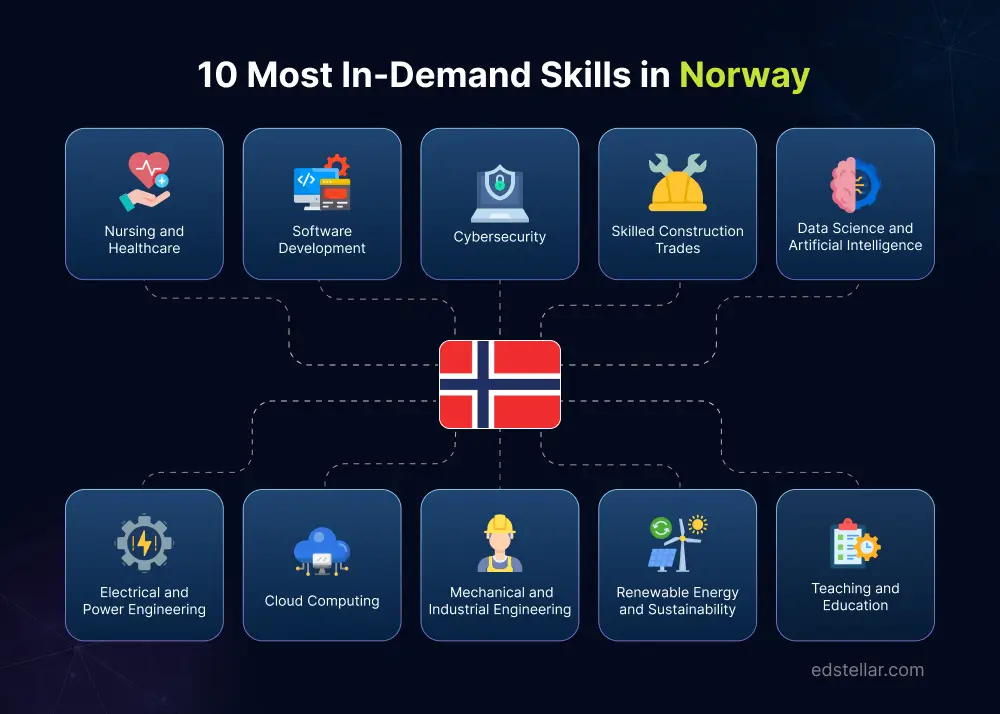
Norway's skills shortages span healthcare, technology, construction, engineering, and education, reflecting an economy shaped by North Sea energy revenues, aggressive digitalisation targets, and one of Europe's fastest-ageing populations. The 10 skills below are ranked by a weighted research score that factors in shortage volume from NAV data, growth velocity, salary premium, cross-sector applicability, and alignment with government policy priorities like the National Digitalisation Strategy 2024–2030 and the green transition roadmap.

NAV's 2025 Bedriftsundersøkelsen identified a shortage of 11,450 workers in health and social services, making it the single largest sectoral gap in the Norwegian economy. NAV director Hans Christian Holte stated that "the shortage in health, nursing and care is far higher than the number of unemployed," pointing to a structural mismatch that recruitment alone cannot solve. At the bachelor's degree level, 10,050 of the total 39,000 worker shortfall is concentrated in nursing positions, while 5,200 master's-level shortages sit primarily in medical specialist roles.
Norway's ageing population is the primary driver. The share of residents over 67 is projected to grow from 16% to 22% by 2040, placing enormous pressure on municipal health services, hospitals, and elderly care facilities. The government's Kompetanseløft 2025 initiative has directed funding toward health worker training, but completion rates have not kept pace with demand. Hospitals including Oslo University Hospital (OUS), Haukeland University Hospital in Bergen, and St. Olavs Hospital in Trondheim are actively recruiting internationally, particularly for specialist nurses in intensive care, geriatrics, and mental health.
Registered nurses in Norway earn between NOK 500,000 and NOK 700,000 annually according to SSB wage statistics, with specialist nurses and nurse anaesthetists commanding higher salaries. UDI lists nursing as a shortage occupation eligible for expedited skilled worker visa processing. For healthcare professionals outside the EEA, authorisation through the Norwegian Directorate of Health (Helsedirektoratet) and Norwegian language proficiency at B2 level are required for clinical roles.
Municipal Health Services, Hospital Systems, Home Care and Assisted Living, Public Health Administration
Explore Related Training:
Healthcare Data Analysis with ML ChatGPT for Healthcare All People Management Programs
The Norwegian Computer Society (Den Norske Dataforening) projects a need for over 16,000 software developers in the coming years, and the tech sector is growing at a projected 2.45% annually through 2029. According to NHO's Kompetansebarometer, 30% of Norwegian executives identify the inability to find qualified tech talent as their biggest obstacle to growth. Norway's tech market reached a value of $3.6 billion in 2025, with demand concentrated in Oslo, Bergen, Stavanger, and Trondheim.
Major Norwegian employers are driving this demand. Equinor has positioned technology as central to its digital transformation strategy, running large-scale software platforms for energy operations. Telenor is expanding its digital services across the Nordics and Southeast Asia, recruiting heavily for backend and cloud-native development, with DevOps engineers playing a central role in scaling delivery pipelines. DNB, Norway's largest financial services group, has built an in-house fintech innovation lab. Schibsted, Kahoot!, and Visma are also competing for developer talent across frontend, mobile, and platform engineering roles.
Software developers in Norway earn between NOK 600,000 and NOK 900,000 annually, with senior and staff-level engineers at companies like Equinor and DNB earning above NOK 1,000,000 according to Levels.fyi data. English is sufficient for 80–90% of IT roles in Norway, making this one of the most accessible in demand jobs in Norway for foreigners. Python, Java, JavaScript, TypeScript, and Kotlin are the most requested languages, with React, Node.js, and .NET frameworks dominating job listings.
Energy and Oil & Gas, Financial Services, Telecommunications, SaaS and EdTech
Explore Related Training:
AI Programming with Python Full Stack Development All Software Development Programs
Norway's cybersecurity market is growing at 27%, well above the global average of 18%, according to industry analysis from Grid Dynamics. The Norwegian government has committed NOK 13.8 billion ($1.3 billion) to cybersecurity initiatives, while the new Digital Security Act introduces stricter compliance requirements with fines of up to 4% of annual turnover for non-compliance. Cybersecurity roles are projected to grow 18% in Norway through 2026, creating sustained demand that far outpaces the domestic talent pipeline.
The Norwegian National Cyber Security Centre (NCSC), housed within Nasjonal sikkerhetsmyndighet (NSM), coordinates national cyber defence and operates NorCERT, Norway's national Computer Emergency Response Team. Nkom (Norwegian Communications Authority) was designated as Norway's national AI and digital security supervisor in 2025, expanding the regulatory surface that companies must navigate. Major employers recruiting cybersecurity talent include Equinor, Telenor, DNB, Mnemonic (Norway's largest dedicated cybersecurity firm), and the Norwegian Armed Forces' Cyber Defence unit. Professionals in these roles increasingly need to understand cloud security engineering as more critical infrastructure moves to cloud platforms.
Entry-level Security Analysts start at approximately NOK 460,000 annually, while experienced Information Security Consultants and CISOs can earn up to NOK 1,200,000. Key certifications in demand include CISSP, CEH, CompTIA Security+, and cloud-specific credentials like AWS Security Specialty. Norwegian language is not always required for technical roles, though security governance and compliance positions in the public sector typically require Norwegian at B2 or above.
Defence and Government, Financial Services, Energy and Utilities, Telecommunications
Explore Related Training:
Cybersecurity Risk Management Threat Intelligence All Cybersecurity Programs"A more technologically advanced Norway can best be achieved by expanding our research, innovation and competence as a country. This will enable us to embrace and use new technologies more quickly and efficiently."



NAV's 2025 survey found that Norwegian businesses are missing approximately 16,850 skilled tradespeople and vocational workers, representing 43% of the total national worker shortage. The biggest need is for workers holding a trade certificate (fagbrev) in mechanical and machine trades, including industrial mechanics, construction machine operators, and welders. EURES confirmed that building and related trades workers (excluding electricians) had the highest occurrence of shortage occupations in Norway in 2024.
Norway's construction pipeline is substantial. Residential and commercial development continues across Oslo, Bergen, and Stavanger, while major infrastructure projects include the Rogfast undersea tunnel (the world's longest road tunnel), E39 coastal highway upgrades, and new hospital construction in Stavanger and Drammen. The government's green transition agenda is adding further demand, with offshore wind installations, hydropower upgrades, and energy-efficient building retrofits all requiring skilled tradespeople. Companies like Veidekke, AF Gruppen, and Skanska Norway are among the largest employers in the sector.
Electricians in Norway earn between NOK 550,000 and NOK 700,000 annually, plumbers earn NOK 500,000 to NOK 650,000, and carpenters earn NOK 450,000 to NOK 600,000 according to industry salary surveys. For foreign tradespeople, Norwegian vocational qualifications must be recognised by NOKUT (Norwegian Agency for Quality Assurance in Education), and a fagbrev or equivalent is typically required. UDI includes multiple construction trades on its shortage occupation list for expedited visa processing.
Residential and Commercial Construction, Infrastructure and Civil Engineering, Energy Installation, Industrial Maintenance

The Norwegian government allocated NOK 1 billion to AI research and development over 2025 to 2029, and six national AI research centres were selected and launched in 2025 under the Norwegian Research Council's programme. AI-related job opportunities in Norway are projected to grow by 38% according to industry forecasts, making this one of the fastest-expanding skill categories in the country. KI-Norge (AI Norway), housed within the Norwegian Digitalisation Agency (Digdir), operates a national AI sandbox for companies to experiment with AI systems in a controlled environment.
In December 2025, a coalition of Norway's largest companies, including Aker, Cognite, DNB, DNV, Equinor, Hydro, SINTEF, Telenor, Vår Energi, Yara, NHO, and Kongsberg, signed a letter of intent to launch a coordinated national technology initiative focused on AI and quantum technology. This cross-industry commitment signals that AI and data science skills, supported by strong data engineering foundations, will be critical across energy, maritime, defence, manufacturing, and financial services for the foreseeable future.
Data Scientists in Norway earn between NOK 720,000 and NOK 1,038,000 annually, with AI Architects commanding the highest tech salaries at NOK 1,392,000 to NOK 1,706,000 according to Norwegian salary surveys. Machine Learning Engineers earn between NOK 850,000 and NOK 1,200,000. Key skills in demand include Python, TensorFlow, PyTorch, SQL, and experience with large language models and generative AI frameworks. English is the working language for most data science and AI roles in Norway.
Energy and Oil & Gas, Financial Services, Defence and Maritime, Research Institutions

EURES ranks science and engineering professionals among the top three shortage occupation groups in Norway, and electrical engineers are at the centre of that gap. Norway's energy transition requires massive grid upgrades to support offshore wind connections, expanded EV charging infrastructure, and electrification of industrial processes. According to NHO's Kompetansebarometer, the majority of member companies reported a great need for employees with professional education in natural sciences, engineering, and crafts.
The scale of Norway's energy infrastructure is extraordinary. Statnett, the national grid operator, is investing billions of NOK in grid expansion to connect new offshore wind zones and cross-border interconnectors. Equinor's Hywind Tampen, the world's first commercial-scale floating offshore wind farm, requires power engineering specialists for operations and maintenance. Statkraft, Europe's largest producer of renewable energy, is expanding its hydropower, solar, and wind portfolio globally, creating demand for power systems engineers, substation designers, and SCADA specialists.
Electrical engineers in Norway earn between NOK 600,000 and NOK 850,000 annually, with power systems specialists and those working offshore commanding premiums above NOK 900,000. UDI lists electrical engineering roles on its shortage occupation list. For foreign-trained engineers, NOKUT recognition of qualifications and membership in NITO (Norwegian Society of Engineers and Technologists) are standard requirements. Norwegian language at B1 level is typically expected for site-based roles.
Energy and Utilities, Offshore Wind and Oil & Gas, Infrastructure and Construction, Industrial Manufacturing

Norway's cloud computing market is projected to reach NOK 12.4 billion by 2029, creating over 11,500 new jobs across cloud architecture, infrastructure, and managed services according to industry forecasts. The country's National Digitalisation Strategy 2024–2030 positions cloud adoption as a core enabler for both public and private sector modernisation, with the government aiming to make Norway "the most digitalised country in the world" by 2030. Cloud skills consistently rank among the top IT competencies that Norwegian employers struggle to source, according to NHO survey data.
AWS, Microsoft Azure, and Google Cloud all operate or are expanding data centre regions in the Nordics, with Norway's abundant renewable energy and cold climate making it an attractive location for hyperscale facilities. Green Mountain, one of Norway's largest data centre operators, runs facilities powered entirely by hydroelectricity. Equinor, DNB, and Telenor have all migrated core workloads to cloud platforms, creating demand for cloud engineers, SRE engineers, and platform teams. Kongsberg Digital, a subsidiary of Kongsberg Gruppen, is building cloud-based industrial IoT platforms for maritime and energy sectors.
Cloud engineers in Norway earn between NOK 650,000 and NOK 950,000 annually, with certified AWS Solutions Architects and Azure specialists at the higher end. According to industry data, DevOps engineers with cloud expertise can command NOK 720,000 to NOK 1,000,000. Key certifications valued by Norwegian employers include AWS Solutions Architect, Azure Administrator, Google Cloud Professional, and Kubernetes (CKA/CKAD). English is the working language for most cloud roles.
Financial Services, Energy and Maritime, Telecommunications, Public Sector and Government
Explore Related Training:
Multi-Cloud (AWS + Azure) with DevOps Cloud Security Essentials All Cloud Computing Programs"In the future, having IT skills will be vital, not just for creating growth and jobs but also for ensuring high-quality public services and our national security. So it's crucial that educational programs are prioritized when looking towards the future."


NAV's 2025 survey identified the biggest vocational shortage in workers holding a trade certificate (fagbrev) in mechanical and machine trades, specifically industrial mechanics, construction machine operators, and welders. NHO's Kompetansebarometer confirms that the majority of member companies reported the greatest need for employees with professional education in natural sciences, engineering, and crafts. Mechanical engineering roles feature prominently on UDI's expanded shortage occupation list of over 190 approved occupations.
Norway's industrial base drives this demand. Kongsberg Gruppen, one of Norway's largest technology companies, designs and manufactures advanced defence systems, maritime equipment, and aerospace components, recruiting mechanical engineers across multiple divisions. Hydro, a global aluminium producer headquartered in Oslo, requires process and mechanical engineers for its smelters and recycling operations. The maritime sector, centred in Sunnmøre and the western fjords, employs thousands of mechanical engineers for ship design, offshore equipment, and subsea systems through companies like Ulstein, Rolls-Royce Marine (now Kongsberg Maritime), and Aker Solutions.
Mechanical engineers in Norway earn between NOK 600,000 and NOK 850,000 annually, with offshore and subsea specialists earning above NOK 900,000. Industrial mechanics with a fagbrev typically earn NOK 500,000 to NOK 650,000. Key skills include CAD/CAM software (SolidWorks, AutoCAD, CATIA), FEA analysis, hydraulics, and knowledge of Norwegian industrial standards (NORSOK for offshore). Norwegian language at B1 level is expected for most site-based industrial roles.
Maritime and Shipbuilding, Oil & Gas and Subsea, Defence and Aerospace, Aluminium and Manufacturing

The Norwegian government has committed to building 30 GW of offshore wind capacity by 2040, with the first auction round for bottom-fixed projects held in 2024 and the Utsira Nord floating wind competition announced in 2025. According to Chambers and Partners' Renewable Energy 2025 report, offshore wind is still at an early stage but accelerating rapidly, with 2026 predicted to be "a pivotal year where talent will make the difference." Equinor's Hywind Tampen, the first commercial-scale floating offshore wind project in Norway, commenced production in 2023 and serves as a proving ground for the technologies that will scale across future projects.
Beyond offshore wind, Norway is investing in carbon capture and storage (CCS) through the Northern Lights project, a joint venture between Equinor, Shell, and TotalEnergies that will store CO2 under the North Sea. Statkraft continues expanding its hydropower, solar, and onshore wind portfolio. Green shipping is another growth area, with companies like Yara developing zero-emission vessels and Havyard Group building hybrid-electric ferries. SINTEF, Norway's largest independent research organisation, is recruiting sustainability researchers and engineers for energy transition projects across its Trondheim and Oslo campuses.
Renewable energy specialists in Norway earn between NOK 650,000 and NOK 950,000 annually, depending on specialisation. Offshore wind project managers and CCS engineers command higher salaries given the scarcity of experienced professionals. Key qualifications include energy engineering degrees, NEBOSH or HSE certifications for offshore roles, and experience with environmental impact assessments. Norwegian language requirements vary: English is typically sufficient for engineering roles at international companies, but municipal planning and permitting roles require Norwegian.
Offshore Wind and Energy, Oil & Gas Transition, Maritime and Shipping, Research and Consulting
Explore Related Training:
Renewable Energy and Sustainability Green Project Management All Environmental Sustainability Programs
EURES identifies teaching professionals as one of the top three shortage occupation groups in Norway, alongside building trades and engineering professionals. SSB projects that starting in 2035, the number of new teachers graduating will not compensate for retirements, with the shortage of kindergarten teachers (barnehagelærere) already reaching 2,126 positions in 2024 and projected to increase by another 1,770 by 2060. According to OECD Education at a Glance 2025, about 27% of Norwegian teachers under age 30 intend to leave the profession within five years, an increase of 18 percentage points since 2018.
The shortage is particularly acute in Northern Norway, where some municipalities lack up to 30% of teachers with certified degrees, according to High North News reporting. Subjects in highest demand include mathematics, science, special education, and Norwegian as a second language (norsk som andrespråk). The government has introduced incentive programmes for teachers willing to relocate to rural and northern regions, including student loan forgiveness and salary supplements. KS (Norwegian Association of Local and Regional Authorities) coordinates municipal recruitment efforts and advocates for improved teacher working conditions.
Primary school teachers in Norway earn between NOK 500,000 and NOK 620,000 annually, with experienced teachers and school leaders earning above NOK 650,000. Kindergarten teachers typically earn NOK 450,000 to NOK 550,000. Teaching in Norway requires a recognised teaching qualification and Norwegian language proficiency at C1 level. For foreign-trained teachers, NOKUT assesses qualifications, and the Norwegian Directorate for Education and Training (Utdanningsdirektoratet) grants authorisation. Teaching remains one of the in demand jobs in Norway where Norwegian language skills are non-negotiable.
Municipal Schools and Kindergartens, Upper Secondary Education, Vocational Training Centres, Private and International Schools
Explore Related Training:
Explore Training Programs"We need to bring the expertise here. There are many skilled people in Europe and elsewhere who may want to work in Norway. We have a need in Norway to educate more people in IT skills and ensure we can also recruit expertise locally."


How To Get A Job In Norway: Practical guide covering the Norwegian job market, in-demand sectors, application tips, and what foreigners need to know about working in Norway.
Norway's geography creates distinct regional labour markets, each shaped by different industries, population densities, and infrastructure realities. Understanding where specific skills are most needed helps corporate L&D teams, HR managers, and workforce planners target their upskilling investments and recruitment strategies more precisely.
Oslo concentrates over 60% of Norway's IT jobs, with Equinor, DNB, Telenor, and Schibsted all headquartered in the capital region. Bergen is Norway's maritime capital and a growing hub for offshore wind development. Stavanger remains the energy capital, home to Equinor's operations centre and the Northern Lights CCS project, with its workforce transitioning from oil to renewables.
Trondheim's strength comes from NTNU, SINTEF, and Kongsberg Defence, creating a strong research and startup ecosystem. Northern Norway faces the most severe teacher and healthcare shortages, with some municipalities lacking up to 30% of certified teachers. Sørlandet hosts companies like Elkem and the GCE NODE cluster of offshore drilling and energy technology companies. Corporate training programmes that account for these regional variations will be significantly more effective at closing the right gaps in the right places.
Pete Ford is a corporate training specialist with over 15 years of experience in training methodologies, employee engagement, and performance improvement. He has a proven track record of developing and implementing effective training programs that enhance employee skills and productivity.
#On-site #Virtual #GroupTraining #Customized
Explore 2000+ industry ready instructor-led training programs.

Create dynamic leaders and cohesive teams. Learn more now!


Do a quick Skill gap analysis with Edstellar’s Free Skill Matrix tool

Unlock premium resources, tools, and frameworks designed for HR and learning professionals. Our L&D Hub gives you everything needed to elevate your organization's training approach.
Access L&D Hub Resources.svg)
.svg)
.svg)
.svg)

.svg)


.svg "Click Here to Follow on Medium")
.svg)


