

Control-M Workload Automation Corporate Training
Instructor-led corporate training that builds Control-M workload automation skills for your operations and engineering teams.
Help your team build, schedule, and monitor enterprise workloads with confidence. This instructor-led program from a corporate training company teaches Control-M job design, dependency orchestration, SLA management, and secure automation practices. Your employees learn to develop reliable batch workflows, troubleshoot failures fast, and keep critical workloads running on schedule through hands-on labs.
Instructor-led group trainingVirtual / on-site / hybrid10+ languagesDelivered in English, Spanish, Mandarin, German, Arabic, Portuguese, Hindi, French, Japanese, Italian, and more100+ countriesWe have delivered in United States, United Kingdom, India, Canada, Germany, France, Netherlands, UAE, Saudi Arabia, Singapore, Australia, Japan, Brazil, South Africa and 90+ more countries
How we build a batch-reliable team
The Edstellar WORKLOAD AUTOMATION Capability Model
Diagnose
Map current batch jobs, pain points, and failure patterns.
Standardize
Align job design and naming conventions across teams.
Practice
Run hands-on labs on scheduling, dependencies, and monitoring.
Measure
Track SLA adherence, failure rates, and recovery times.
Scale
Extend automation standards across business units.
 Expert trainers
Need more than one program?Get a group quote
Trusted as a Leading Corporate Training Provider by
















Control-M Workload Automation Training for Employees: Program Overview

Control-M Workload Automation is Edstellar's instructor-led technical program for operations and platform teams running business-critical batch workloads. Participants master Control-M architecture, job definitions and folders, scheduling with dependencies and conditions, the Automation API and jobs-as-code, monitoring with alerting and SLA management, security and high availability, and troubleshooting. The program is built for teams who own production batch end to end.
Training is console-driven from the first module. Engineers define jobs, model complex dependencies, and codify workflows through the Automation API in guided labs with instructor feedback. Alerting, SLA, and troubleshooting drills mirror production incidents. The program closes with a capstone where participants build and defend an end-to-end automated batch pipeline.
Fragile batch jobs, undocumented dependencies, and manual reruns are how quiet outages start, and how audit findings land. Teams without automation discipline spend their nights firefighting. This program teaches disciplined job design, dependency modeling, jobs-as-code, SLA monitoring, and recovery procedures, so batch becomes a managed asset instead of a nightly gamble.
The capstone is a pipeline your operations team would sign off on: an automated batch pipeline with jobs defined, dependencies modeled, workflows codified through the Automation API, SLA alerts in place, and hardening for high availability, built and defended by your engineers under instructor review. It doubles as your new reference implementation: the next workflow your team automates follows the capstone's patterns. Batch nights get quieter, and audits get easier, because the discipline is in the code now.
Over 32 hours, participants move from architecture foundations through job design, advanced scheduling, and the Automation API to monitoring, security, and disaster recovery. Each module pairs concept sessions with guided labs, so your team practices the exact workflows it owns in production. The program ends with a capstone where participants build and defend an end-to-end automated batch pipeline.
What's Included in this Workshop for Your Enterprise Teams
- 1
Architecture deep dive
Core components, agents, and security roles.
- 2
Job design and orchestration
Build job flows with dependencies and conditions.
- 3
Automation API and jobs-as-code
Define, version, and deploy workloads as code.
- 4
Monitoring and SLA management
Track alerts, SLAs, and batch health in real time.
- 5
Security and resilience
Harden, audit, and recover Control-M environments.
- Instructor-led sessions in hybrid, onsite, or live virtual formats
- Flexible scheduling across your team's time zones
- Hands-on lab environment provisioned for every participant
- Tailored examples based on your batch platforms and tooling
- Dedicated training advisor from booking through delivery
- Post-training support to reinforce skills on the job
Build your team's skills. Anywhere in the world.
Real-world use cases
from day one
Instructor-led training
for your teams
Delivered globally
in 100+ countries

Enterprise Training Solutions Customized for Your Company
One partner for instructor-led corporate training, delivered the way your teams work.
Request a Training Quote- Customized Training Delivery
- Scale Your Training: Small to Large Teams
- In-person Onsite, Live Virtual or Hybrid Training Modes
- Plan from 2000+ Industry-ready Training Programs
- Guided Technical Labs, Led by Industry Experts
Control-M Workload Automation Course Topics and Program Outline
Eight modules take your team from Control-M foundations to production-grade workload automation, with guided labs in every module and a final capstone pipeline build.
Built by Edstellar with workload automation practitioners
Built by engineers who run enterprise batch workloads in production, shaped around your stack and use cases.
We baseline your team's batch maturity, tooling, and priority workloads before training starts.
Two foundation modules cover Control-M architecture, job design, and core scheduling concepts.
Five hands-on labs build scheduling, API automation, monitoring, and recovery skills in a live environment.
A capstone pipeline build proves your team can run production workloads with confidence.
From first job to full pipeline: 32 hours of guided, hands-on workload automation training.
Delivered as
The program runs 32 hours across 8 modules, typically over four to five days, and can be scheduled to fit your team's availability.

Explore the Control-M environment and run your first job.
learnControl-M/Server, Enterprise Manager, and agent architecture
Job types, folders, and workspaces
Calendars, time zones, and scheduling fundamentals
Security roles and user administration basics
Define and organize job definitions with properties, variables, and templates.
learnDefining jobs: properties, commands, and notifications
Folders, sub-folders, and job templates
Variables, parameters, and resource pools
Run, hold, rerun, and cleanup actions
Build complex schedules with dependencies and what-if forecasts.
practicePrerequisites, in/out conditions, and quantitative resources
Calendars, periodic calendars, and scheduling overrides
Cross-folder job flow dependencies
What-if analysis and forecast simulations
Define workloads as JSON, version them in Git, and deploy through the Automation API.
practiceAutomation API fundamentals and authentication
JSON job definitions: authoring and validation
Deploy and describe workflows across environments
Git-based versioning for workload definitions
Monitor batch health, manage alerts, and track SLA performance in live labs.
practiceMonitoring views, alerts, and event management
SLA management and batch impact analysis
Operational reporting and Control-M Reports
Notification and escalation workflows
Apply security controls, audit trails, and HA configuration in enterprise labs.
applyAuthentication, authorization, and role-based access
Audit trails and compliance controls
Security hardening for Control-M components
High-availability configuration and failover
Backup and disaster recovery planning
Diagnose failures, analyze logs, and tune throughput for high-volume schedules.
applyDiagnosing failed, stuck, and overdue jobs
Log analysis and database health checks
Throughput tuning for high-volume schedules
Root-cause patterns and preventive maintenance
Design, build, and defend a complete automated batch pipeline.
applyDesigning a multi-application batch workflow
Building the job network with dependencies
Securing, monitoring, and documenting the pipeline
Instructor review and optimization feedback
Customize This Program Tailored to Your Team?
Tell us your training needs: what your team already works with, the level they’re at, and the topics you want them to focus on. We’ll adjust the modules, duration and hands-on labs, and send you a customized outline for your group.
Key Skills and Outcomes Your Team Will Gain
Your team will develop the practical competencies needed to operate Control-M workloads reliably in production.
Control-M architecture
Explain Control-M components and how they orchestrate enterprise batch workloads.
Job design
Define, organize, and maintain job definitions with variables and templates.
Scheduling and dependencies
Build advanced schedules with dependencies, conditions, and forecasts.
Jobs-as-code automation
Automate workload management through the Control-M Automation API.
Monitoring and SLAs
Track batch health, manage alerts, and meet SLA commitments.
Security and compliance
Apply access controls, audit trails, and hardening practices.
Troubleshooting
Diagnose failures and tune performance for high-volume schedules.
Teams that Benefit from this Control-M Workload Automation Group Training
Control-M touches every team that depends on batch processing. This program is built for the groups that design, run, and support enterprise workloads, and content adapts to each cohort's roles and experience so every team practices the workflows it owns.
Run dependable nightly batch cycles
For teams that own daily batch windows and keep critical jobs completing on time.
Workflow friction
- Fragile schedules that break on minor changes
- Slow manual recovery from failed jobs
- Limited visibility into batch health and SLAs
How the program helps
- Standardize job design across the batch estate
- Cut incident response time with faster triage
- Improve SLA adherence for nightly cycles
Practice use cases
- Nightly batch cycles
- Dependency mapping
- SLA tracking
- Alert triage
Orchestrate workloads across pipelines
For engineers automating delivery and platform operations with jobs-as-code practices.
Workflow friction
- Manual job changes that bypass review
- Inconsistent environments between releases
- Slow handoffs between dev and operations
How the program helps
- Version workload definitions in source control
- Automate deployments through the Control-M API
- Integrate batch into CI/CD workflows
Practice use cases
- Jobs-as-code pipelines
- API-driven deployments
- Environment promotion
- Versioned job definitions
Schedule reliable data pipelines
For teams running ETL and data pipelines that must land on time, every time.
Workflow friction
- Brittle pipeline schedules and missed SLAs
- Opaque failures in overnight data loads
- Scaling batch without breaking reliability
How the program helps
- Orchestrate ETL workflows with dependencies
- Catch late data before downstream impact
- Scale schedules for growing data volumes
Practice use cases
- ETL orchestration
- Data SLAs
- Late-data alerting
- Pipeline scaling
Own uptime for critical workloads
For service teams accountable for workload availability and incident response.
Workflow friction
- Fragmented monitoring across workload tools
- Audit gaps in regulated environments
- Disaster recovery plans that are untested
How the program helps
- Centralize monitoring for all batch workloads
- Speed up incident triage and escalation
- Demonstrate compliance with audit trails
Practice use cases
- Workload monitoring
- Incident escalation
- Audit compliance
- Disaster recovery
Talk to us about tailoring the program to your batch environment.
Prerequisites: This program benefits batch operators, DevOps and platform engineers, data engineers, and IT service staff most. Familiarity with scheduling concepts and basic scripting helps, but no prior Control-M experience is needed. Every batch adapts pace, lab scenarios, and the capstone brief to your team's tools and context.
Operations Analyst to Workload Automation Engineer
A 32-hour learning path that takes teams from Control-M foundations to confidently operating automated batch workloads in production.
One program that grows with operations careers, from batch foundations to confident production practice.
Different Teams, Locations, Time Zones, or Languages? We've Got You Covered.
Whether your teams are spread across countries, time zones, languages, or experience levels, we deliver tailored training programs that ensure a consistent learning experience across your global workforce.
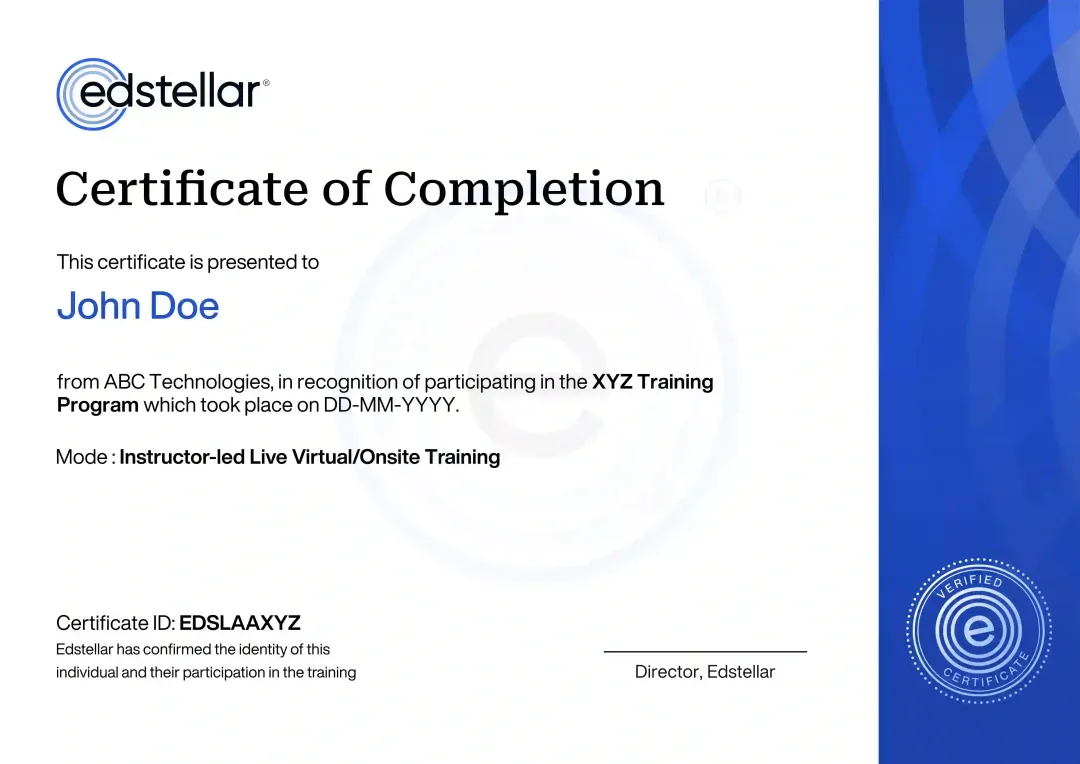
Certificate of Training Completion.
On successful completion, employees receive an Edstellar course completion certificate, recognizing their commitment to ongoing learning and professional development. It validates the skills they have built and motivates them to keep growing and contribute to organizational success.
Earned, not attended. Awarded on completion of all hands-on labs and the capstone project.
Training Delivery Modes: Onsite, Virtual and Hybrid
Choose the format that fits your team. Every delivery mode includes the same 8 modules, 7 guided labs, and capstone pipeline build.
Control-M Workload Automation Onsite Training
Host instructor-led sessions at your office for focused, team-wide learning. Labs run on your schedule, with the trainer adapting examples to your batch environment and tooling.
- Instructor-led sessions at your location
- Examples adapted to your batch environment
- Focused team-wide learning with no travel
- Labs run on your schedule and tooling

Control-M Workload Automation Live Virtual Training
Join live virtual instructor-led sessions from anywhere. Interactive demos and guided labs run over video conferencing, with the same curriculum and capstone as every delivery mode.
- Join from anywhere with full lab access
- Interactive demos and guided exercises
- Real-time Q and A with the instructor
- Same capstone project as every mode

Control-M Workload Automation Hybrid Training
Combine live virtual sessions with hands-on labs at your own pace. Your team joins instructor-led workshops remotely while practicing in a shared lab environment, with flexible scheduling across time zones.
- Live virtual sessions with an expert instructor
- Hands-on labs in a shared cloud environment
- Flexible scheduling across time zones
- Same curriculum and capstone as every mode

Need a Customized Training Format That Works for Your Team?
Our training delivery is customized to your team's schedule, full days, half days, sessions spread across weeks, or modular formats. Share your preferred timeline, and we'll plan the training around it.
Frequently Asked Questions
Workload teams build an automated batch pipeline and explain its operating design. Edstellar connects job definitions and schedules with API automation, monitoring and recovery so the result can be maintained by the team.
The course connects job design and scheduling with API automation and dependable operation. Guided labs lead to an end-to-end batch pipeline that participants build and defend.
Edstellar brings Control-M Workload Automation training to enterprise teams through a network of 5,000+ vetted trainers and coaches, built on work with 200+ enterprise clients in 100+ countries. Built with workload automation engineers, the program covers Control-M jobs, scheduling, monitoring and integration. Exercises can use your own tools, data and scenarios, and you can review the matched trainer's profile before confirming. Delivery is onsite, virtual or hybrid, with pre- and post-training assessments.
Look for practical expertise in Control-M architecture and job definitions, exercises that fit your workplace and clear assessment criteria. Review Edstellar's trainer profile and proposed outline against your Control-M environment, workloads, scheduling rules and operational access. Compare the complete scope, delivery quality, practice and follow-on support as well as price.
Ask to review the proposed trainer's profile and discuss the delivery approach before confirming. Prioritize practical experience in Control-M architecture and job definitions and the ability to facilitate relevant work for batch operators, DevOps and platform engineers, data engineers and IT service staff. Confirm required industry experience, qualifications and language skills during selection.
Question Not Answered Here?
Put it in the request. A training specialist answers it directly, within one business day.
Where this Training Fits in Your Team's learning path.
Control-M often runs shell scripts, so shell scripting comes first. After your team automates workloads with Control-M, it learns Airflow for data pipeline orchestration and DataOps for running those pipelines reliably.
SCRIPT THE SHELL
Shell Scripting & Automation for Linux Training
Write the shell scripts that Control-M jobs commonly call.
AUTOMATE WITH CONTROL-M
Control-M Workload Automation Training
Define, schedule and monitor job flows across systems with Control-M.

ORCHESTRATE WITH AIRFLOW
Apache Airflow Training
Orchestrate data pipelines with Airflow alongside enterprise scheduling.
RUN RELIABLE PIPELINES
DataOps & Pipeline Reliability Training
Monitor and recover pipelines so scheduled data work stays reliable.
More related courses
BMC TrueSight Orchestration Training
JCL & Mainframe Batch Engineering Training
IBM Mainframe (z/OS) Administration & Modernization Training
Why Choose Edstellar as Your Control-M Workload Automation Training Provider
Edstellar delivers instructor-led Control-M training that is tailored to your batch estate, practiced in live labs, and measured against the skills your teams need. Every batch ends with a capstone pipeline your engineers built themselves.

EXPERT TRAINERS
YEARS DELIVERING
ORGANIZATIONS TRAINED
CERTIFIED
Tailored
We map every module to your batch estate, scheduling patterns, and compliance needs, so labs mirror the workloads your team owns.
Proven Methodology
A Diagnose, Standardize, Practice, Measure, Scale approach moves teams from fragile batch jobs to dependable automated workflows.
Practice-Based Learning
Seven guided labs and a capstone pipeline build give each engineer real keyboard time scheduling and troubleshooting live workloads.
Expert Trainers
Instructors are practitioners who run Control-M workloads in production, and they teach the failure modes they have fixed.
Global Scale
We deliver the same 32-hour program across regions and time zones, with consistent labs and instructor quality for every cohort.
Measurable Outcomes
Assessments before and after the program show exactly which automation skills each team gained, tied to the pipelines they built.
Build Control-M Workloads With Clear Dependencies and Observable Service Behavior
Edstellar develops workload automation from job design and scheduling to jobs-as-code, monitoring, and fault diagnosis. Participants connect batch dependencies with operational controls in guided Control-M exercises. Their final pipeline is reviewed for scheduling logic, recovery reasoning, service visibility, and the documentation supporting reliable administration of the proposed workload.
- Step 01
Consult
We assess scheduling and scripting familiarity to identify gaps in job structure, dependency logic, API automation, SLA monitoring, and batch-failure diagnosis.
- Step 02
Plan
We establish Control-M architecture before job definitions and dependencies, then JSON automation, monitoring, security, availability, and tuning within the integrated batch pipeline.
- Step 03
Align
We align workload-automation instruction with batch operations, platform, data, and IT-service roles, confirming practice tools and foundational support for new Control-M users.
- Step 04
Customize
We tailor sample calendars, job dependencies, and failure scenarios to relevant business workloads while keeping scheduling assumptions and service targets explicit.
- Step 05
Execute
Participants define jobs-as-code, forecast dependencies, and investigate failures, receiving feedback on schedule behavior, alert usefulness, access controls, and throughput choices.
- Step 06
Evaluate
We assess the batch pipeline for correct dependency execution, coherent monitoring and security, evidence-supported troubleshooting, and a clear explanation of service-level behavior.
Also from Edstellar
Talent assessments
Psychometric, behavioral, leadership and 360-degree assessment.
→Training needs analysis
Needs analysis, gap identification, and a training roadmap.
→L&D consulting
Learning strategy, content, technology and ROI measurement.
→OD consulting
Org design, succession planning and cultural change.
→Managed training services
Training outsourcing, vendor management, logistics and administration.
→Coaching solutions
Executive and manager coaching that keeps skills in use.
Start an RFP shaped to your needs.
Answer three quick questions about team size, scope, and how often you need the program run, then send the request from the last step. Everything you choose travels with it, so you only fill this in once.
How many team members need training?
Control-M Workload Automation Training Packages & Pricing
Where L&D holds an annual budget, license packages price the whole year at once instead of raising a purchase order per workshop. Hours and licenses are pooled across teams, programs and locations, so unused capacity is not stranded in one department.
Starter
120
trainee licenses64 hours of group training
Tailored for SMBs
Growth
320
trainee licenses160 hours of group training
Ideal for growing SMBs
Enterprise
800
trainee licenses400 hours of group training
Designed for large corporations
Custom
Unlimited
trainee licensesDuration set by the rollout
Multi-region and multi-year
Training Packages & Pricing
Choose the training format that works for your team. Pricing is customized based on your requirements, cohort size, and delivery needs.
Request a Quote for Control-M Workload Automation Training for Your Team
Request Control-M Workload Automation training for your team. Share your batch environment and scheduling challenges on a short discovery call, and we will tailor the program to your needs.