7 Roles & Responsibilities for Chief Experience Officer (CXO)

.svg "edstellar")

The Chief Experience Officer (CXO) has emerged as one of the most strategic roles in modern corporate leadership, bridging the gap between customer expectations, employee engagement, and business performance.
As organizations navigate an era defined by heightened experience expectations and rapid technological transformation, the CXO role has evolved from a customer-focused role to a comprehensive experience architect responsible for both customer and workforce experience.
Despite widespread adoption, CXOs face significant challenges in influencing experience initiatives and demonstrating ROI. Deloitte’s research reveals that CXOs spend nearly 40% of their time making the case for experience investments, highlighting the ongoing need to demonstrate business value.
This comprehensive guide explores the seven critical roles and responsibilities that define the CXO role, offering insights into how these leaders drive customer-centric transformation and deliver measurable business impact.
“Empathy for the customer experience needs to be experienced by employees themselves. And truth be told, many of them are aware of the fact that we do not always provide the best service. Yet, employees may feel as though they can’t make a difference because they don’t know who to tell or that if they do, nobody will listen. Others have become complacent and simply accepted this experience as the status quo."


The Chief Experience Officer serves as the primary architect of an organization’s experience strategy, establishing a comprehensive vision that aligns customer experience (CX) and employee experience (EX) with broader business objectives. This foundational responsibility extends beyond tactical customer service improvements to encompass strategic planning that influences corporate direction, product development, and operational processes.
CXOs develop experience roadmaps that articulate how every touchpoint throughout the customer and employee journey contributes to organizational success. According to Forrester’s 2024 report, only 3% of companies are currently customer-obsessed, putting customers’ needs at the forefront of all business decisions. Organizations that achieve customer obsession report 41% faster revenue growth, 49% faster profit growth, and 51% better customer retention than non-customer-obsessed organizations, demonstrating the tangible business value of strategic experience leadership.
The strategic architecture role requires CXOs to establish clear North Star metrics that guide organizational decision-making. These leaders must translate abstract experience concepts into measurable business outcomes, creating frameworks that connect experience improvements to revenue impact, customer lifetime value, and employee productivity. By establishing this strategic foundation, CXOs ensure experience initiatives receive appropriate resource allocation and executive support.
Edstellar’s Executive Leadership Training equips senior leaders with the strategic planning and vision-setting capabilities essential for experienced leadership roles, enabling them to develop comprehensive experience strategies aligned with organizational objectives.
Building and maintaining trust stands as a top priority for CXOs, yet many experience leaders overlook the key drivers that truly influence stakeholder behavior. Deloitte’s TrustID research identifies four factors that increase trust: humanity, transparency, capability, and reliability. However, less than 20% of workforce experience and customer experience leaders feel they excel at demonstrating empathy and kindness, treating everyone fairly, and openly sharing information, despite these being the top trust drivers.
Deloitte's TrustID research, based on over 200,000 survey responses across nearly 500 brands, identifies humanity as the single biggest trust driver for customers, organizations that demonstrate empathy and fairness see trust scores rise substantially more than those focusing solely on reliability or capability.
CXOs must prioritize what their audiences value most, recognizing that while capability and reliability remain essential, transparency and humanity are becoming non-negotiables, especially for younger generations. Gen Z and millennial customers increasingly prioritize transparency and humanity in assessing brand competence, directly influencing purchase decisions.
When these demographics perceive a brand as demonstrating high levels of humanity and transparency, their likelihood of recommending and repurchasing increases significantly.
The trust-building responsibility extends to employee experience, where open communication around policies and organizational changes proves critical. Research shows that as companies increase in size, trust typically drops, making the CXO’s role in maintaining transparent communication even more vital. Additionally, companies that allow 21%-40% remote work have the highest capability scores, suggesting that flexibility and balanced approaches inspire employee trust.
CXOs serve as connectors across organizational silos, fostering collaboration between departments that traditionally operate independently. The ability to bridge functional gaps between Sales, Marketing, Product, Operations, IT, and Customer Service defines successful experience leadership.
According to McKinsey's research on organizational effectiveness, companies that foster strong cross-functional collaboration are up to five times more likely to be high-performing, making the CXO's role as an organizational connector one of the highest-value positions in the C-suite.
Interestingly, Deloitte’s longitudinal research from 2023 to 2024 shows that collaboration with other leaders on experience priorities fell from #1 in 2023 to #11 in 2024, representing the largest year-over-year improvement among CXO challenges. This dramatic shift suggests growing organizational openness to incorporating human-experience ideals into broader business objectives, representing a significant win for experience leaders.
However, the research also indicates that less tenured CXOs prioritize measurement and proving ROI, while more experienced CXOs focus on collaboration across the business. This suggests that, initially, experienced leaders focus on demonstrating value, but as they gain tenure, fostering collaboration becomes key to achieving their objectives. The implication for CXOs at all levels is clear: consider collaboration implications early, as building relationships is just the beginning; the real challenge lies in strategic execution and driving meaningful change.
Effective CXOs establish governance structures that facilitate cross-functional decision-making and ensure that customer and employee perspectives influence strategic choices. They create forums where diverse stakeholders can align on experience priorities, share insights, and coordinate initiatives that span multiple departments. This collaborative approach ensures experience improvements aren’t confined to single functions but permeate the entire organization.
Edstellar’s Leadership Essentials Training provides foundational collaboration and stakeholder management skills that enable leaders to drive cross-functional alignment, essential capabilities for leadership success.
Establishing and tracking the right metrics represents one of the most time-consuming yet critical responsibilities for CXOs. The challenge of securing sufficient budget to execute brand experience strategy rose from #9 in 2023 to #2 in 2024 among CXO challenges, representing the largest year-over-year increase. In budget-constrained environments, the ability to confidently articulate the business value of experience data is essential to securing the necessary resources.
CXOs invest approximately 18% of their time, according to Deloitte research, in identifying and tracking the right metrics. These leaders must move beyond traditional customer satisfaction scores to establish comprehensive measurement frameworks that connect experience improvements to financial outcomes. Key metrics include Net Promoter Score (NPS), Customer Lifetime Value (CLV), Customer Effort Score (CES), Employee Net Promoter Score (eNPS), and custom indices that reflect organizational priorities.
The measurement responsibility extends to developing attribution models that demonstrate how experience investments influence revenue, retention, and operational efficiency. CXOs must establish baselines, implement continuous tracking mechanisms, and create dashboards that provide real-time visibility into experience performance across touchpoints. This data-driven approach enables evidence-based decision-making and helps prioritize initiatives based on potential impact.
Moreover, CXOs must balance quantitative metrics with qualitative insights, ensuring numbers don’t overshadow the human stories behind the data. Combining analytics with customer and employee feedback creates a comprehensive understanding of experience quality that resonates with both analytical and empathetic stakeholders.
For organizations seeking to develop data-driven leadership capabilities, Edstellar’s Customer Service Leadership Skills Training provides frameworks for measuring and improving customer experience outcomes through systematic assessment and continuous improvement methodologies.
CXOs serve as experience futurists, balancing multiple responsibilities, including proving value, gaining organizational buy-in, and pushing technological boundaries through a forward-looking vision. As technology evolves rapidly, these leaders must steer development with a human-centered focus, ensuring innovations enhance rather than complicate experiences.
Deloitte’s 2024 research identifies the top emerging technologies CXOs anticipate will significantly impact experiences: artificial intelligence (AI), edge computing, blockchain, and neuromorphic computing. These technologies have the potential to enable personalized, real-time data processing and decision-making, creating superior experiences for customers and employees.
Edge computing processes data near its source, reducing latency and enabling real-time responsiveness crucial for time-sensitive applications. For employees, this might manifest as video conferencing systems with minimal lag, improving collaboration quality. For customers, edge computing enables instantaneous personalization and service delivery.
Blockchain technology provides decentralized, transparent record-keeping that builds trust through verifiable transactions. Financial services companies can use blockchain to enable customers to manage their personal information securely, reducing data breach risk. This technology lowers barriers to innovation, potentially triggering an innovation boom.
Neuromorphic computing mimics human brain function to achieve exceptional energy efficiency and adaptive learning. This enables businesses to deliver enhanced, personalized services cost-effectively while meeting environmental goals. For example, companies can use neuromorphic computing to respond quickly to customer feedback trends, improving overall satisfaction.
Beyond monitoring emerging technologies, CXOs must evaluate and integrate existing tools, including customer relationship management (CRM) platforms, experience management software, journey mapping tools, and analytics solutions. They serve as gatekeepers, asking critical questions to ensure technological advancements support human-centered transformations rather than creating friction.
Transforming organizational culture to prioritize the customer experience is one of the CXO’s most challenging yet impactful responsibilities. This involves shifting mindsets from product-centric to experience-centric approaches, establishing customer and employee obsession as core values, and ensuring every team member understands their role in delivering exceptional experiences.
Cultural transformation requires CXOs to champion human experiences amid constant pressure for cost savings and quantifiable data. CXOs must persistently make the business case while gradually shifting organizational values and behaviors.
Change management extends to developing experience-focused capabilities throughout the organization. CXOs design and oversee training programs that teach human-centered design skills, empathy development, and customer-centric decision-making. They establish recognition programs that celebrate experience excellence, creating positive reinforcement loops that embed desired behaviors.
Additionally, CXOs must manage resistance to change, particularly from stakeholders focused solely on short-term financial metrics. This requires diplomatic influence skills, the ability to tell compelling stories with data, and patience to demonstrate that experience investments deliver sustainable competitive advantage over time.
The cultural transformation responsibility also encompasses embedding experience considerations into recruitment, onboarding, performance management, and succession planning processes. By integrating experience principles throughout the employee lifecycle, CXOs ensure their cultural impact extends beyond their tenure.
Edstellar’s Customer Excellence Training provides comprehensive frameworks for building customer-centric cultures and equips teams with advanced skills to consistently deliver exceptional experiences.
CXOs serve as the primary advocates for customers and employees within executive leadership, ensuring their needs, preferences, and feedback inform strategic decisions. This advocacy role involves creating mechanisms to capture, analyze, and act upon the voice of customer (VoC) and voice of employee (VoE) insights systematically.
Effective advocacy requires establishing governance structures that give customers and employees a “virtual seat at the table” during key decision-making meetings. CXOs implement feedback loops that translate frontline insights into actionable improvements, ensuring organizational leadership remains connected to the lived experiences of those they serve.
The advocacy responsibility extends to challenging internal proposals that might compromise experience quality in favor of short-term gains. CXOs must possess the credibility and courage to raise difficult questions: “How will this impact our customers?” “What does this mean for employee experience?” “Are we maintaining our brand promise?”
This role also involves democratizing customer and employee insights across the organization, making feedback accessible to teams that can act on it. By widely sharing customer stories, employee testimonials, and experience data, CXOs create organizational empathy that motivates continuous improvement.
Furthermore, CXOs advocate for investments in experience infrastructure, tools, and capabilities. They build business cases for journey-mapping initiatives, experience design resources, and customer-insight platforms. This advocacy ensures the experience function receives appropriate support to fulfill its strategic mandate.
According to research highlighted in Edstellar’s recent article on Chief Customer Officer roles and responsibilities, customer experience is built or broken in the gaps between functions. Effective advocacy bridges these gaps, ensuring seamless experiences across touchpoints.
The Chief Experience Officer role stands at a pivotal juncture, balancing foundational responsibilities such as trust-building and ROI demonstration with forward-looking duties, including technology integration and collaboration-fostering. As organizations tighten budgets while simultaneously recognizing experience as a competitive differentiator, CXOs must demonstrate both strategic vision and tactical execution excellence.
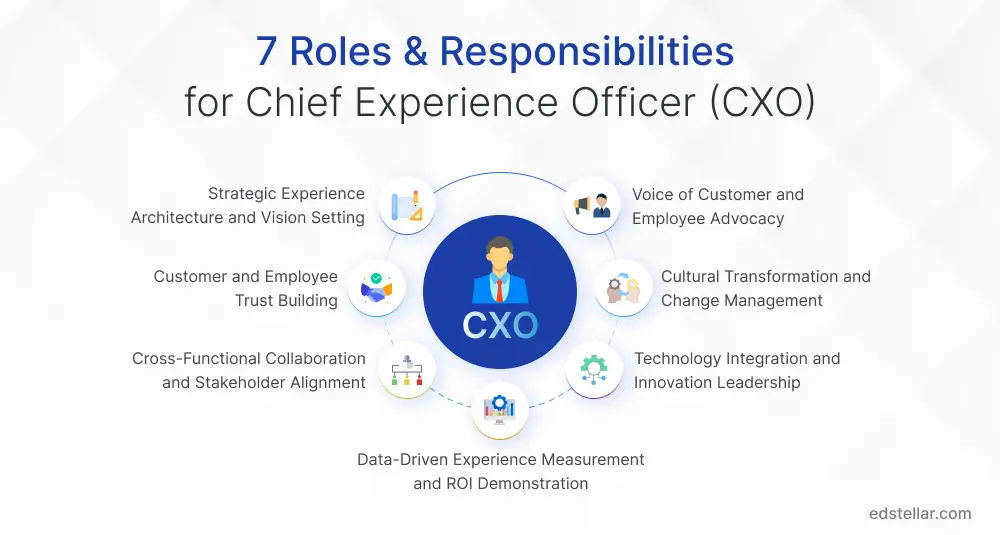
The seven roles and responsibilities outlined in this guide, strategic architecture, trust building, collaboration, measurement, technology leadership, cultural transformation, and advocacy, form an interconnected framework that defines successful experience leadership. CXOs who excel across these dimensions position their organizations to deliver exceptional experiences that drive customer loyalty, employee engagement, and sustainable business growth.
The improving ease of collaboration noted in Deloitte’s 2024 research suggests a positive shift toward organizational openness regarding experience initiatives. By capitalizing on this momentum, aligning experience strategies with trust drivers, continually demonstrating business value, and staying ahead of technological advancements, CXOs can elevate the human experience while delivering measurable business outcomes.
For organizations seeking to develop experienced leadership capabilities, investing in comprehensive training programs represents a critical step. Edstellar’s portfolio of leadership training courses equips current and aspiring CXOs with the skills, frameworks, and insights needed to excel in this strategic role, driving transformational change that benefits customers, employees, and the bottom line simultaneously.
#On-site #Virtual #GroupTraining #Customized
Explore 2000+ industry ready instructor-led training programs.

Create dynamic leaders and cohesive teams. Learn more now!


Do a quick Skill gap analysis with Edstellar’s Free Skill Matrix tool

Unlock premium resources, tools, and frameworks designed for HR and learning professionals. Our L&D Hub gives you everything needed to elevate your organization's training approach.
Access L&D Hub Resources.svg)
.svg)
.svg)
.svg)

.svg)


.svg "Click Here to Follow on Medium")
.svg)


