Chief Customer Officer (CCO) Roles & Responsibilities Explained
.webp)
.svg "edstellar")

Two companies launch near-identical products at the same price point. Both have solid tech, competent sales teams, and reasonable marketing budgets. Five years later, one is running at 95%+ retention and compound revenue growth; the other is stuck at 60% retention and flat topline. The real gap isn’t the product. It’s who, at the executive table, owns the customer mandate end-to-end and whether that role has the clarity, authority, and accountability to act.
That’s where the Chief Customer Officer (CCO) comes in. Forrester’s 2024 US Customer Experience Index shows that customer-obsessed organizations deliver 41% faster revenue growth, 49% faster profit growth, and 51% better customer retention than their peers.
But simply having a CCO on the org chart is meaningless if the role is vague, toothless, or spread thin across functions. Many CCOs are told to “own the customer” while P&L sits with sales, roadmap sits with product, service sits with operations, and data sits with IT. The result is predictable: banner titles, weak outcomes, and a lot of internal theatre disguised as customer-centricity.
This guide is about fixing that. It focuses on the non-negotiable roles and responsibilities of a modern Chief Customer Officer, what the CCO should truly own, influence, decide, and be measured on. We’ll map how a high-impact CCO role spans revenue and retention, customer journey orchestration, cross-functional governance, data and insight, and culture change.
If you’re a current or aspiring CCO, or a CEO/CHRO designing this role, use this article as a benchmark: to sharpen the mandate, align expectations, and ensure the CCO is positioned not as a symbolic “voice of the customer,” but as a core driver of growth and enterprise value.
The Chief Customer Officer is not a glorified head of support. At its best, the role is the single executive owner of customer outcomes across the entire lifecycle, acquisition quality, onboarding, adoption, value realization, renewal, and expansion. The CCO’s job is to turn “we’re customer-centric” from a slogan into hard numbers on a dashboard: revenue, retention, profitability, and advocacy.
Unlike traditional customer service or support leaders, who primarily manage issue resolution, the CCO operates at the strategy and governance level. They align product, sales, marketing, service, and finance around a common customer reality, and they force trade-off conversations when short-term targets conflict with long-term customer value.
If you strip away job-title theatre, a real CCO owns or co-owns these responsibility domains:
1. Revenue & Economic Outcomes
2. Customer Journey & Experience Governance
3. Functional Leadership & Operating Model
4. Voice of the Customer in the C-Suite
5. Operational Excellence & Scale
If a CCO doesn’t have clear accountability in these areas, you don’t really have a CCO; you have a customer advocate with an executive title and limited leverage.
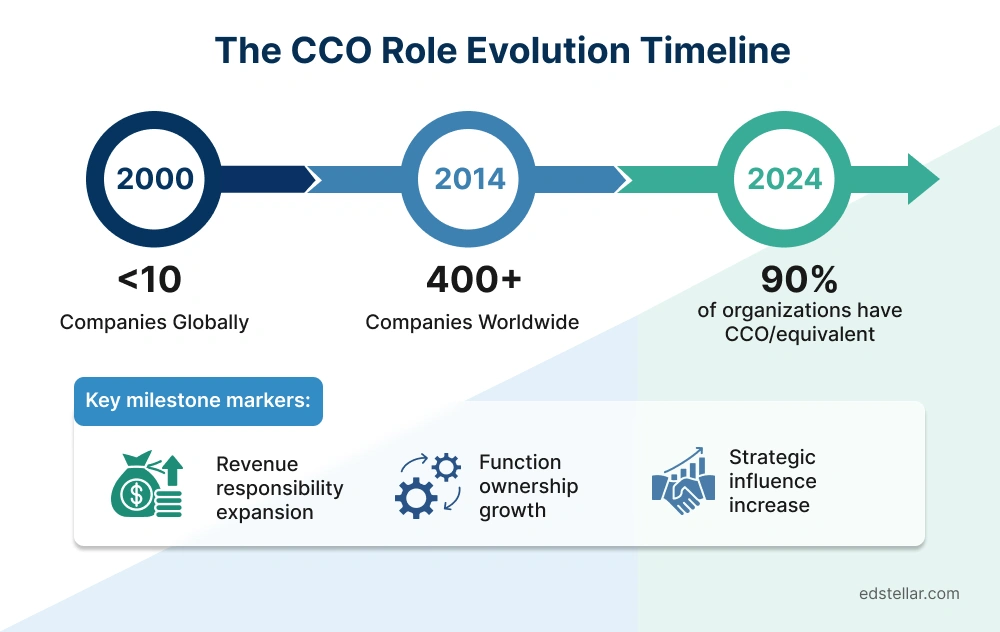
The role’s expansion isn’t a branding trend; it’s a response to economics. According to Grokipedia, in 2000, fewer than 10 companies worldwide had a Chief Customer Officer. By 2014, that number had grown to 400+.
Today, Gartner reports that nearly 90% of organizations have a CCO, CXO, or equivalent executive owning customer experience at the C-suite level, and around 22% of Fortune 100 companies have explicitly adopted the CCO role.
Why? Because in recurring-revenue and service-heavy businesses, retention and expansion drive the P&L:
In that context, the CCO role exists because somebody at the top must be explicitly accountable for monetizing customer value over time, not just closing the first deal. When no one owns that mandate, it gets diluted across sales, product, and marketing, and the company quietly bleeds margin through churn, poor-fit customers, and broken experiences.
These results don’t appear just because someone has “Chief Customer Officer” on their email signature. They appear when the CCO has a clear mandate and real decision rights over retention, expansion, journey design, CX/CS operating models, and customer insight.
This guide now focuses on the non-negotiable roles and responsibilities required to move those numbers in practice. Use it to stress-test your CCO charter: if the role can’t realistically influence the metrics in that yellow box, it’s under-scoped or badly designed.
A Chief Customer Officer’s first non-negotiable responsibility is to define the customer strategy for the company and ensure it is inseparable from the business strategy. This isn’t about “being customer-centric” in slogans; it’s about deciding which customers you serve, what value you promise them, and how that value translates into revenue, margin, and growth.
In practice, this responsibility means the CCO leads the work of turning abstract strategy into a concrete, customer-backed plan that the CEO and CFO can sign off on. That includes:
Owning the Customer Strategy Narrative
Aligning Customer Initiatives with Corporate Goals
Designing Scalable Customer Frameworks
Anticipating Risk and Market Shifts
Owning customer strategy and alignment is not a one-off offsite; it’s an ongoing discipline. Edstellar’s Visionary Leadership and Strategic Thinking and Customer Service Leadership Skills programs help senior leaders strengthen strategic thinking and scenario planning. They also build the cross-functional alignment needed to turn customer strategy into concrete plans and execution. This makes it easier for the CEO, CFO, and board to measure the impact and hold the CCO accountable for results.
A modern CCO is accountable for how the entire organization understands the customer. That means owning the systems, processes, and rhythms that turn raw signals into decisions rather than letting “Voice of Customer” live as a vanity NPS slide in quarterly reviews. If the CCO doesn’t control the listening architecture and how insight is used, every other responsibility (strategy, journey design, CX investments) rests on guesswork.
The CCO’s responsibility is to make that “understanding” concrete: who our customers are, what outcomes they are buying, where we’re failing them, and which changes will actually move retention, NRR, and advocacy.
In practice, this responsibility includes:
Designing the Customer Listening Architecture
Turning Insight into Decisions, Not Just Dashboards
Owning Journey Mapping and Segmentation Intelligence
Institutionalizing Empathy at Scale
“Different companies draw the line differently, but every CCO should own customer success, support, services, education, community, digital scale, and customer operations; functions like advocacy, account management, and renewals are optional, tailored to your strategy and philosophy."


Building and leading such an insight engine requires both analytical discipline and strong interpersonal skills. Edstellar’s Customer Excellence training program helps customer leaders and their teams strengthen communication, questioning, and relationship-building, and learn how to systematically gather, interpret, and apply customer intelligence. This enables CCOs to move beyond opinion-driven debates and anchor decisions in a shared, evidence-based view of the customer.
If the CCO can’t talk in numbers, they won’t control the budget, roadmap, or priority. CEOs and CFOs don’t care how “customer-centric” something sounds; they care what it does to GRR, NRR, churn, CLV, and profit. The much-quoted 356% median CX ROI only shows up when the CCO defines the right metrics, standardizes them across the business, and drives decisions through those numbers, not anecdotes.
This responsibility is about owning the customer metrics stack and the way it is used, not doing ad hoc “data analysis” when someone asks for a slide.
1. Define the Non-Negotiable CCO Metrics
The CCO leads the definition and governance of a small, hard set of customer metrics everyone agrees on. At a minimum, that includes:
The key is clarity: one definition, one source of truth, no metric theater.
2. Build Executive and Operational Dashboards That Drive Action
Raw data and 40-field dashboards don’t change behavior. The CCO works with RevOps/data to build:
3. Install a Data-Driven Decision Cadence
Metrics are pointless if they aren’t baked into how the business runs. The CCO is responsible for:
4. Use Health Scoring and Simple Predictive Logic (Not Hype)
You don’t need a PhD in ML to be effective. High-performing CCOs build practical health scoring models first, typically combining:
These scores trigger alerts and workflows (e.g., risk playbooks, save campaigns, executive outreach). Used well, they can cut churn in the 15–25% range, long before you ever touch “AI.” If your foundations are broken, chasing machine learning is a distraction.
5. Build a Data-Literate Customer Team
Finally, the CCO has to change how customer teams think and talk:
Mastering this kind of metrics engine requires more than basic Excel skills. Edstellar’s Data-Driven Leadership program help senior leaders learn how to choose the right KPIs, build meaningful dashboards, and translate customer data into clear strategic choices. This gives CCOs and their teams a practical toolkit to argue for investments, defend decisions, and prove impact in the language the CEO and CFO respect.
Customer experience is built (or broken) in the gaps between functions: Sales, Product, Marketing, Finance, Operations, and Support.
A CCO who only “runs Customer Success” but doesn’t shape how these teams work together is basically a highly paid escalation manager. The real responsibility is to align the entire operating system around customer outcomes and ensure trade-offs are made consciously.
In practice, this responsibility includes:
1. Influence Without Formal Control
2. Create Cross-Functional Governance for the Journey
Stand up Customer Journey Councils (or equivalent) that meet on a fixed cadence with clear agendas and owners, for example:
Make sure these forums are not talking shops: they track shared metrics and commit to specific experiments and fixes.
3. Manage Conflict and Trade-Offs Explicitly
4. Align Partners and Ecosystem Delivery
Orchestrating this kind of cross-functional engine demands more than charm. Edstellar’s Leading Cross-Functional Teams training helps senior leaders build the influence, conflict-resolution, and alignment skills needed to get Sales, Product, Marketing, and Operations actually pulling in the same direction.
Complementary programs like Collaboration Skills provide the practical tools for teams to work across silos, making it easier for the CCO to turn “shared outcomes” into real, sustained execution.
Strategy, insight, and metrics only matter if they’re understood, believed, and acted on by people who control capital, roadmap, and headcount. This responsibility isn’t about “being a good presenter”; it’s about making sure customer reality is impossible to ignore in CEO, CFO, and board discussions.
A high-impact CCO takes ownership of how customer truth is told inside the company what gets highlighted, how it’s framed for different stakeholders, and how it translates into decisions. Done badly, customer presentations are feel-good storytime. Done well, they reset priorities, unlock budget, and kill initiatives that quietly hurt retention and NRR. And because these conversations are often politically charged, they demand not just clarity and data, but real emotional intelligence.
“Research shows that 90 percent of top performers have high emotional intelligence, yet only about one-third of people can identify their emotions as they happen. Emotional intelligence is not a soft skill. It is a leadership superpower that determines how trust is built, how teams thrive, and how businesses grow."

1. Turn Data into Executive-Ready Narratives
2. Adapt the Message by Stakeholder
3. Institutionalize “State of the Customer” Reviews
4. Model Honest, Two-Way Communication
5. Raise the Communication Bar Across Customer Teams
Being the executive voice of the customer demands sharp, practiced communication, not improvisation. Edstellar’s Leadership Communication program help senior leaders develop executive presence, concise storytelling, and the ability to handle tough conversations under scrutiny.
Complementary courses like Feedback Skills for Leaders strengthen how CCOs and their teams give and receive feedback, helping build a culture where customer truths are surfaced early, discussed honestly, and acted on quickly.
Most organizations already have a CXO/CCO title; far fewer have a culture where decisions, incentives, and daily behavior truly line up with customer outcomes. One of the CCO’s core responsibilities is to lead the transformation from slogan-level customer focus to an operating reality across structure, process, incentives, and mindset.
That means acting as a chief change architect, not just the head of a function. If the CCO isn’t driving how the organization changes, customer strategy stays trapped in slide decks while legacy habits quietly keep churn, NRR, and experience flat.
1. Define the Customer-Centric Change Vision and Case
2. Build a Coalition with Real Power
3. Design and Run a Structured Change Roadmap
Move in phases rather than big-bang declarations for example:
Back this with clear milestones, owners, and success criteria.
4. Anticipate and Manage Resistance
5. Rewire Culture, Incentives, and Rituals
Leading this kind of transformation requires practical change tools. Edstellar’s comprehensive guide to change management tools presents 30 essential tools for planning, communication, risk management, and training, all crucial for CCOs leading transformation.
For hands-on change leadership development, Edstellar’s Transition Management training equips leaders with essential strategies to navigate change, support teams effectively, and maintain high productivity during organizational transitions.
Additionally, Edstellar’s guide to building change-ready culture offers a five-step framework for developing organizational change capability, essential for CCOs who need their organizations to adapt continuously to evolving customer expectations.
One of the CCO’s core responsibilities is to design and continuously improve the operating model: the segments, processes, playbooks, and self-service capabilities that deliver consistent outcomes without burning people out.
1. Define Segments and Engagement Models
2. Standardize Playbooks for Critical Motions
Document clear, non-negotiable playbooks for:
Make sure new hires can be productive using the system, not tribal knowledge.
3. Drive Metrics-Driven Process Improvement
4. Scale with Self-Service and Low-Touch Options
Reduce unnecessary human dependency by building:
Reserve human effort for high-value, complex, or strategic work.
Building a scalable operating model isn’t just drawing flowcharts; it’s about how people actually behave inside those processes. Edstellar’s leadership and client-focused programs (such as
5. Client Management and Customer Service Mindset) help teams:
Combined with your internal process design, this gives the CCO both the system and the skills needed to move from ad-hoc heroics to reliable, scalable execution.
Modern CCOs are increasingly compensated on GRR and NRR, and in many organizations, they fully own renewals and a big chunk of expansion. That makes it a core responsibility to own how customer outcomes show up in the P&L and to provide a forward-looking view of revenue, not just commentary after the fact.
A high-impact CCO can sit with the CEO and CFO and clearly explain: which customers create or destroy value, what current churn really costs, what NRR will look like next quarter, and which investments in customer success, product, or service will pay off and when.
1. Master the Customer Unit Economics
Own the story behind metrics like:
Use these to:
2. Provide Health-Based Revenue Forecasts
Build and own a renewal and expansion forecast grounded in:
3. Build Business Cases for Customer Investments
When asking for more headcount, new tech, or program budgets, present:
4. Shape Commercial Constructs and Negotiations
AI will sit inside almost every part of the customer engine: health scoring, churn and expansion prediction, call analysis, and play recommendations. The CCO’s job won’t be to hype AI, but to decide where AI augments humans, where it doesn’t belong, and how it changes roles and workflows.
Implication for CCOs: You don’t need to be a data scientist, but you do need to understand AI capabilities and limits, ask hard questions about data quality and bias, and redesign your operating model around AI-assisted work rather than manual heroics.
The line between CCO and CRO will continue to blur: More CCOs will be accountable for renewals, expansion, and customer-led new revenue, not just “experience.” NRR will become a primary scorecard metric, not a secondary one.
Implication for CCOs: Financial and commercial acumen become table stakes. If you can’t talk confidently about unit economics, pricing, deal structure, and forecast accuracy, you won’t be in the room for the real decisions.
The next evolution after Product-Led Growth is Customer-Led Growth: expansion driven by adoption, advocacy, community, and co-creation. Your best customers will do as much selling and support as your internal teams if you design for it.
Implication for CCOs: Community, advocacy programs, and customer marketing are no longer side projects. You’ll need to work closely with Marketing and Product to turn happy customers into demand, content, and co-innovation partners.
As data and tooling mature, 1:1-like personalization won’t be reserved for just the top accounts. Journeys, content, and even product experiences will adapt dynamically to behavior and desired outcomes, not just firmographics.
Implication for CCOs: Segmentation must move beyond “industry + size.” You’ll need behavioral and outcome-based views of customers and an operating model that can act differently for different patterns automatically.
Customers, boards, and regulators are all raising the bar on how business is done, not just what is delivered. Data usage, AI ethics, and environmental and social impact will increasingly shape buying and renewal decisions.
Implication for CCOs: You’ll be expected to have a point of view on ethical data use, AI impacts, and how your company’s sustainability and responsibility show up in the customer experience. That means partnering with Sustainability, Legal, and Compliance, not treating these as “someone else’s” topics.
The Chief Customer Officer role is no longer experimental. It sits at the center of how modern companies grow, protect revenue, and differentiate. But titles don’t create impact. What separates an average CCO from an exceptional one is whether they truly own the non-negotiable responsibilities that move retention, net revenue retention, and customer economics.
Throughout this guide, we reframed the role around a clear set of mandates:
If a CCO is not accountable for these, they are effectively a senior support leader, not a true C-suite owner.
For aspiring CCOs, the path forward is simple but not easy: accumulate real responsibility for revenue, retention, and customer outcomes as early as possible, and deliberately build the strategic, analytical, and leadership capabilities that sit behind these responsibilities. For current CCOs, the bar is continuous recalibration, re-examining your mandate, your scorecard, your operating model, and your influence in the C-suite as markets, products, and expectations shift.
For organizations, the choice is binary: either you design a CCO role that can actually move customer economics and invest in that leader’s capability, or you end up with a symbolic title that doesn’t change outcomes. There is no middle ground that works for long.
If you want your CCO and customer leadership team to deliver on these responsibilities, you need more than ad-hoc workshops. You need structured development that strengthens strategic, commercial, and operational capability.
Edstellar’s corporate training portfolio can be mapped directly to the core CCO responsibilities:
Strategic Leadership Programs:
Customer Excellence Programs:
Collaboration and Change Programs:
Communication Programs:
With instructor-led programs delivered by 5,000+ vetted experts, Edstellar offers customized learning paths, flexible delivery (onsite, virtual, hybrid), and measurable pre-/post-assessment to track skill gains and behavioral change.
If you want your CCO to be more than a title, someone who can actually own and deliver on the responsibilities laid out in this guide, work backwards from those mandates and build the capabilities to match. Edstellar can help you design and deliver that development journey for your leadership and customer teams.
#On-site #Virtual #GroupTraining #Customized
Explore 2000+ industry ready instructor-led training programs.

Create dynamic leaders and cohesive teams. Learn more now!


Do a quick Skill gap analysis with Edstellar’s Free Skill Matrix tool

Unlock premium resources, tools, and frameworks designed for HR and learning professionals. Our L&D Hub gives you everything needed to elevate your organization's training approach.
Access L&D Hub Resources.svg)
.svg)
.svg)
.svg)

.svg)


.svg "Click Here to Follow on Medium")
.svg)


