7 Key Roles and Responsibilities of Chief Marketing Officer
.webp)
.svg "edstellar")

The Chief Marketing Officer role has never been more critical or more complex. According to Spencer Stuart's CMO Tenure Study, the average CMO tenure at S&P 500 companies stands at 4.1 years, a figure that underscores marketing leadership's expanding strategic mandate while remaining below the C-suite average of 5 years.
That upward movement matters because it signals a shift: companies are increasingly treating marketing leadership as a long-term, enterprise-level mandate, not a short-term “campaign owner” seat.
But a longer tenure doesn’t mean an easier job. It reflects how the CMO remit has expanded from brand and advertising into a higher-accountability role that connects growth strategy, customer experience, data, and technology across the business.
That expansion is accelerating rapidly with AI: Gartner reports that 65% of CMOs believe advances in AI will dramatically transform their role within the next two years, pushing CMOs further into measurement, automation, experimentation, and cross-functional execution, not just creative direction.
Given this rapidly changing landscape, this article breaks down the seven key roles and responsibilities that define effective CMOs today and shows what each looks like in practice.
“Creativity doesn't stop with pixels and atoms. Creativity exists in bits and bytes as well. And so I think the first thing I'd say is the creative piece of all of the work, from determining your north star to figuring out how you could actually get hold of the data to so on and so forth, is always going to not always, but in the foreseeable future, is going to require a lot of human intervention, and that's where we have a delta as human beings."


A Chief Marketing Officer (CMO) is a C-suite executive responsible for overseeing an organization’s marketing strategy, initiatives, and operations. The CMO serves as the primary architect of brand positioning, customer engagement, and revenue-generating marketing activities.
This role has evolved dramatically from its traditional roots in advertising and public relations to become a strategic business partner focused on driving measurable growth through data-driven insights and digital innovation.
The CMO landscape reflects both continuity and change. According to Spencer Stuart’s CMO Tenure Study, 66% of Fortune 500 companies maintain an enterprise-level marketing leader, though only 40% use the traditional “Chief Marketing Officer” title. The remaining marketing leaders hold various titles, including Chief Brand Officer, Chief Customer Officer, or Chief Growth Officer, reflecting the expanding scope of marketing leadership.
The modern CMO must balance creative storytelling with analytical rigor, combining traditional marketing wisdom with cutting-edge technology expertise. They orchestrate complex customer journeys across multiple touchpoints, leverage artificial intelligence for personalization at scale, and demonstrate clear return on investment for every marketing dollar spent.
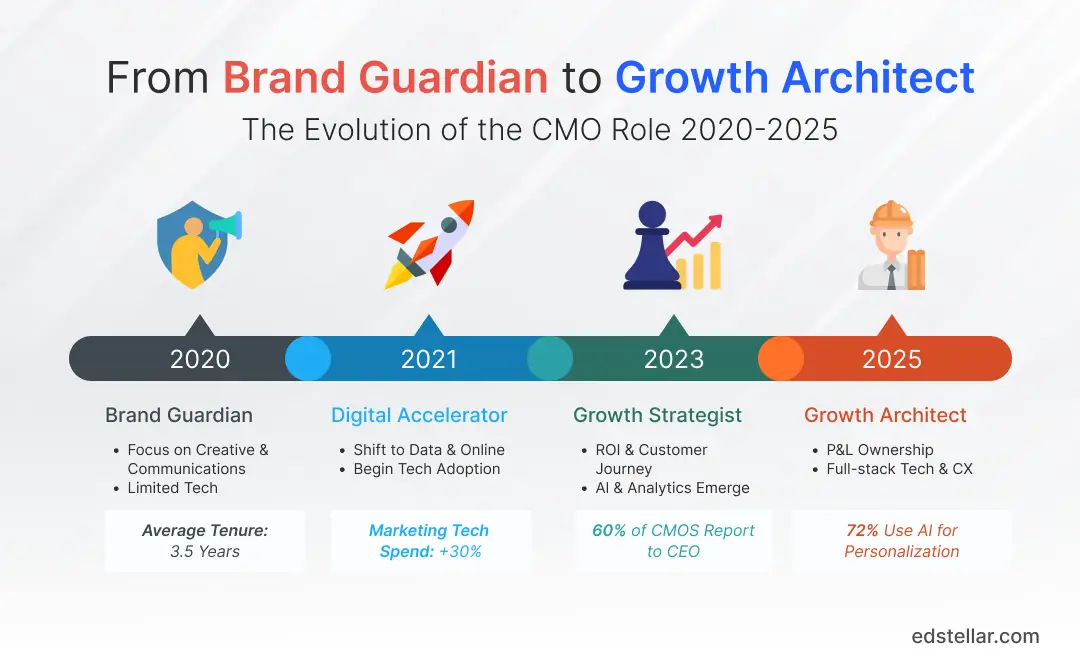
The Chief Marketing Officer has transitioned from tactical executor to strategic business leader whose decisions directly impact organizational growth and competitive positioning. In today’s marketplace, where customer expectations shift rapidly and digital channels multiply exponentially, the CMO serves as the primary guardian of customer relationships and the architect of sustainable revenue streams.
Marketing leadership drives business outcomes through three critical pathways. First, CMOs establish and protect brand equity, creating differentiation in crowded markets. Second, they orchestrate customer experiences across increasingly complex journeys. Third, they leverage technology and data to optimize resource allocation, proving marketing’s contribution with unprecedented precision.
As Marketing Dive reports, 37% of Fortune 500 CEOs built their leadership path through marketing experience, while 10% of departing Fortune 500 CMOs step directly into CEO roles evidence that marketing leadership has become one of the strongest pipelines to the top of the enterprise. This demonstrates that marketing expertise has become essential preparation for enterprise leadership.
Technology integration represents another dimension of strategic importance. According to Gartner’s 2025 survey, 65% of CMOs believe AI advances will dramatically transform their role within two years.
Strategic marketing planning forms the foundation of the CMO’s responsibilities. This involves developing comprehensive, long-term marketing strategies that align with overall business objectives while remaining agile enough to respond to market dynamics. The CMO must conduct thorough market analysis, identify target audiences, understand the competitive landscape, and chart a course to differentiate their organization.
Effective strategic planning requires CMOs to balance multiple time horizons simultaneously. They must deliver short-term results that meet quarterly targets while investing in long-term brand building that may take years to materialize. This dual focus demands sophisticated prioritization skills and the ability to articulate marketing’s value across different timescales.
The execution component is equally critical. CMOs translate strategic vision into actionable plans and coordinate campaigns across multiple channels. They establish clear objectives, define success metrics, allocate resources effectively, and create accountability structures. Modern marketing execution increasingly relies on agile methodologies, allowing teams to test, learn, and iterate rapidly.
Organizations seeking to develop strategic marketing capabilities can benefit from strategic planning training that equips teams with frameworks for effective long-term planning.
Brand management represents one of the CMO’s most visible responsibilities. The Chief Marketing Officer serves as the custodian of brand identity, ensuring consistent messaging, visual presentation, and customer experience across all touchpoints. In an era when customers interact with brands across countless channels, maintaining consistency requires vigilant oversight.
Effective brand positioning creates differentiation that transcends product features or pricing. CMOs develop and articulate what their brands stand for, the values they represent, and the promises they make to customers. This positioning must resonate authentically with target audiences while distinguishing the organization from competitors.
Brand protection has become increasingly complex in digital environments where reputational risks can escalate rapidly. CMOs must monitor brand perception continuously, respond swiftly to potential crises, and build resilience through authentic engagement.
The financial value of strong brands makes this responsibility particularly strategic. Brand equity directly impacts customer acquisition costs, pricing power, customer loyalty, and ultimately enterprise valuation. CMOs who successfully build and maintain powerful brands create competitive advantages that persist long after specific campaigns fade.
Organizations can strengthen their brand management capabilities through marketing leadership training that develops skills in brand strategy and positioning.
Digital transformation has elevated the CMO from technology consumer to technology leader. Modern CMOs must architect and oversee sophisticated marketing technology ecosystems that encompass customer data platforms, marketing automation systems, analytics tools, and, increasingly, artificial intelligence applications. These technology decisions shape not just marketing capabilities but how entire organizations understand and serve customers.
The CMO’s technology responsibilities extend beyond tool selection to strategic integration. Marketing technology must connect seamlessly with sales systems, customer service platforms, and enterprise data warehouses. CMOs ensure these integrations create unified customer views and generate actionable insights.
Artificial intelligence represents the current frontier of marketing technology leadership. CMOs are deploying AI for predictive analytics, content generation, customer segmentation, and marketing optimization. However, successful AI adoption requires a strategic vision about where automation creates value versus where human creativity remains essential.
Budget allocation for technology reflects its strategic importance. With marketing budgets stabilizing at 7.7% of overall company revenue, CMOs must carefully balance technology investments with creative development, media spending, and talent acquisition.
Customer experience has emerged as a critical battleground for competitive advantage, and CMOs increasingly bear responsibility for orchestrating seamless experiences across the entire customer journey. This role extends beyond marketing’s traditional boundaries into product design, sales processes, customer service, and post-purchase support.
Effective customer experience leadership begins with a deep understanding. CMOs invest in research methodologies that reveal not just what customers do but why they make particular choices. This insight comes from quantitative analytics, qualitative research, social listening, and direct customer feedback.
Journey mapping represents a core tool for experience design. CMOs document every touchpoint where customers interact with their organizations, identifying pain points and opportunities for differentiation. They ensure consistency across channels so customers receive coherent experiences whether engaging through websites, mobile apps, retail locations, or call centers.
Personalization at scale has become possible through technology but requires strategic vision to implement effectively. CMOs balance the value of tailored experiences against privacy concerns and operational complexity.
Edstellar’s Customer Service Excellence Program helps organizations develop teams capable of delivering exceptional experiences that drive loyalty.
Data analytics has transformed marketing from an art based primarily on intuition into a discipline balancing creativity with rigorous measurement. CMOs must be fluent in data interpretation, comfortable with statistical concepts, and able to translate complex analyses into strategic decisions.
The modern CMO oversees sophisticated measurement frameworks tracking performance across multiple dimensions. These include traditional metrics such as brand awareness, alongside more complex calculations of customer lifetime value, marketing mix effectiveness, and attribution across touchpoints.
Demonstrating return on investment is now non-negotiable for marketing leaders. CFOs and CEOs expect CMOs to demonstrate clear connections between marketing expenditures and business outcomes. This requires rigorous testing methodologies, control groups, and statistical modeling that isolates marketing’s impact.
Predictive analytics represents the cutting edge of marketing measurement. Advanced CMOs use data science to forecast future outcomes, identify customers likely to churn, predict which prospects will convert, and optimize campaigns in real-time.
Traditional vs. Data-Driven Marketing
Budget management represents one of the CMO’s most critical and scrutinized responsibilities. With marketing investments typically ranging from 5% to 10% of company revenue, these budgets represent substantial commitments requiring careful stewardship. CMOs must allocate resources strategically across channels, campaigns, technology, and talent.
Effective budget management begins with clear prioritization aligned to strategic objectives. CMOs evaluate potential investments against expected returns, risk profiles, and strategic fit. They balance short-term performance marketing with long-term brand building, recognizing that different marketing activities produce value over different timeframes.
Resource optimization has become increasingly sophisticated through analytics and testing. CMOs continuously analyze performance data to shift budgets toward higher-performing channels while reducing investments in underperforming areas. This requires courage to discontinue activities that may have organizational constituencies but fail to deliver results.
Financial acumen extends beyond marketing budgets to understanding broader business economics. CMOs must grasp unit economics, contribution margins, customer acquisition cost ratios, and payback periods. They collaborate closely with CFOs to forecast revenue impacts and demonstrate marketing’s role in achieving corporate financial objectives.
Organizations can strengthen their financial capabilities through finance and accounting training that builds business finance literacy.
Cross-functional collaboration distinguishes exceptional CMOs from merely competent ones. Marketing touches virtually every aspect of modern organizations, requiring CMOs to build productive relationships with leaders across sales, product development, technology, finance, and operations.
The CMO-sales leader relationship particularly impacts results. Marketing generates awareness and qualified leads while sales converts prospects. When these functions operate as integrated revenue engines rather than siloed departments, organizations achieve dramatically better outcomes.
Leadership of marketing teams requires distinctive capabilities. CMOs must attract, develop, and retain diverse talent spanning creative professionals, analytical specialists, technology experts, and strategic thinkers. They foster cultures that balance creativity with accountability.
Change management represents an often-overlooked dimension of marketing leadership. CMOs frequently champion organizational transformations focused on customer centricity, digital business models, or agile operating methods.
The career impact is significant. As noted earlier, 37% of Fortune 500 CEOs have marketing experience, and 10% of exiting CMOs become CEOs.
Edstellar’s leadership communication training helps marketing leaders develop communication and influence skills for cross-functional collaboration.
The expanding scope of CMO responsibilities demands a sophisticated and diverse skill set. Strategic thinking stands paramount among these competencies. Successful CMOs think several moves ahead, anticipating market evolution, competitive responses, and technological disruption.
Data literacy has become foundational for marketing leaders. CMOs must understand statistical concepts, interpret analytical findings, and translate data insights into strategic decisions. This analytical fluency enables evidence-based decision-making, replacing intuition with insight.
Digital marketing proficiency encompasses an understanding of search engine optimization, programmatic advertising, marketing automation, customer data platforms, and emerging technologies like AI. CMOs needn’t possess technical implementation skills, but strategic technology leadership requires sufficient understanding.
Leadership and people management capabilities determine whether CMOs can translate strategy into execution. This includes hiring and developing talent, building high-performing teams, fostering collaborative cultures, and driving accountability.
Communication skills enable CMOs to influence across their organizations and externally. They must articulate a compelling vision, present complex analyses accessibly, negotiate diplomatically, and represent their organizations authentically.
Customer empathy separates truly exceptional marketing leaders from competent technicians. The best CMOs maintain genuine curiosity about customers, their motivations, frustrations, aspirations, and behaviors.
Despite growing recognition of marketing’s strategic importance, CMOs navigate significant challenges. Balancing short-term performance demands with long-term brand building creates constant tension. Leadership teams expect immediate results while simultaneously wanting to build enduring brands that command premium pricing.
The pace of technological change presents both opportunity and challenge. New platforms and tools emerge constantly, each promising revolutionary improvements. CMOs must evaluate these innovations critically, distinguishing genuine advances from temporary hype.
Proving marketing value remains persistently difficult despite analytical advances. Marketing often operates across multiple touchpoints over extended periods, making attribution complex. CMOs must continuously explain these complexities while demonstrating clear value.
Talent acquisition and retention challenges intensify as marketing requires increasingly diverse expertise. Organizations need data scientists, AI specialists, content creators, brand strategists, and performance marketers in tight labor markets.
Privacy regulations and evolving technology platforms add complexity. Restrictions on third-party cookies, data-collection limitations, and evolving consumer expectations require CMOs to rethink their targeting approaches fundamentally.
Developing the sophisticated capabilities required for modern marketing leadership demands comprehensive training that bridges strategic thinking with tactical execution. Edstellar’s Marketing Excellence Programs provide organizations with customized training solutions that develop marketing talent across all levels.
Our Marketing Leadership Training specifically addresses the competencies explored throughout this article: strategic planning, brand management, digital transformation, customer experience design, data analytics, budget optimization, and cross-functional collaboration.
Edstellar’s approach recognizes that effective marketing leadership requires more than functional expertise. Our Strategic Marketing Training builds the long-term thinking that distinguishes strategic leaders from tactical executors.
The Chief Marketing Officer role has evolved into one of the most strategically significant positions within modern organizations. Today’s CMOs serve as growth architects who drive digital transformation, orchestrate customer experiences, leverage data and technology, and lead cross-functional initiatives spanning entire enterprises.
Success as a CMO requires continuous learning and adaptation. With 65% of marketing leaders expecting AI to dramatically transform their role within two years, standing still means falling behind. The most effective CMOs cultivate curiosity about emerging technologies, evolving customer behaviors, and innovative business models.
The upward career trajectory of marketing executives, with 37% of Fortune 500 CEOs having marketing experience, validates marketing leadership as excellent preparation for enterprise leadership.
Key Takeaways:
Organizations that invest in developing sophisticated marketing leadership capabilities position themselves for sustainable competitive advantage.
#On-site #Virtual #GroupTraining #Customized
Explore 2000+ industry ready instructor-led training programs.

Create dynamic leaders and cohesive teams. Learn more now!


Do a quick Skill gap analysis with Edstellar’s Free Skill Matrix tool

Unlock premium resources, tools, and frameworks designed for HR and learning professionals. Our L&D Hub gives you everything needed to elevate your organization's training approach.
Access L&D Hub Resources.svg)
.svg)
.svg)
.svg)

.svg)


.svg "Click Here to Follow on Medium")
.svg)


