4 Stages of Digital HR Maturity: Where Do You Stand?
.webp)

.svg "edstellar")

If you ask HR leaders whether they’ve “gone digital,” most will point to an HRIS, an applicant tracking system, and a modern learning platform. And they’re not wrong; those investments matter.
But in practice, many of the same teams still rely on spreadsheets to reconcile data, manual workarounds to move people through processes, and after-the-fact reporting that arrives too late to shape outcomes. The result is a familiar frustration: we bought the tools, so why does it still feel this hard?
The answer is that digitization and digital maturity are not the same thing. Digitization moves transactions into systems. Digital maturity changes the HR operating model, enabling work to move reliably across the employee lifecycle, insights to be trusted, and the function to run faster with less friction.
Most organizations plateau at what we call Stage 1: operational digitization. HR becomes more efficient, but not meaningfully more strategic, because integration, data governance, adoption, and capability building aren’t treated as first-class work.
“HR has to operate like an integrated operating system, working together to deliver solutions to each workforce segment."


This article presents a four-stage model for Digital HR Maturity that we’ve found useful in practice. Use it to diagnose your current stage, understand what’s keeping you there, and build a practical path toward strategic integration.
Many organizations feel digitally mature in HR because core systems are in place. But maturity shows up in outcomes, not implementations. Two benchmarks make the gap hard to ignore: Deloitte notes that around 75% of HR teams are still in “exploring” or “experimental” stages with AI in HR, and McKinsey finds that only 12% of U.S. HR leaders do strategic workforce planning with at least a three-year focus.
Three Myths Keep Teams Stuck at Stage 1:
1. Myth 1: “We implemented HR tech, so we’re transformed.”
Reality check: Do you still rely on spreadsheets and manual handoffs to run recruiting → onboarding → payroll, → learning?
2. Myth 2: “Every digital HR initiative is strategic.”
Reality check: Are you building compounding capabilities (shared data, integration, governance) or just adding one more tool for one team?
3. Myth 3: “Transformation is a one-time project.”
Reality check: After go-live, who owns adoption, data quality, and continuous improvement, or does it drift back to workarounds?
If those reality checks sting, you’re not behind; you’re normal. But you’re likely in Stage 1.
A useful way to make “digital HR” concrete is to separate what’s being digitalized: day-to-day HR practices (how HR work is executed) and HR strategy (how HR intends to create value).
When you use those two dimensions, you get four clear ideal-types ranging from fully analogue HRM to strategic integration, where digital capabilities are built into strategy formulation, not just execution.
This distinction also helps clean up common terminology:
In the stages below, we use Stage 0–3 to reflect that four-part typology:
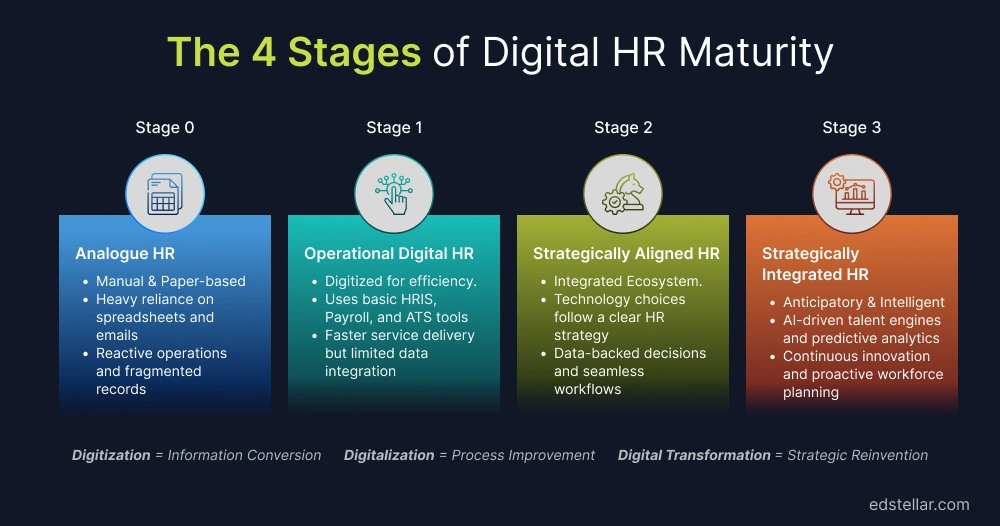
"We still use spreadsheets and paper forms for most HR processes."
At this stage, HR work gets done through people and manual coordination. Systems (if they exist) don’t function as a reliable backbone. Information is scattered, and HR spends more time moving work than improving it.
You’re Likely in Stage 0 If:
Business Impact
"We use an HRIS for payroll and benefits administration."
At this stage, digital tools are primarily used to improve HR operational practices. HR is more efficient, but not yet strategically enabled.
You’re Likely in Stage 1 If:
What it Looks Like in Practice
Recruiting runs in one system, onboarding in another, learning in another. Each team can “do their job,” but data doesn’t travel cleanly. HR spends time reconciling records, building reports manually, and translating between systems, so the organization is still dependent on people to make the workflow whole.
Business Impact
The Gap: At this stage, organizations have tools but lack strategy. They've digitized existing processes without reimagining what HR could become with digital capabilities.
"Our HR technology roadmap supports our business strategy."
At this stage, HR practices are digitized, and the HR strategy is supported by digital technologies. Technology choices follow strategy.
You’re Likely in Stage 2 If:
What it Looks Like in Practice
HR can translate business goals into people programs that actually run at scale: internal mobility pathways, skills development tied to roles, onboarding that doesn’t depend on chasing approvals, and reporting that shows progress against priorities.
Business Impact
The Limitation: Strategy still tends to be set first, and technology is selected to support it. Digital enables better execution, but it isn’t yet a consistent source of strategic innovation (new ways of planning, developing, and moving talent that weren’t feasible before).
"Digital capabilities define what's possible in our HR strategy."
You’re Likely in Stage 3 If:
What it Looks Like in Practice:
Instead of waiting for attrition to spike or roles to stay open too long, HR can model upcoming capability gaps using business plans, pipeline signals, and internal movement patterns. Learning and mobility become targeted at scale: employees can see credible pathways, managers can plan talent moves earlier, and HR can intervene before issues turn into churn or stalled delivery.
Business Impact
The Real Difference at Stage 3
The strategy is no longer “improve recruiting with better tools.” It’s “build a talent intelligence system that helps the organization anticipate and shape workforce capability ethically, transparently, and at scale.”
This table summarizes the key differences across all four stages:
If you want a fast, honest read on your current maturity stage, use Edstellar’s Digital HR Maturity Assessment. It’s designed to do two things well: help you name your current reality (Stages 0–3) and give you clear, practical direction on what to fix next without getting stuck in tool debates.
The assessment takes 10–15 minutes and guides you through 15 questions across the HR lifecycle (data, integration, recruiting, onboarding, performance, learning, mobility, service delivery, analytics, and roadmap). You’ll receive a maturity stage result, along with a brief explanation of what that stage typically means operationally and what progress looks like.
1. Use it as a baseline, not a verdict.
This is a self-assessment, so treat the result as your starting point. If your score sits between two stages, you’re likely in a transition: keep the higher stage as the direction, but plan as if the lower stage is still true in parts of the lifecycle.
2. Don’t do it solo; run it as a calibration.
Have HR Ops, Talent Acquisition, L&D, HRBP, Payroll/Finance, and IT take it separately. Compare answers. The gaps are the insight: they usually reveal where “it works for one team” but breaks end-to-end.
3. Use the output to drive decisions, not slides.
Once you have the stage, use it to pick one lifecycle flow to fix next (hire→start, performance→development, mobility→fill). The fastest progress comes from killing rework and clarifying ownership, not adding features.
4. Export the PDF and use it to align stakeholders.
The template lets you generate a professional PDF report, add your company branding, and use it as a shared reference in steering meetings so you’re arguing from the same reality.
This gap isn’t philosophical. It shows up as three very real taxes on the business:
1. The Turnover Tax
When people leave, you don’t just pay to “replace a head.” You pay in lost output, manager time, rehiring, and ramp-up. Gallup estimates replacement costs vary by role: roughly 40% of salary for frontline roles, 80% for technical roles, and ~200% for leaders/managers.
2. The Vacancy Tax
Even when candidates are available, roles sit open longer than leaders think, often because decision-making and handoffs drag. For example, iCIMS reported time-to-fill for tech roles rising from 48 to 51 days (Feb 2024 → Feb 2025), and manufacturing at 42 days vs 40 the year prior (Oct 2025 vs Oct 2024).
Every extra week a role stays open pushes work onto everyone else (or forces expensive workarounds).
3. The Hiring-cost Tax (and the Measurement Gap)
Even before onboarding and ramp, hiring is expensive. SHRM’s 2025 benchmarking reports put average nonexecutive cost-per-hire at $5,475 (executives are much higher).
And many teams still can’t prove whether those hires were “good” hires. SHRM also notes that only 20% of organizations track quality of hire.
A Simple Back-of-the-Envelope Check (Use Your Numbers):
If you have 5,000 employees and reduce regrettable turnover by just one percentage point (50 fewer exits), the savings can be substantial, since replacement costs are often a meaningful fraction of salary (and far higher for leadership/critical roles).
In short, lower maturity quietly forces you to spend more on churn, delays, and rework while limiting your ability to measure what’s working and scale it.
Progressing through digital HR maturity isn’t “buy more tools.” It’s moving from digitization (technical conversion) to digitalization (socio-technical change) and, at higher stages, using digitization potential to shape strategy (digital transformation as the strategic subset).
Below are practical moves that work because they’re socio-technical: tech + process + governance + capabilities + adoption.
“Build the backbone.”
To move out of Stage 0, the goal isn’t “more tools”; it’s a reliable HR backbone that replaces spreadsheets and email as the operating system.
Start by agreeing on what “truth” means in practice: define the system of record by domain (e.g., employee identity in HRIS, pay elements in payroll, cost centers in finance) and document it.
Then standardize a small set of high-frequency workflows (Joiner, Leaver, Leave) with audit trails and clear ownership.
Put basic data governance in place, shared definitions for critical fields, access controls, and a recurring data-quality routine so the system stays usable after go-live.
And don’t let the old world survive through “exceptions via email”: create a limited exception path (with approval + SLA) and close the backdoor for everything else.
Proof you’ve moved: you can produce workforce basics without spreadsheet stitching, core requests flow through the system by default, and manual re-entry drops sharply.
“Connect the lifecycle and align to priorities.”
Stage 1 becomes Stage 2 when HR stops being a set of “digital islands” and starts behaving like an end-to-end lifecycle.
Focus on the few integrations that remove the most rework, typically ATS→HRIS, HRIS→Payroll/Finance, and HRIS→IT provisioning, so data moves without humans acting as middleware.
If IT capacity is limited, use an interim automation (API/file feeds/RPA) to kill re-entry while deeper integration is queued.
In parallel, redesign workflows end-to-end (not just automate steps): collapse legacy approvals, clarify decision rights, and standardize the “happy path” so work doesn’t bounce around on exceptions.
Make the HR tech roadmap explicitly serve business priorities (growth, retention, capability shifts) so decisions aren’t vendor-feature-led.
Finally, treat adoption as capability building: manager self-service paths, enablement, and deliberate retirement of spreadsheet workarounds.
Proof you’ve moved: hires flow from recruit to onboarding without re-entry, managers complete routine actions without HR “help,” and reporting is trusted often enough that leaders actually use it.
“Turn execution into a workforce decision system with guardrails.”
Stage 3 is not “more AI.” It’s when digital capabilities become a repeatable decision system for workforce outcomes, with trust built in.
The practical way to get there is to pick one strategic use-case skills gap forecasting, mobility-first staffing, capacity planning, or retention risk in critical roles, and build a decision rhythm around it (inputs, scenarios, actions, measurement).
Make it real by instituting a monthly Workforce Decision Review: what we’re seeing, what we’re deciding, who owns the action, and what outcome we’ll track.
Connect roles, skills, learning, and mobility enough to act at scale (pathways, targeted development, redeployment), not as a one-off analysis.
Build governance explicitly with privacy-by-design, transparency, bias checks, and human accountability, but start with lower-risk applications (planning and recommendations) rather than automated employment decisions.
And run it like a product: clear ownership, metrics, iteration, and continuous improvement.
Proof you’ve moved: leaders use workforce scenarios in planning (not after the fact), internal mobility and development become steerable rather than ad hoc, and interventions are tracked to measurable business outcomes.
Most organizations remain trapped at Stage 1 not because of technology limitations, but because of three critical barriers:
1) Governance is Missing Where it Matters Most
HR tech often launches without clear decision rights: who owns data definitions, who approves workflow changes, who controls integrations, and who resolves cross-functional conflicts. Without governance, every change becomes a negotiation, and the safest option becomes doing nothing.
What Breaks Through: a lightweight governance spine (data owner, process owner, tech owner) with authority to standardize, integrate, and retire workarounds.
2) Ownership is Fragmented Across the Lifecycle
Recruiting owns recruiting. L&D owns learning. Payroll owns payroll. Each optimizes locally, but no one owns the end-to-end employee lifecycle, so handoffs break, and HR becomes the human glue between systems and teams.
What Breaks Through: name one accountable owner per critical lifecycle flow (hire→start, performance→development, mobility→fill), measured on outcomes, not activity.
3) Incentives Reward Go-live, Not Sustained Adoption
Projects get celebrated at launch. But adoption work manager behavior change, data discipline, process compliance, continuous improvement is invisible and underfunded. So the organization drifts back to exceptions, side channels, and spreadsheet “patches” that feel faster in the moment.
What Breaks Through: define success as run-state metrics (usage, cycle time, rework, ticket volume, data quality) and enforce the operating rules that keep the new way in place.
Organizations don’t get stuck because they lack technology. They get stuck because they lack the governance, ownership, and incentives that turn technology into a working system.
If you’re serious about moving up a stage, the hardest part usually isn’t selecting tools. It’s building the operating system around their governance, ownership, adoption, and the capabilities to sustain progress.
Edstellar supports organizations across that journey from stabilizing the basics to building strategically integrated, trust-based digital HR capabilities. Our L&D Consulting work is designed to be practical, not theoretical:
If you want a clear view of where you are and what it will take to move forward, schedule a consultation with Edstellar’s L&D experts to assess your Digital HR maturity and map the next stage.
#On-site #Virtual #GroupTraining #Customized
Explore 2000+ industry ready instructor-led training programs.

Create dynamic leaders and cohesive teams. Learn more now!

Do a quick Skill gap analysis with Edstellar’s Free Skill Matrix tool

Unlock premium resources, tools, and frameworks designed for HR and learning professionals. Our L&D Hub gives you everything needed to elevate your organization's training approach.
Access L&D Hub Resources.svg)
.svg)
.svg)
.svg)

.svg)


.svg "Click Here to Follow on Medium")
.svg)


