7 HR Analyst Skills That Make You Indispensable at Work

.svg "edstellar")

The human resources landscape has undergone a seismic transformation. Organizations no longer view HR as merely an administrative function but as a strategic powerhouse that drives business outcomes through data-driven insights. At the heart of this evolution stands the HR Analyst, a professional who bridges the gap between people management and advanced analytics to unlock organizational potential.
“An organisation needs to look at its people analytics function as a potential long-term investment."

According to SHRM’s 2025 Talent Trends research, 28% of organizations reported that filling full-time regular positions required candidates to possess new skills, highlighting the unprecedented pace of change in workforce capabilities. This shift isn’t just incremental, it’s revolutionary. As HR departments race to meet strategic organizational priorities, HR Analysts equipped with the right competencies become indispensable assets in navigating this complexity.
The U.S. Bureau of Labor Statistics projects that employment of human resources specialists will grow 6% from 2024 to 2034, faster than the average for all occupations, with approximately 81,800 openings projected annually. This sustained demand underscores a fundamental reality: organizations recognize that effective people analytics directly correlates with competitive advantage.
But what exactly separates exceptional HR Analysts from the rest? What skills transform raw workforce data into actionable strategies that reshape organizational culture, enhance employee engagement, and drive measurable business results? This comprehensive guide explores the seven must-have skills that define excellence in HR analytics, competencies that empower professionals not just to interpret data, but to translate it into transformative workforce strategies.
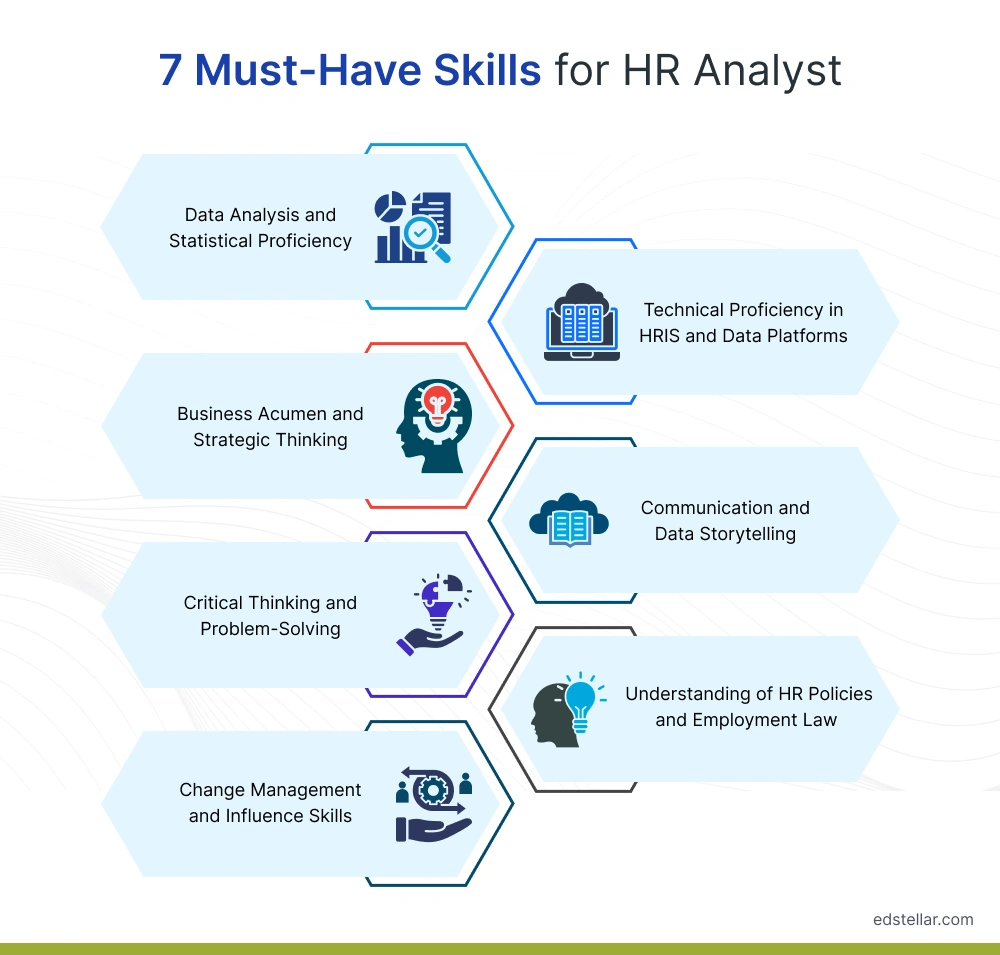
Data analysis isn’t simply about crunching numbers; it’s about extracting meaning from complexity and turning information into intelligence. HR Analysts must possess robust analytical capabilities to identify patterns in employee behavior, predict attrition risks, and uncover hidden trends that impact organizational performance.
The World Economic Forum’s Future of Jobs Report 2025 revealed that analytical thinking remains the top core skill for employers, with 70% of companies considering it essential. This emphasis on analytical capabilities reflects how technological advancement and data proliferation have fundamentally altered HR’s role. Modern HR Analysts work with large datasets, including recruitment metrics, performance evaluations, engagement surveys, and compensation benchmarks, and use sophisticated analytical techniques to derive actionable insights.
Statistical proficiency enables HR Analysts to move beyond descriptive reporting to predictive and prescriptive analytics. Understanding concepts such as regression analysis, correlation, hypothesis testing, and statistical significance enables analysts to validate assumptions, test interventions, and forecast workforce trends with confidence. When an organization wants to understand which factors most strongly predict employee retention or determine whether a new training program genuinely improves performance, statistical rigor provides the answers.
Business Impact: Organizations with strong analytical capabilities can reduce turnover by identifying at-risk employees before they resign, optimize recruitment budgets by focusing on high-yield channels, and design compensation structures that balance internal equity with market competitiveness. The ability to quantify HR’s contribution to business outcomes transforms the function from a cost center to a strategic partner.
Edstellar’s Approach: Edstellar’s data analytics training programs equip HR professionals with hands-on experience in statistical methods, data modeling, and analytical thinking. Through instructor-led sessions delivered by certified trainers globally, participants learn to apply analytics to real-world HR challenges, building confidence in data-driven decision-making that directly impacts organizational success.
Technical mastery has become non-negotiable for HR Analysts. While HR once relied primarily on spreadsheets and intuition, today’s professionals must navigate sophisticated Human Resource Information Systems (HRIS), extract data from multiple platforms, and leverage specialized analytics tools to perform their duties effectively.
Gartner’s 2024 HR Investment Trends identified HR technology as the top investment priority for the third consecutive year, with 48% of organizations planning to increase their HR technology budgets. This investment surge reflects recognition that technology enables HR to scale operations, improve employee experiences, and generate insights previously impossible to obtain.
HR Analysts must demonstrate proficiency across multiple technology dimensions. At the foundational level, advanced Excel skills, including pivot tables, VLOOKUP/XLOOKUP functions, and data visualization, remain essential for data manipulation and reporting. Beyond Excel, familiarity with HRIS platforms such as Workday, SAP SuccessFactors, Oracle HCM, or BambooHR enables analysts to efficiently extract workforce data and understand how HR systems structure information.
SQL (Structured Query Language) represents another critical technical skill. The ability to write database queries allows analysts to access data directly from organizational databases, join tables, filter records, and create custom datasets without relying on IT support. SQL proficiency dramatically increases an analyst’s independence and responsiveness to urgent data requests.
Additionally, exposure to business intelligence tools such as Tableau, Power BI, or Looker enables analysts to create interactive dashboards and visualizations that make data accessible to non-technical stakeholders. As organizations generate increasing volumes of workforce data, these tools transform static reports into dynamic, self-service analytics platforms.
Business Impact: Technical proficiency accelerates decision-making cycles, reduces dependence on IT resources, and enables HR Analysts to respond quickly to business questions. When leaders need real-time insights about workforce composition, skill gaps, or compensation competitiveness, technically skilled analysts deliver answers in hours rather than weeks.
Edstellar’s Technology Training Solutions: Edstellar’s comprehensive HRMS/HRIS training and data visualization courses provide hands-on experience with industry-leading platforms. With a network of 5,000+ certified instructors and flexible delivery options, Edstellar ensures HR professionals master the technical tools that drive modern people analytics.
Technical skills alone don’t make an exceptional HR Analyst; business acumen transforms data expertise into strategic impact. HR Analysts must understand how their organization creates value, generates revenue, manages costs, and competes in the marketplace. This contextual understanding enables analysts to ask the right questions, prioritize the most impactful analyses, and communicate findings in business language that resonates with executive leadership.
According to SHRM’s 2025 research, systems and resource management skills, which include complex problem-solving and judgment, are anticipated as the most critical competencies for future success, with 49% of organizations identifying these capabilities as essential over the next five years. This finding underscores that as HR becomes more strategic, analysts must think beyond functional boundaries to connect workforce insights with broader organizational objectives.
Business acumen manifests in several ways. First, HR Analysts should understand key financial metrics like revenue per employee, labor cost percentage, profit margins, and return on investment. When presenting workforce strategies, framing recommendations in financial terms dramatically increases their persuasiveness. Second, analysts must grasp their industry’s competitive dynamics, customer needs, and market trends. An HR Analyst in pharmaceutical manufacturing should understand drug development timelines and regulatory requirements; one in retail should comprehend seasonal workforce fluctuations and customer service imperatives.
Strategic thinking involves connecting HR analytics to business outcomes. Rather than simply reporting that turnover increased by 3%, strategic analysts investigate whether the increase was concentrated in critical roles, identify root causes through exit-interview analysis, model the financial impact of retention initiatives, and recommend evidence-based interventions. They anticipate the questions leaders will ask and proactively provide context to support decision-making.
Business Impact: HR Analysts with strong business acumen become trusted advisors to leadership. They translate workforce challenges into business problems, quantify the ROI of people investments, and position HR initiatives as enablers of strategic objectives rather than compliance obligations.
Developing Strategic Business Perspective: Edstellar’s business analytics training helps HR professionals develop the strategic thinking framework necessary to connect people data with business outcomes. Through case studies and practical exercises, participants learn to analyze business challenges from multiple perspectives and develop data-driven recommendations that align with organizational strategy.
The most sophisticated analysis becomes meaningless if stakeholders don’t understand or act on it. Communication skills, particularly the ability to translate complex data into compelling narratives, represent a defining characteristic of impactful HR Analysts.
The World Economic Forum’s 2025 Future of Jobs Report noted that while employers expect 39% of workers’ core skills to change by 2030, human-centric competencies such as creative thinking, resilience, and communication remain among the top five essential skills. This persistent importance of communication reflects a fundamental truth: in an AI-augmented world, the ability to connect with other humans through clear, persuasive communication remains uniquely valuable.
Effective HR Analysts master multiple communication modalities. Written communication includes creating clear, concise reports that highlight key findings, provide relevant context, and recommend specific actions. These documents must be tailored to their audience; an executive summary for C-suite leaders differs dramatically from a detailed technical report for HR colleagues.
Verbal communication skills enable analysts to present findings persuasively in meetings, respond confidently to challenging questions, and facilitate productive discussions about workforce strategies. The confidence to speak up in executive meetings, challenge assumptions respectfully, and advocate for data-driven approaches requires both communication competence and organizational credibility.
Data storytelling represents the synthesis of analytical and communication skills. Rather than presenting tables of numbers, skilled analysts construct narratives that contextualize data within organizational challenges, highlight the “so what” of their findings, and guide audiences toward logical conclusions. Effective data stories typically follow a structure: establish context, present the problem or opportunity, reveal insights from data, explain implications, and recommend actions.
Visual communication through charts, graphs, and dashboards amplifies understanding. HR Analysts should master data visualization principles, choosing appropriate chart types, using color strategically, eliminating clutter, and highlighting key messages. A well-designed dashboard can communicate workforce trends more effectively than a 50-page report.
Business Impact: Superior communication skills amplify the impact of every analysis. When HR Analysts tell compelling data stories, they inspire action, secure resources for critical initiatives, and position HR as a strategic partner rather than a reporting function.
Building Communication Excellence: Edstellar’s communication skills training covers presentation skills, business writing, and data storytelling. Through interactive sessions led by experienced trainers, HR professionals learn to communicate complex information clearly and confidently, ensuring their analytical insights drive organizational change.
HR Analysts don’t simply answer questions; they identify the right questions to ask. Critical thinking involves challenging assumptions, considering alternative explanations, evaluating evidence objectively, and recognizing when additional information is needed before reaching a conclusion.
Research from Gartner’s 2024 HR survey revealed that HR leaders cite learning and development as a top investment area, with organizations addressing continuous business and technology change by developing employee skills at speed and scale. This focus on rapid skill development reflects the premium organizations place on adaptive thinking and problem-solving capabilities that transcend specific technical knowledge.
Critical thinking in HR analytics manifests through systematic problem decomposition. When faced with high turnover in a specific department, superficial analysis might blame compensation or management. Critical thinkers dig deeper: Is turnover concentrated among certain tenure groups or demographics? Do exit interview themes point to specific issues? How does turnover compare to industry benchmarks? What changed recently that might explain the trend? This structured inquiry reveals root causes rather than symptoms.
Problem-solving extends beyond diagnosis to solution design. Effective HR Analysts generate multiple potential interventions, evaluate each option’s feasibility and likely impact, consider unintended consequences, and recommend approaches with the highest probability of success. They recognize that organizational problems rarely have single causes or simple solutions, requiring multifaceted strategies to address systemic issues.
Critical thinking also involves healthy skepticism about data quality. Experienced analysts question anomalies, verify unusual findings, recognize potential data collection biases, and understand the limitations of their analyses. They distinguish between correlation and causation, avoiding the trap of attributing causality to statistical relationships without supporting evidence.
Business Impact: Critical thinking prevents costly mistakes based on faulty assumptions or incomplete analyses. Organizations benefit when HR Analysts challenge conventional wisdom, identify overlooked problems, and design evidence-based solutions that address true root causes rather than superficial symptoms.
Developing Analytical Rigor: Edstellar’s problem-solving and decision-making training helps HR professionals develop structured approaches to complex challenges. Through scenario-based learning and critical-thinking exercises, participants develop the analytical discipline needed to navigate ambiguous situations and deliver robust, defensible recommendations.
HR Analysts operate at the intersection of data and compliance. While analytical and technical skills enable insight generation, deep knowledge of HR policies, employment law, and regulatory requirements ensures that analyses and recommendations respect legal boundaries and organizational governance.
According to SHRM’s 2025 research, ensuring all HR functions comply with federal, state, and local regulations represents a fundamental responsibility for HR specialists. This compliance imperative becomes particularly complex in analytics, where aggregating and analyzing employee data must comply with privacy regulations, while investigating potential discrimination patterns requires a sophisticated understanding of equal employment opportunity principles.
HR Analysts must understand key areas of employment law. Compensation analysis requires knowledge of Fair Labor Standards Act provisions regarding exempt and non-exempt classifications, minimum wage requirements, and overtime calculations. Recruitment analytics must comply with Equal Employment Opportunity Commission guidelines and avoid analyses that could reveal or perpetuate discriminatory patterns. Leave management analytics must account for Family and Medical Leave Act requirements, Americans with Disabilities Act accommodations, and state-specific leave regulations.
Data privacy and security represent increasingly critical concerns. HR Analysts handle sensitive employee information, compensation data, performance ratings, medical information, and disciplinary records, all of which require strict confidentiality protocols. Understanding data protection regulations, such as the GDPR (for European operations) and applicable state privacy laws, helps ensure analytics practices comply with legal requirements while maintaining employee trust.
Policy knowledge also includes understanding organizational HR policies, collective bargaining agreements (in unionized environments), and internal governance procedures. This contextual knowledge helps analysts interpret data correctly and recognize when workforce patterns reflect policy constraints rather than organic trends.
Business Impact: Compliance expertise protects organizations from costly legal risks while ensuring analytics serve legitimate business purposes. When HR Analysts combine analytical rigor with legal and policy knowledge, they deliver actionable, defensible insights.
Building HR Expertise: Edstellar’s HR excellence programs and compliance training courses provide comprehensive coverage of employment law, policy administration, and regulatory requirements. This foundation enables HR Analysts to perform their technical work within appropriate legal and ethical frameworks.
The ultimate measure of an HR Analyst’s effectiveness isn’t the quality of their analyses; it’s whether those insights drive organizational change. Change management and influence skills enable analysts to shepherd recommendations from presentation to implementation, navigating organizational politics and resistance to drive meaningful transformation.
The World Economic Forum’s 2025 report identified leadership and social influence as the most important, with a 22-percentage-point increase in the share of employers identifying them as core skills. This dramatic elevation reflects recognition that in volatile, uncertain business environments, the ability to guide others through change becomes increasingly valuable.
Change management begins with understanding organizational culture and political dynamics. Effective HR Analysts identify key stakeholders, understand competing priorities, anticipate sources of resistance, and develop strategies to build support for their recommendations. They recognize that data alone rarely persuades; people change when they understand why change matters and trust those leading it.
Influence without authority represents a critical competency. HR Analysts typically don’t hold executive positions but must convince executives to act on their recommendations. This influence requires building credibility through consistent, high-quality work; understanding what motivates different stakeholders; framing recommendations around stakeholder priorities; and demonstrating how proposed changes advance organizational objectives.
Effective change agents also help with the adoption of new processes or tools. When rolling out new HR analytics dashboards, skilled analysts don’t just build the tools; they run training sessions, create user guides, offer ongoing support, and celebrate early adopters. They know that technical solutions won’t succeed without proper change management.
Business Impact: Change management skills translate analyses into practical improvements. When HR Analysts successfully execute workforce strategies, they deliver tangible results like lower turnover, higher productivity, and increased employee engagement, which justify ongoing investment in people analytics.
Developing Leadership Capabilities: Edstellar’s leadership training programs and change management courses help HR professionals develop the influence and change-management skills needed to drive organizational transformation. Through practical scenarios and expert coaching, participants learn to navigate resistance, build coalitions, and implement lasting change.
Mastering these seven essential skills doesn’t happen overnight; it requires deliberate practice, continuous learning, and real-world application. The most successful HR Analysts approach skill development strategically, identify their current capabilities, target priority development areas, and seek opportunities to apply new competencies in progressively challenging contexts.
Organizations committed to data-driven HR should invest in developing these capabilities across their HR teams. The World Economic Forum’s research indicates that 50% of the workforce completed training as part of long-term learning strategies in 2024, up from 41% in 2023. This acceleration in training completion reflects growing recognition that continuous skill development represents the only sustainable response to rapid change.
As HR analytics matures as a discipline, the bar for excellence continues rising. Forward-thinking HR Analysts don’t simply react to skill demands, they anticipate future requirements, position themselves ahead of industry trends, and become the strategic advisors their organizations desperately need.
Edstellar stands at the forefront of HR professional development, offering comprehensive training solutions that build the competencies outlined in this guide. With a global network of 5,000+ certified instructors, 1,000+ training courses, and innovative training management platforms, Edstellar provides scalable, customizable learning solutions that help organizations develop world-class HR analytics capabilities.
Whether you need data analytics training, HR systems expertise, strategic thinking development, or communication skills enhancement, Edstellar’s instructor-led training delivers measurable results. Our flexible delivery options, virtual and onsite, ensure training accessibility regardless of geographic location or organizational structure.
Transform your HR analytics capabilities. Connect with Edstellar today to discuss how our training solutions can elevate your organization’s people analytics maturity.
#On-site #Virtual #GroupTraining #Customized
Explore 2000+ industry ready instructor-led training programs.

Create dynamic leaders and cohesive teams. Learn more now!

Do a quick Skill gap analysis with Edstellar’s Free Skill Matrix tool

Unlock premium resources, tools, and frameworks designed for HR and learning professionals. Our L&D Hub gives you everything needed to elevate your organization's training approach.
Access L&D Hub Resources.svg)
.svg)
.svg)
.svg)

.svg)


.svg "Click Here to Follow on Medium")
.svg)


