10 Most In-Demand Skills in Sweden for 2026
.webp)

.svg "edstellar")

Sweden recorded a total shortage of 70,000 workers across various occupations in Q3 2024 according to Statistics Sweden (SCB), with half of all employers experiencing recruitment difficulties in the preceding six months. The shortage spans data, technology, healthcare, and vocational occupations simultaneously, creating a structural mismatch where 8.2% unemployment coexists with thousands of unfilled positions that employers cannot staff. Swedish tech companies raised over EUR 13.7 billion in 2024, accounting for 18.4% of all European tech funding, yet the IT and cybersecurity sector alone faces a shortage of over 30,000 professionals. For corporate L&D leaders and HR managers operating in Europe's most innovative economy, these numbers translate directly into urgent training priorities.
Several structural forces are intensifying this skills gap. The OECD Economic Survey of Sweden 2025 highlights that severe labour shortages exist side-by-side with a pool of long-term unemployed who lack the skills employers need, with approximately 40% of registered unemployed classified as long-term jobless. Sweden's workforce is aging, the relatively low birth rate combined with decreased immigration is compressing the labour supply, and the healthcare system needs an estimated 100,000 additional care workers by 2026.
At the same time, 35% of Swedish enterprises now use AI according to SCB's 2025 survey, the green industrial transition is creating entirely new job categories in battery technology and green steel, and Stockholm was ranked the most innovative region in Europe by the European Commission in 2025.
So which skills are truly driving Sweden's economy, and where should organisations invest their training budgets? This guide breaks down the top 10 skills in demand in Sweden, spanning artificial intelligence, cybersecurity, healthcare, green technology, and skilled trades. Drawing on SCB labour data, Arbetsformedlingen shortage assessments, OECD workforce analysis, and industry salary benchmarks, it provides an evidence-based picture of what jobs are in demand in Sweden, whether you are planning corporate upskilling programmes, building internal talent pipelines, or advising teams on high demand skills in Sweden for 2026 and beyond.
Every ranking in this guide is backed by data from Swedish government bodies, industry associations, and established hiring platforms.
Sweden's skills landscape in 2026 reflects the paradox of Europe's most innovative economy grappling with structural workforce shortages across virtually every high-skill sector. The 10 skills below span technology, healthcare, trades, financial services, and green industry, mirroring the sectors where employer demand, salary premiums, and government policy investment are highest. Each ranking draws on the policy signals, job market data, and industry investments outlined in the sources above.
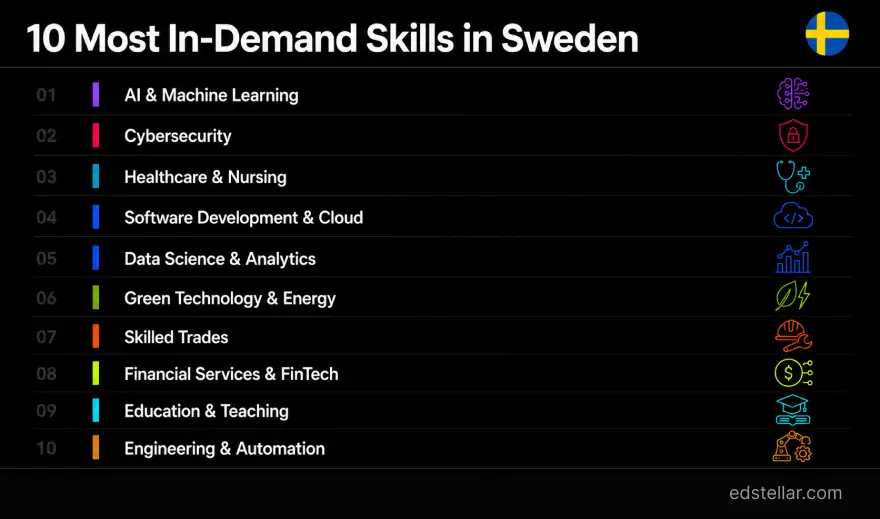

Demand for AI skills is growing rapidly according to TechSverige's January 2026 labour market analysis, and 35% of Swedish enterprises now use AI based on the SCB 2025 enterprise survey. According to KiTalent analysis, Stockholm's AI and cloud talent market faces a significant scale gap, with demand for senior AI/ML engineers, MLOps specialists, and AI product managers far outstripping supply. Sweden was ranked second in total European tech funding in 2024 at EUR 13.7 billion, and the concentration of AI investment in Stockholm, Gothenburg, and Malmo is creating intense competition for professionals who can build and deploy machine learning systems at scale.
AI specialists earn average salaries of SEK 777,031 annually, with entry-level positions starting around SEK 530,000 and senior specialists with eight or more years of experience commanding up to SEK 939,706. Senior AI/ML engineers earn base salaries of SEK 950,000 to SEK 1,300,000, with total compensation including equity reaching SEK 1,200,000 to SEK 1,800,000. The demand extends beyond pure technology firms: healthcare organisations deploy AI for patient outcome prediction, automotive companies including Volvo Cars, Scania, and Einride develop autonomous vehicle systems, and financial institutions use ML for fraud detection and algorithmic trading.
Sweden produces the highest density of billion-dollar startups per capita outside Silicon Valley, and AI is central to the next generation of Swedish unicorns. Spotify, Klarna, King (Activision Blizzard), and iZettle (PayPal) all built their competitive advantages on data and ML capabilities. The AI Apprenticeship Programme and university partnerships at KTH Royal Institute of Technology, Chalmers University of Technology, and Lund University provide training pathways, but the gap between graduate output and industry demand continues to widen.
Technology & Startups, Automotive & Autonomous Vehicles, Financial Services, Healthcare & Life Sciences
Explore Related Training:
Machine Learning with Python AI Programming with Python All AI Training Programs
Sweden's cybersecurity market is expected to grow to USD 2.19 billion by 2029, driven by a 35% increase in cyber attacks and over 70,000 IT jobs available across the economy according to industry analysis. The IT and cybersecurity sector faces a shortage exceeding 30,000 professionals, making it one of the most acute talent gaps in the Swedish economy. The financial and manufacturing sectors are leading demand, with Stockholm's fintech ecosystem alone adding approximately 1,200 compliance and regulatory technology roles in 2025 as companies prepare for DORA implementation and tightened AML requirements.
Entry-level cybersecurity positions in Sweden earn approximately SEK 450,000 annually, with senior roles exceeding SEK 850,000. Salaries are projected to increase by 22% by 2029 as the gap between supply and demand widens. Swedish companies are not just competing locally for cyber talent; they face international competition from firms offering higher packages, making retention a critical challenge. Understanding the full scope of cybersecurity engineer roles and responsibilities helps L&D teams design training that meets both Swedish regulatory requirements and the practical demands of defending critical infrastructure.
Major employers include Ericsson, Saab, Securitas, and the major banks (SEB, Handelsbanken, Swedbank, Nordea), alongside government agencies including the Swedish Civil Contingencies Agency (MSB) and the National Defence Radio Establishment (FRA). The Nordic region's growing focus on defence and national security, accelerated by Sweden's NATO membership, is creating additional demand for cybersecurity professionals with clearance eligibility and experience in OT/ICS security for critical infrastructure.
Financial Services, Defence & Government, Telecommunications, Manufacturing & Industrial
Explore Related Training:
Cybersecurity Risk Management Threat Intelligence All Cybersecurity Programs
Nursing shortages affect 80% of Sweden's healthcare sector according to official data, with employers reporting a shortage of 3,500 assistant nurses alongside critical gaps in specialist physicians, radiology nurses, and specialist nurses in psychiatry, anaesthesia, ambulance care, intensive care, and surgery. SCB data confirms that health professionals and health associate professionals are among the occupational groups with the highest shortage frequency in Sweden. The healthcare system needs an estimated 100,000 additional care workers by 2026 to maintain current service levels.
The demographic pressure is severe. Sweden's aging population is expanding demand for geriatric care, home health services, and chronic disease management faster than the training pipeline can produce qualified professionals. Above-average early retirements due to ill health compound the problem, and the lengthy education required for nursing specialisations means that replenishment is inherently slow. Over the last decade, Sweden relied on approximately 4,000 foreign doctors, 2,000 nurses, and 33,000 assistant nurses to supplement the domestic workforce, but recent immigration policy changes have disrupted this pipeline.
Sweden's regions (kommuner) operate their own healthcare systems, and shortages are particularly acute in rural and northern areas where recruitment and retention are most challenging. The major university hospitals in Stockholm (Karolinska), Gothenburg (Sahlgrenska), and Malmo (Skane University Hospital) compete for the same limited pool of specialists. For international healthcare professionals, Sweden offers structured pathways through the National Board of Health and Welfare's licensing process, though Swedish language proficiency at the B2/C1 level is typically required for clinical practice.
Regional Healthcare (Landsting), Municipal Elder Care, University Hospitals, Private Healthcare Providers
"The higher salaries for IT talent reflect a combination of experiential value addition, the current shortages of skills in the marketplace and any inflationary effects on salary expectations."



Sweden's tech sector contributes 12% to GDP with over 400,000 employees and produced record tech exports of SEK 387 billion in 2024 according to Business Sweden. Software developers are consistently among the most in-demand roles, and salaries for IT professionals with three years of experience jumped 12% to EUR 4,000 monthly since 2022. Companies offering less than EUR 6,000 monthly for senior roles are effectively invisible to experienced candidates, reflecting the intensity of competition for engineering talent in Stockholm, Gothenburg, and Malmo.
Sweden produces the highest density of billion-dollar startups per capita outside Silicon Valley, and this startup ecosystem absorbs software talent at scale. Spotify, Klarna, Trustly, Tink (Visa), and dozens of growth-stage companies compete with established firms including Ericsson, Volvo, IKEA, and H&M for full-stack developers, backend engineers, and platform architects. DevOps engineers with cloud-native expertise are particularly sought after as Swedish enterprises accelerate migration to AWS, Azure, and Google Cloud. Kubernetes-certified professionals earn 15–20% premiums above peers with similar experience levels.
The government has announced plans to invest EUR 5.3 billion in growth initiatives and is making it easier for foreign tech workers to enter the country, with the salary threshold for work permits set at EUR 3,200 monthly from mid-2025. For international developers, Sweden offers competitive compensation, strong work-life balance, and access to one of Europe's most dynamic startup ecosystems. Python, JavaScript, TypeScript, Java, and Go are the most requested languages, with React, Node.js, and Kubernetes frameworks dominating job listings.
Technology & Startups, Financial Technology, Automotive & Mobility, E-Commerce & Retail Tech
Data scientists lead Sweden's salary rankings for tech professionals, with senior roles reaching up to SEK 1,200,000 according to industry salary data. SCB identified data-related occupations as one of the key shortage areas in its 2024 recruitment needs survey, and the convergence of traditional analytics with AI capabilities is creating hybrid roles where statistical foundations and machine learning expertise are equally valued. Sweden's strong data privacy framework under GDPR adds an additional layer of demand for professionals who can work within regulatory constraints while extracting business value.
Financial services is the highest-paying sector for data professionals in Sweden, with SEB, Handelsbanken, Swedbank, and Nordea all building internal data science teams for credit risk modelling, fraud detection, and customer analytics. Healthcare systems use predictive analytics for patient outcomes and resource planning. Manufacturing firms deploy industrial analytics for predictive maintenance and supply chain optimisation. Understanding the scope of data analyst roles and responsibilities helps organisations build effective data teams that match specialisations to business needs.
Stockholm, Gothenburg, and Malmo are the primary hiring hubs, with Lund and Uppsala offering additional opportunities through their university-linked research ecosystems. Python, SQL, R, Tableau, and Power BI remain core technical requirements, with Databricks, Snowflake, and cloud-based analytics platforms increasingly appearing in job descriptions. For mid-career professionals, data analytics represents one of the strongest reskilling pathways in the Swedish market, supported by the government's transition study allowance and career development support schemes.
Financial Services, Healthcare & Life Sciences, E-Commerce & Retail, Manufacturing & Automotive
Explore Related Training:
Data Science with Python Data Visualization with Tableau All Data Science Programs
Sweden's cleantech sector attracted EUR 10.4 billion in investment in 2024, the largest single category of Swedish tech funding, and the country has set a renewable energy target of minimum 90% of final energy consumption. The Green Transition Fund supports regional job creation in forestry, circular economy, and energy efficiency, while the Just Transition Strategy for a Climate-Neutral Sweden guides decarbonisation alongside worker protection. Sweden relied on fossil fuels for just 1.2% of its electricity in 2025, demonstrating how far the energy transition has progressed and where the remaining workforce challenges lie.
The northern Swedish industrial revolution is the most visible manifestation of green skills demand. Green steel production (H2 Green Steel, SSAB), large-scale battery manufacturing (following Northvolt's bankruptcy and Lyten's acquisition of its assets), and hydrogen energy projects in Norrbotten and Vasterbotten counties are creating demand for electrochemical engineers, process technicians, renewable energy specialists, and sustainability managers. The EUR 5.3 billion government investment in growth initiatives includes significant allocations for green industrial development in these regions.
Across the broader economy, ESG reporting, carbon accounting, and climate risk assessment skills are in growing demand as Sweden's mandatory climate reporting framework expands. The convergence of traditional engineering with sustainability credentials is creating hybrid roles that command premium compensation. For professionals in energy, engineering, or manufacturing, adding green technology expertise represents one of the highest-return career investments in the Swedish market.
Clean Technology & Renewables, Steel & Heavy Industry, Battery & Energy Storage, Financial Services (Green Finance)
Explore Related Training:
Renewable Energy and Sustainability Energy Transition and Innovation All Environmental Sustainability Programs
Building and related trades workers are among the occupational groups with the highest shortage frequency in Sweden according to Arbetsformedlingen assessments. SCB data shows that among vocational programme occupations, employers experienced the most acute shortage of carpenters, care workers in health care, and machinery mechanics and fitters. Regional shortages are widespread: Vastmanland County lacks certified carpenters and plumbers, Kalmar County faces shortages of certified roofers and painters, and similar patterns repeat across Sweden's 21 counties.
Cultural biases favouring university education over vocational training have created a structural shortage of electricians, plumbers, welders, and carpenters that cannot be resolved through short-term measures alone. The retirement of experienced tradespeople is accelerating the problem, as the knowledge transfer from senior to junior workers is disrupted. The green industrial transition adds a new layer of demand: electricians certified in EV charging infrastructure, heat pump installation technicians, and construction workers with energy-efficient building expertise are commanding premiums above traditional trade salaries.
The Swedish government's comprehensive transition package includes a new transition study allowance and basic transition and skills support scheme aimed at helping workers develop new capabilities throughout their careers. For young people and career changers, skilled trades offer strong employment prospects with salaries that rival many white-collar positions, particularly in regions with concentrated industrial activity. For international tradespeople, Sweden offers work permit pathways with the monthly salary threshold set at EUR 3,200.
Construction & Real Estate, Industrial Manufacturing, Energy & Utilities, Green Building & Renovation
"For executives, it's about balancing two parallel realities: building long-term resilience and competitiveness while also making critical short-term decisions around AI, cybersecurity, and acquiring the right competencies."

Stockholm's fintech sector comprises approximately 370 active companies, and 81% of surveyed fintech firms indicated a need for new recruits in 2026 according to industry surveys. The sector added roughly 1,200 compliance and regulatory technology roles in 2025, driven by DORA implementation requirements, while losing approximately 1,000 generalist positions in the same period. LinkedIn Economic Graph data from Q4 2024 showed demand for DORA implementation and ICT risk management professionals exceeding supply by 3:1 in the Stockholm market.
The Swedish Bankers' Association reported a 40% year-over-year increase in AML headcount demand across the sector. The defining feature of Stockholm's fintech hiring market in 2026 is the specialist-versus-generalist divide: employers seeking DORA implementation specialists, AI governance leads, or chief information security officers compete for pools measured in the dozens, while generalist banking operations staff face a market swollen by recent restructuring. The four major banks (SEB, Handelsbanken, Swedbank, Nordea) alongside fintechs including Klarna, Trustly, and Tink are all competing for the same limited pool of specialist talent.
For finance professionals, the pathway to career resilience runs through regulatory technology, AI governance, and digital assets expertise. Sweden's position as a fintech innovation hub, having produced Spotify's payment infrastructure, Klarna's buy-now-pay-later model, and Trustly's open banking platform, creates a market where financial technology skills are rewarded with compensation packages that rival traditional banking. The Stockholm School of Economics and KTH provide graduate programmes that feed directly into the fintech pipeline.
Banking & Financial Institutions, Fintech Startups & Scale-ups, Insurance & Pension, Capital Markets
Explore Related Training:
AI for Financial Services Industry Financial Risk Management All Finance & Accounting Programs
Sweden faces approximately a 30% shortage of fully trained teachers, with an estimated shortage of 10,600 qualified teachers by 2038. The greatest gaps are expected among early childhood education and care (ECEC) teachers, special educational needs teachers, vocational teachers, and upper secondary school teachers. The teacher shortage is both a workforce challenge and a skills pipeline problem: without enough qualified educators, the next generation of Swedish professionals cannot be trained in the technical and vocational skills the economy desperately needs.
The structural causes mirror those in healthcare: lengthy education requirements, below-market salaries relative to other professional occupations, and workload pressures that drive experienced teachers out of the profession. Swedish municipalities (kommuner) operate the school system and compete against each other and the private sector for qualified educators. Vocational teachers are in especially short supply because they require both pedagogical qualifications and industry experience in their subject area, creating a double bottleneck.
The government's labour market reforms include transition study allowances that can support mid-career professionals moving into teaching, and international teachers can access pathways through the Swedish National Agency for Education's certification process. Swedish language proficiency is essential for classroom teaching roles. For L&D professionals, the teacher shortage creates an indirect skills impact: if companies cannot rely on the education system to produce job-ready graduates, they must invest more heavily in their own corporate training and apprenticeship programmes.
Municipal Education (Kommuner), Upper Secondary Schools, Private Education Providers, Universities & Research
Explore Related Training:
Advanced Leadership Communication Strategies All Leadership Communication Programs
Sweden recorded 147,500 job vacancies in a single quarter according to employment data, with recruitment pressures particularly high for specialised technicians in operational technology, robotics, and industrial maintenance. Sweden's automation programmes increasingly compensate for persistent skills shortages in the manufacturing labour market, but this creates a secondary demand for professionals who can design, programme, and maintain automated systems. The automotive sector (Volvo Cars, Volvo Trucks, Scania), defence industry (Saab), and telecommunications equipment (Ericsson) are the largest employers of industrial engineers.
The green industrial transition in northern Sweden is creating a new class of engineering roles. H2 Green Steel's Boden facility, the post-Northvolt battery manufacturing ecosystem (now under Lyten), and LKAB's transformation from iron ore mining to fossil-free steel production all require mechanical, electrical, chemical, and process engineers who can operate at the intersection of traditional industry and clean technology. These roles increasingly involve cloud-connected manufacturing systems, digital twins, and industrial IoT platforms that demand hybrid expertise across both physical engineering and digital systems.
Engineering roles in Sweden offer strong compensation with an excellent work-life balance that distinguishes the Swedish market from other engineering hubs. The combination of complex industrial challenges, world-class employer brands, and a society that values innovation creates an attractive career environment. For international engineers, Sweden's work permit pathway requires a minimum monthly salary of EUR 3,200 and a valid employment contract, with processing typically taking two to four months.
Automotive & Mobility, Defence & Aerospace, Telecommunications Equipment, Green Steel & Industrial Manufacturing
Explore Related Training:
AI in Manufacturing Industry Lean Manufacturing Green Belt All Quality Management Programs"Sweden must take urgent action. It's essential to recognize that Sweden needs to make substantial investments across multiple sectors to develop and secure critical assets and capabilities."


Why Sweden Is So Good at Startups: analysis of Sweden's innovation ecosystem, the talent driving Europe's most prolific startup economy, and the skills fuelling its technology sector.
Sweden's skills demand varies significantly by region, shaped by the geographic concentration of industries, university talent pipelines, and the emerging green industrial corridor in the north. Understanding these regional patterns helps corporate L&D teams and HR managers target training investments where they will have the greatest impact.
Stockholm dominates technology, financial services, and fintech hiring, hosting the headquarters of Spotify, Klarna, Ericsson, SEB, and hundreds of startups. Gothenburg is Sweden's industrial heartland, anchored by Volvo Cars, Volvo Trucks, and the shipping industry, with a growing life sciences cluster. Northern Sweden is experiencing a green industrial renaissance, with H2 Green Steel, LKAB, and energy projects creating thousands of new roles in regions that historically depended on mining and forestry. For organisations planning multi-site operations, aligning training programmes with these regional demand patterns ensures that upskilling investments match actual hiring needs.
#On-site #Virtual #GroupTraining #Customized
Explore 2000+ industry ready instructor-led training programs.

Create dynamic leaders and cohesive teams. Learn more now!

Do a quick Skill gap analysis with Edstellar’s Free Skill Matrix tool

Unlock premium resources, tools, and frameworks designed for HR and learning professionals. Our L&D Hub gives you everything needed to elevate your organization's training approach.
Access L&D Hub Resources.svg)
.svg)
.svg)
.svg)

.svg)


.svg "Click Here to Follow on Medium")
.svg)


