

Austria's labour market is sending a clear signal: there are not enough skilled workers to fill the roles that keep the economy running. The Austrian Federal Economic Chamber (WKO) reports that 78% of companies are affected by labour shortages, with 272,000 positions sitting unfilled across the country
At the same time, the Federation of Austrian Industries (IV) projects that Austria's working-age population will decline by 262,000 by 2040, making the situation structurally worse before it gets better.
For 2026, the federal government expanded the austria skilled occupation list to 64 nationwide shortage occupations, up from 58 in 2025, plus 66 additional regional shortage occupations. These are roles where fewer than 1.5 job seekers are available per vacancy reported to the Austrian Public Employment Service (AMS). For corporate L&D leaders, HR managers, and workforce planners, these numbers translate directly into training priorities and hiring strategy.
So which skills are truly driving the Austrian economy, and where should organisations invest? This guide breaks down the top 10 in-demand skills in Austria across technology, healthcare, engineering, and services. It draws on official government data, industry body reports, and live job market figures to give you an evidence-based picture of what skills are in demand in Austria, whether you are planning corporate upskilling, exploring the Red-White-Red Card pathway, or advising teams on professional development.
Sources Behind This Research
Every ranking in this guide is backed by data from Austrian government bodies, local industry authorities, and established hiring platforms. We weighted Austrian-specific sources more heavily than global reports, because local data reflects what is actually happening on the ground. Here is where the numbers come from.
Austrian Federal Ministry of Labour and Economy (BMAW)
Fachkraefteverordnung 2026Defines 64 nationwide shortage occupations for 2026, up from 58 in 2025. This official list was our primary ranking input for identifying which skills face the most acute supply gaps.
View source →Austrian Public Employment Service (AMS)
Labour Market Data 2025Tracks 434,000 people registered as unemployed or in training. Their vacancy and job-seeker ratio data directly determines which occupations qualify for the shortage list.
View source →Work in Austria (ABA)
Red-White-Red Card Shortage OccupationsReports 64 nationwide and 66 regional shortage occupations. Provides guidance for international skilled workers seeking high demand jobs in Austria for foreigners.
View source →Cedefop
Austria 2025 Skills ForecastProjects business services growth at 2.3%+ per annum, with computer programming among the fastest-growing sub-sectors. Provided employment projections for digital skills rankings.
View source →Austrian Federal Economic Chamber (WKO)
Arbeitskraefteradar 202587% of companies affected by shortages; 272,000 unfilled positions; nearly 40% of companies cannot find qualified young candidates. Core data source for shortage severity.
View source →Federation of Austrian Industries (IV)
Workforce ProjectionsProjects that Austria's working-age population will decline by 262,000 by 2040. This demographic data underscores the structural nature of Austria's skills gap.
View source →Digital Austria
Digital Skills Strategy 2030EUR 6,188M allocated for digital skills. Target to raise basic digital skills to 100% by 2030. Key context for digital and cloud computing skill demand.
View source →Glassdoor Austria
Live Job Listings 2025728 software engineer jobs, 255 electrical engineering jobs, 87 data scientist roles, and 270 data analytics positions. Real-time hiring demand data for Austria.
View source →"The skills shaping Austria's workforce today demand professionals who are both technically capable and strong in leadership and collaboration. Organizations that invest in developing well-rounded skill sets across their teams build a workforce that is engaged, adaptable, and ready to perform in competitive European markets."
Mike Walt
10 Key Skills in Demand Across Austria's Job Market
Covering both cutting-edge technology roles and essential trades, the list spans sectors where Austrian employers are hiring most aggressively in 2026. Each skill is ranked by research score based on shortage severity and hiring demand, giving you a clear view of where to focus training and recruitment.
Cybersecurity
Research Score: 9.25/10
Austria's NIS2 transposition law, known as NISG 2026, takes full effect in October 2026. This single piece of legislation brings approximately 4,000 Austrian organizations under new cybersecurity compliance requirements, spanning energy, transport, banking, healthcare, and digital infrastructure. The PwC Digital Trust Insights 2026 survey confirms that 55% of Austrian companies are already investing in cybersecurity retraining to prepare for NIS2 compliance obligations. This is not a distant concern; it is one of the most urgent jobs in demand in Austria right now.
The demand extends well beyond compliance. Financial institutions in Vienna, healthcare providers across the Bundeslaender, and critical infrastructure operators all face growing threat volumes. Austria's position as a hub for international organizations (the UN, OSCE, and IAEA are all headquartered in Vienna) makes the country a high-value target for state-sponsored and criminal cyber activity. Employers need professionals who can build Zero-Trust architectures, run Security Operations Centers (SOC), and respond to incidents in real time.
Sub-skills in highest demand include Cloud Security, Incident Response, NIS2 Compliance frameworks, Zero-Trust Architecture design, and AI-Driven Threat Detection. For organizations conducting a training needs analysis, cybersecurity should sit at the top of the priority list. The gap between current capability and regulatory requirement is widening, and the penalty for non-compliance under NIS2 is severe.
Key Sub-skills
Top Industries
Finance, Healthcare, Critical Infrastructure, IT Services, Manufacturing
Explore Related Training:
Incident Response Training Cloud Data Security & Compliance All Cybersecurity ProgramsNursing and Healthcare
Research Score: 8.70/10
Graduate nurses (Dipl. Gesundheits- und KrankenpflegerInnen) rank #2 on Austria's 2026 Fachkraefteverordnung shortage occupation list, while physicians rank #7. Healthcare demand increased 8% year-over-year in 2025, driven by an ageing population and expanding home care requirements. Austria allocates 851 bachelor nursing places annually through its Fachhochschulen, but this capacity falls well short of actual needs. For international professionals exploring high demand jobs in Austria for foreigners, nursing offers one of the most direct pathways to employment and residency.
The shortage is particularly severe in elderly care. Austria's population aged 65 and above is growing faster than in most EU countries, and the traditional model of family-based care is breaking down as more women enter the formal workforce. Hospitals in Vienna, Graz, Innsbruck, and Linz compete for the same pool of qualified nurses, while rural regions in Burgenland, Carinthia, and Lower Austria face even deeper gaps. Clinical specialization, advanced nursing practice, and elderly care management are the sub-skills that employers find hardest to source.
For corporate trainers and healthcare HR teams, the challenge is twofold: recruiting qualified staff from abroad (which requires navigating the Red-White-Red Card system and Austrian qualification recognition) and retaining existing staff through professional development. Investment in patient safety training, medical technology upskilling, and leadership development for nursing managers directly addresses both retention and care quality.
Key Sub-skills
Top Industries
Hospitals, Home Care, Elderly Care, Medical Technology, Public Health
Explore Related Training:
ISO 45001: Health & Safety ChatGPT for Healthcare People Management Programs"We have enormous potential in Vienna, but we must actively realise it. People want to contribute, we must give them the skills."


Software Development
Research Score: 8.60/10
Nearly 45% of all job openings in Austria in 2025 are in tech-related fields, with over 2,530 open developer positions on Glassdoor Austria at any given time. Data-processing engineers are explicitly named on Austria's 2026 shortage occupation list, making software development one of the clearest examples of austria jobs in demand that offer both strong compensation and visa eligibility. Vienna's tech ecosystem alone, anchored by companies like Bitpanda, Dynatrace, and Runtastic (Adidas), generates consistent demand for full-stack and backend developers.
The demand goes beyond Vienna. Linz has emerged as Austria's second tech hub, driven by companies like Catalysts, Cloudflight, and the proximity to the JKU (Johannes Kepler University) computer science department. Graz contributes through its automotive tech corridor, where software engineers work on connected vehicles and industrial IoT applications for companies like AVL List and Magna Steyr. Across all three cities, employers consistently report that finding developers with production-level experience in Python, TypeScript, and cloud-native architectures is their biggest hiring challenge.
For L&D professionals, the software development skills gap is one of the most measurable. You can track it through time-to-fill metrics, offer-to-acceptance ratios, and the premium your company pays above market rates. Addressing this gap through structured training in Full-Stack Development, DevOps practices, Cloud Architecture, and API Development is often more cost-effective than competing in an overheated recruiting market. Organizations that build individual development plans for their existing tech staff retain talent longer and reduce dependency on external hiring.
Key Sub-skills
Top Industries
Technology, Finance, Manufacturing, Telecommunications, E-commerce
Explore Related Training:
App Development with Cloud Run Cloud Architecture All Software Development Programs78% of Austrian companies are affected by labour shortages, with 272,000 positions unfilled." - Austrian Federal Economic Chamber (WKO), Arbeitskraefteradar 2025
Electrical and Power Engineering
Research Score: 8.45/10
Power engineering technicians, specialist power engineers, and electrical installers occupy three of the top 15 positions on Austria's 2026 shortage list. This is not surprising given Austria's ambitious target of 100% renewable electricity by 2030 and full climate neutrality by 2040. Job boards currently list over 250 electrical engineering positions, with the real number across all platforms considerably higher according to Austrian Federal Economic Chamber (WKO) workforce data.
The energy transition is creating entirely new categories of electrical work. PV system installation, battery storage integration, heat pump commissioning, and EV charging infrastructure all require electricians and power engineers with specialized training. Traditional grid infrastructure also needs upgrading: Austria's transmission network operator, APG, is investing billions in grid expansion to accommodate decentralized renewable generation. Rail transport, a backbone of Austrian mobility, requires power engineering specialists for electrification projects on the OeBB network.
For companies in energy, construction, and manufacturing, the electrical skills gap is among the hardest to close because it requires both formal qualifications (Lehrabschluss or equivalent) and hands-on experience. Apprenticeship completion rates remain a concern, with nearly 40% of Austrian companies reporting they cannot find qualified young candidates according to WKO data. Upskilling existing maintenance teams in high-voltage systems, renewable energy integration, and energy efficiency is a practical path forward while the apprenticeship pipeline rebuilds.
Key Sub-skills
Top Industries
Energy, Renewable Energy, Construction, Manufacturing, Rail Transport
Data Science and Analytics
Research Score: 8.30/10
AI and ML roles in Austria are growing at 28.56% annually, and the demand for data professionals is accelerating across every major industry, with over 270 data analytics positions and 87 data scientist roles currently advertised according to Glassdoor Austria hiring data. The Austrian government has committed EUR 350 million in new digital funding for 2025-2027 under the Digital Austria strategy, a significant portion of which flows into data capability building across the public and private sectors.
What makes data skills particularly valuable in Austria is the country's strong manufacturing and financial services base. Companies like Voestalpine, OMV, and Erste Group are investing heavily in predictive analytics, process optimization, and customer intelligence. Vienna's growing fintech sector (led by companies like Bitpanda and N26's Austrian operations) requires data scientists who can build recommendation engines, fraud detection systems, and real-time dashboards. The intersection of traditional Austrian industrial strength with modern data science creates roles that are uniquely difficult to fill.
For organizations evaluating their data maturity, the common skills gap examples in data teams are well documented: insufficient Python or R programming depth, limited experience with production ML pipelines, and weak data visualization and storytelling capabilities. Structured training in Machine Learning, Statistical Analysis, and tools like Tableau can move existing analysts from reporting into true data science, which is exactly the transition Austrian employers need.
Key Sub-skills
Top Industries
Finance, Healthcare, Technology, Manufacturing, Retail
Explore Related Training:
Healthcare Data Analysis with ML Data Analytics & Visualization All Data Analytics ProgramsNeed a Training Plan for Your Austria Team?
Edstellar's Training Needs Analysis consultants identify your priority skill gaps and build a customised training roadmap. Get matched with the right programmes in 48 hours.
Request a Free Consultation →
Cloud Computing
Research Score: 7.80/10
Cloud architects command the highest-paying tech salaries in Austria, averaging EUR 82,850 annually according to salary survey data. The Digital Austria 2030 strategy sets an ambitious target of raising basic digital skills to 100% of the population, and cloud infrastructure is the backbone that makes this possible. Cedefop's 2025 Skills Forecast for Austria projects computer programming and related services growing at 2.3% per annum or higher, with cloud computing driving significant expansion.
Austrian enterprises are at different stages of cloud maturity, which creates demand across the full spectrum of cloud skills. Large organizations like Raiffeisen Bank International, Vienna Insurance Group, and the Austrian federal government are migrating legacy systems to hybrid cloud environments, requiring architects who understand both on-premise and cloud-native design. Mid-market manufacturers, many of them hidden champions in niche industrial sectors, are adopting cloud platforms for ERP modernization, IoT data processing, and supply chain management. This diversity means that AWS, Azure, and GCP skills are all in demand, though Azure tends to dominate in enterprise and public sector contexts.
Infrastructure as Code (Terraform, Pulumi), Kubernetes orchestration, serverless computing, and cloud security are the sub-skills that separate senior cloud professionals from entry-level practitioners. For companies building their cloud capabilities, a structured training path that covers both platform-specific certifications and architectural design principles delivers the best return on investment. The highest paying jobs in Austria in tech are increasingly cloud-focused, which means upskilling existing IT staff in cloud competencies also serves as a retention strategy.
Key Sub-skills
Top Industries
Technology, Finance, Healthcare, Manufacturing, Public Sector
Explore Related Training:
Cloud Security on AWS Multi-Cloud (AWS + Azure) with DevOps All Cloud Computing ProgramsMechanical Engineering
Research Score: 7.65/10
Mechanical engineering technicians are on the 2026 shortage list, and the numbers from the WKO Arbeitskraefteradar 2025 paint a stark picture: 78% of companies affected by shortages, 272,000 unfilled positions nationwide, and nearly 40% of companies unable to find qualified young candidates for technical apprenticeships. International skilled workers can access step-by-step guidance on Austria's work permit process for these shortage occupations. Austria's manufacturing sector, which accounts for roughly 18% of GDP, depends entirely on a steady supply of skilled mechanical engineers and technicians.
Austria punches far above its weight in advanced manufacturing. Companies like Voestalpine (specialty steel), ENGEL (injection molding machines), Andritz (plant engineering), and Rosenbauer (firefighting vehicles) are global leaders in their niches. These companies need CNC machinists, CAD/CAM specialists, welding technologists, and quality control engineers who can work to exacting tolerances. The automotive supply chain, centred in Upper Styria and Upper Austria, adds another layer of demand, with firms like Magna Steyr and ZF requiring mechanical engineers for both conventional and electric vehicle production.
Industrial automation is reshaping the skill requirements within mechanical engineering. Traditional machining skills remain essential, but employers increasingly need technicians who can program and maintain robotic systems, work with precision tooling for additive manufacturing, and integrate digital quality control systems. For organizations looking to close their mechanical engineering performance gaps, combining hands-on technical training with digital upskilling (CAD/CAM software, industrial IoT, predictive maintenance) is the most effective approach.
Key Sub-skills
Top Industries
Manufacturing, Automotive, Construction, Energy, Aerospace
"Every Austrian should have the necessary level of competence to master digital situations in everyday life, appropriate to their own needs and requirements, both privately and professionally and regardless of age, educational background or origin."

Renewable Energy and Sustainability
Research Score: 7.65/10
Austria has committed to 100% renewable electricity by 2030 and full climate neutrality by 2040, targets that are among the most ambitious in Europe. The IEA PVPS National Survey Report for Austria 2024 confirms that the PV sector alone supported 12,100 jobs in 2024, with total renewables employment growing 44% between 2018 and 2022, making it one of Europe's fastest growing green job markets.
These are not projections; this is documented growth that is already reshaping the Austrian labour market. For professionals and organisations asking about high demand jobs in Austria, renewable energy sits squarely at the intersection of policy commitment and market reality.
The Erneuerbaren-Ausbau-Gesetz (Renewable Energy Expansion Act, EAG) provides the legislative framework and funding mechanisms driving this demand. Solar PV installation, wind energy systems, and energy efficiency auditing are the fastest-growing sub-skills. Austria's building stock, much of it historic and energy-inefficient, creates enormous demand for professionals who can design and implement sustainable building retrofits. Smart grid technology is another growth area, as distributed renewable generation requires intelligent network management that Austria's existing grid infrastructure was not designed to handle.
Carbon management and sustainability reporting are becoming compliance requirements for Austrian companies, particularly those subject to the EU Corporate Sustainability Reporting Directive (CSRD). This regulatory pressure creates demand for professionals who combine technical energy knowledge with ESG reporting, lifecycle assessment, and sustainable supply chain management skills. For Austrian manufacturers with global supply chains, carbon management expertise is increasingly a competitive necessity rather than a voluntary initiative.
Key Sub-skills
Top Industries
Energy, Construction, Manufacturing, Agriculture, Transport
"Austria's working-age population will decline by 262,000 by 2040, making upskilling the existing workforce a strategic imperative." - Federation of Austrian Industries (IV)
Skilled Construction Trades
Research Score: 7.30/10
Austria's construction sector faces 24,000 unfilled vacancies, with 81% of construction companies reporting severe shortages according to WKO construction sector data. Roofers, pipe installers, and asphalt workers are explicitly named on the 2026 Fachkraefteverordnung, confirming fast track Red-White-Red Card eligibility. Construction is one of the most persistent categories on the austria skilled occupation list, and the gap is growing as infrastructure investment accelerates.
Several factors compound the construction skills shortage in Austria. Housing demand in Vienna (one of Europe's fastest-growing capital cities by population) requires large-scale residential construction. The national building renovation strategy, driven by Austria's climate targets, creates additional demand for insulation specialists, window installers, and green building retrofit professionals. Major infrastructure projects, including tunnel construction for the Brenner Base Tunnel (the world's longest underground railway link) and highway upgrades managed by ASFINAG, absorb thousands of skilled tradespeople.
The apprenticeship system (Lehre), while a strength of the Austrian education model, is struggling to attract enough young people into construction trades. Perception issues, competition from white-collar career paths, and physically demanding working conditions all contribute to the pipeline problem. For construction companies, investing in green building skills, modern construction technology (such as BIM and prefabrication), and workplace safety training helps attract and retain the next generation of tradespeople. The companies that modernize their training offerings will have a significant advantage in this tight market.
Key Sub-skills
Top Industries
Construction, Infrastructure, Real Estate, Energy, Government
Project Management
Research Score: 6.85/10
Project management demand in Austria is growing at 15% annually, driven by the scale and complexity of construction, infrastructure, energy, and digital transformation projects across the country, with PMI Austria reports shortages of Scrum Masters and Agile Coaches, reflecting the shift from traditional waterfall project delivery to Agile and hybrid methodologies. FH BFI Vienna offers dedicated master's programs in project management, but the academic pipeline cannot keep pace with employer demand across sectors.
The breadth of project management demand in Austria sets it apart from more specialized skills. Construction companies need project managers to deliver residential developments and infrastructure megaprojects. Technology firms need them to coordinate software releases and cloud migrations. Manufacturing companies need them to manage production line upgrades and Industry 4.0 implementations. Public sector bodies need them for EU-funded programs, digitization initiatives, and healthcare system reforms. This cross-sector applicability makes project management one of the most versatile jobs in Austria for professionals looking to move between industries.
The skills that differentiate effective project managers in 2025 are evolving rapidly. Traditional scope, time, and budget management remain table stakes. Employers now expect proficiency in Agile frameworks (Scrum, Kanban, SAFe), risk management methodologies, stakeholder communication across cultural boundaries (particularly relevant in Austria's multilingual business environment), and increasingly AI-assisted project planning tools. Hybrid project management, which combines predictive and adaptive approaches, is the dominant methodology in Austrian enterprises managing complex, multi-year programs.
Key Sub-skills
Top Industries
Technology, Construction, Manufacturing, Consulting, Public Sector
Explore Related Training:
Construction Project Management Project Risk Management All Project Management ProgramsAustria Work Visa 2025: Complete breakdown of 110 newly added shortage occupations, work visa options, and job application portals.
Industry-Specific Skills Demand in Austria
Austria's skills demand varies significantly by industry sector. Use this breakdown to prioritize training investments based on your organization's primary business domain.
| City/Region | Priority Skills | Key Industries |
|---|---|---|
| Vienna |
|
Financial Services (Raiffeisen, Erste Group), Technology (Bitpanda, Dynatrace), International Organizations (UN, OSCE), Healthcare, Public Administration |
| Graz (Styria) |
|
Automotive Technology (Magna Steyr, AVL List), Engineering Services, Green Technology, Medical Technology, Higher Education |
| Linz (Upper Austria) |
|
Technology (Catalysts, Cloudflight, TGW Logistics), Steel Manufacturing (Voestalpine), Automotive (BMW Motoren), Chemical Industry |
| Innsbruck, Salzburg & Western Austria |
|
Tourism & Hospitality, Healthcare, Renewable Energy (Alpine Hydro), Infrastructure (Brenner Base Tunnel), Winter Sports Industry |
| Burgenland, Carinthia & Lower Austria |
|
Healthcare (Regional Hospitals), Agriculture & Wine Production, Renewable Energy (Solar, Wind), Construction, Tourism |
How to Develop These Skills
Austria's skills gaps are structural, not cyclical. With the working-age population projected to decline by 262,000 over the next 15 years, recruiting alone will not solve the problem. Companies that invest in systematic upskilling and reskilling of their existing workforce will hold a decisive competitive advantage. Here is how to approach it.
- Start with a skills audit. Use a structured training needs analysis to map your current team capabilities against the skills your business needs over the next 12 to 24 months. Focus on the gaps that directly affect revenue, compliance, or project delivery.
- Build individual development plans. Generic training programs produce generic results. Use individual development plan templates to tailor learning pathways to each employee's current skills and career trajectory.
- Combine certifications with applied learning. Certifications in AWS, Azure, PMP, or Scrum provide credentialing, but applied projects and instructor-led workshops build real-world capability. The most effective programs blend both approaches.
- Leverage instructor-led corporate training. Edstellar delivers over 2,000 instructor-led courses across cybersecurity, cloud computing, data analytics, project management, and engineering disciplines. Programs can be customized to Austrian industry requirements, delivered virtually or on-site, and scaled across distributed teams.
The Austrian government's Digital Austria 2030 strategy, backed by EUR 6,188 million in funding, signals where public investment is heading. Private companies that align their training budgets with these national priorities position themselves for both talent retention and access to co-funding opportunities.
Frequently Asked Questions
Which skills are in demand in Austria?
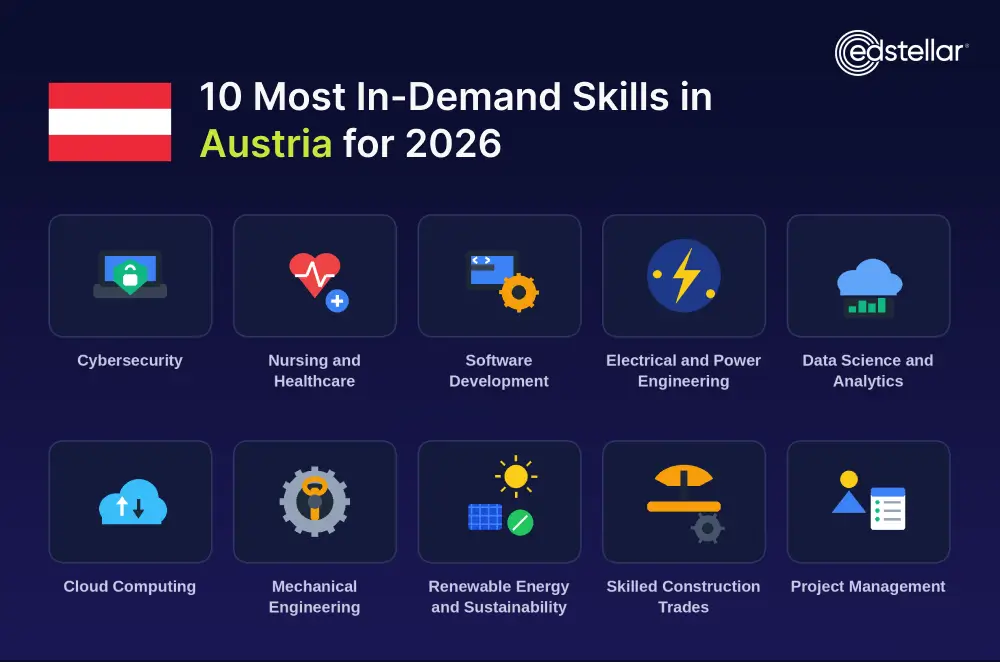
The most in-demand skills in Austria include Cybersecurity, Nursing and Healthcare, Software Development, Electrical and Power Engineering, Data Science and Analytics, Cloud Computing, Mechanical Engineering, Renewable Energy and Sustainability, Skilled Construction Trades, and Project Management. These span technology, healthcare, engineering, and services, reflecting Austria's diversified industrial economy and its ambitious energy transition targets.
Is it easy to get a job in Austria?
Austria's job market is favourable for skilled professionals, with 272,000 unfilled positions and 87% of companies reporting labour shortages. However, most roles require German language proficiency at B1 level or higher. Professionals with qualifications in shortage occupations listed on the Fachkraefteverordnung can apply for a Red-White-Red Card, which fast-tracks work permits. Competition for entry-level roles in non-shortage fields remains strong, particularly in Vienna.
What jobs are in demand in Austria?
Austria publishes an annual Fachkraefteverordnung that lists shortage occupations eligible for fast-track work permits. For 2026, the list includes 64 nationwide and 66 regional shortage occupations. Top shortage roles include graduate nurses, power engineering technicians, software developers, electrical installers, mechanical engineering technicians, roofers, pipe installers, and data-processing engineers. The full list is available on the Work in Austria website.
Which language is spoken in Austria?
German is the official language of Austria and is required for most jobs, typically at B1 to C1 level depending on the role. Austrian German has distinct vocabulary and pronunciation compared to standard High German. For international companies, research institutions, and tech startups in Vienna, Graz, or Linz, English may be the working language, but German proficiency significantly improves employment prospects and is weighted in the Red-White-Red Card points system.
Is Austria an English-speaking country?
No, Austria is a German-speaking country. However, English is widely spoken in business, tourism, and academia, especially in Vienna, Graz, and Salzburg. Many international companies and tech firms operate in English. For the Red-White-Red Card, applicants earn points for both German and English language skills, though German is weighted more heavily for most occupations. Learning German before or shortly after arrival is strongly recommended.
What are the best IT recruitment agencies in Austria?
Leading IT recruitment agencies in Austria include Hays Austria, Michael Page Austria, Randstad Austria, Robert Half, and epunkt (a specialist Austrian IT recruiter based in Linz). The Austrian Public Employment Service (AMS) also lists tech vacancies. For international candidates, Work in Austria (ABA) provides guidance on the Red-White-Red Card process and connects applicants with employers in shortage occupations.
"Cybersecurity, the Internet of Things, networking and artificial intelligence are increasingly entering our working life. According to a recent survey, 93 percent of decision-makers in Europe and North America report an IT talent gap, which is why building digital skills in Austria is so critical."

Conclusion: Positioning for Austria's Skills Future
Austria's skills landscape in 2026 is defined by a fundamental imbalance between demand and supply. With 272,000 unfilled positions, 78% of companies affected by labour shortages, 64 nationwide shortage occupations on the Fachkraefteverordnung, and a working-age population set to decline by over a quarter million people by 2040, the case for proactive skills development has never been more compelling.
The ten skills in demand in Austria covered in this guide represent the intersection of current shortage and future growth. From cybersecurity and cloud computing at the technology frontier, through nursing and electrical engineering in essential services, to renewable energy and project management powering Austria's energy transition and infrastructure pipeline, each skill area offers clear returns on training investment.
For corporate training leaders and HR professionals, the path forward is straightforward: audit your current capabilities, identify the gaps that map to these high-demand areas, and invest in structured, expert-led development. Austria's government is backing this with billions in digital and green skills funding. The organizations that close their skills gaps fastest will be the ones that attract talent, win contracts, and lead their industries through the decade ahead.
Identifying training needs is only the first step in closing Austria’s skills gaps. The next step is choosing the right implementation partner. Our analysis of the best corporate training companies in Austria compares providers across catalog depth, trainer quality, delivery flexibility, and local expertise.
Ready to Upskill Your Austria Team?
Join 500+ organizations that trust Edstellar for corporate training. Get matched with expert trainers in 48 hours.
Schedule a Free Training Consultation →